Engineering is the practice of systematically applying natural science and mathematics to design and improve systems, devices, or processes that solve problems under constraints. It is typically motivated by satisfying human needs, resulting in creations such as bridges, engines, smartphones, pacemakers, the internet, spacecraft, and washing machines. Engineering involves balancing competing demands such as safety, performance, aesthetics, cost, laws and regulations, and time, while operating within fundamental limits such as the laws of physics.
As a human endeavor, engineering has existed since ancient times, starting with the six classic simple machines. Examples of large-scale engineering projects from antiquity include impressive structures like the pyramids, elegant temples such as the Parthenon, and water conveyances like hulled watercraft, canals, and the Roman aqueduct. Early machines were powered by humans and animals, then later by wind. Machines of war were invented for siegecraft. In Europe, the scientific and industrial revolutions advanced engineering into a scientific profession and resulted in continuing technological improvements. The steam engine provided much greater power than animals, leading to mechanical propulsion for ships and railways. Further scientific advances resulted in the application of engineering to electrical, chemical, and aerospace requirements, plus the use of new materials for greater efficiencies.
The word engineering is derived from the Latiningenium. Engineers typically follow a code of ethics that favors honesty and integrity, while being dedicated to public safety and welfare. Engineering tasks involve finding optimal solutions to constrained problems, with testing and simulations being used prior to production. When a deployed product fails, forensic engineering is used to determine what went wrong in order to find a fix. Much of this product lifecycle management is now assisted with computer software, from design to testing and manufacturing. At larger scales, this process is normally funded by a company, multiple investors, or the government, so a knowledge of economics and business practices is needed. (Full article...)
An engineer is a practitioner of engineering. The word engineer (Latiningeniator, Ir is the term and or title of an engineer in countries like Belgium, The Netherlands, and Indonesia) is derived from the Latin words ingeniare ("to contrive, devise") and ingenium ("cleverness"). The foundational qualifications of a licensed professional engineer typically include a four-year bachelor's degree in an engineering discipline, or in some jurisdictions, a master's degree in an engineering discipline plus four to six years of peer-reviewed professional practice (culminating in a project report or thesis) and passage of engineering board examinations. (Full article...)
Featured articles are displayed here, which represent some of the best content on English Wikipedia.
The CFM International CFM56 (U.S. military designation F108) series is a family of high-bypassturbofanaircraft engines made by CFM International (CFMI), with a thrust range of 18,500 to 34,000 pounds-force (82 to 150 kilonewtons). CFMI is a 50–50 joint-owned company of Safran Aircraft Engines (formerly known as SNECMA), France and GE Aviation (GE), United States. Both companies are responsible for producing components and each has its own final assembly line. GE produces the high-pressure compressor, combustor, and high-pressure turbine, and SNECMA manufactures the fan, gearbox, exhaust and the low-pressure turbine, and some components are made by Avio of Italy. The engines are assembled by GE in Evendale, Ohio, and by SNECMA in Villaroche in France. The completed engines are marketed by CFMI. Despite initial export restrictions, it is one of the most common turbofanaircraft engines in the world, in four major variants. (Fullarticle...)
A valve is a device that regulates, directs or controls the flow of a fluid (gases, liquids, fluidized solids, or slurries) by opening, closing, or partially obstructing various passageways. Valves are technically fittings, but are usually discussed as a separate category. In an open valve, fluid flows in a direction from higher pressure to lower pressure. The word is derived from the Latin valva, the moving part of a door, in turn from volvere, to turn, roll.
These are Good articles, which meet a core set of high editorial standards.
Image 1
The Sinclair C5 is a small battery electric one-person recumbent tricycle, technically an "electrically assisted pedal cycle". It was the culmination of the English entrepreneur Clive Sinclair's long-running interest in electric vehicles. Although widely described as an "electric car", Sinclair characterised it as a "vehicle, not a car".
Sinclair had become one of the UK's best-known millionaires, and earned a knighthood, for his successful Sinclair Research range of home computers in the early 1980s. He hoped to repeat his success in the electric vehicle market, which he thought had potential for a new approach. The C5 emerged from an earlier project to produce a small electric car called the C1. After a change in the law, prompted by lobbying from bicycle manufacturers, Sinclair developed the C5 as an electrically powered tricycle with a polypropylene body and a chassis designed by Lotus Cars. It was intended to be the first in a series of increasingly ambitious electric vehicles, but the development of the follow-up C10 and C15 models never progressed, mostly due to the poor public response to the C5. (Full article...)
Image 2
Fizeau–Foucault apparatus may refer to either of two nineteenth-century experiments to measure the speed of light:
Baron Paul Schilling (16April [O.S. 5April] 1786 – 6August [O.S. 25July] 1837), also known as Pavel Lvovitch Schilling, was a Russian inventor, military officer and diplomat of Baltic German origin. The majority of his career was spent working for the imperial Russian Ministry of Foreign Affairs as a language officer at the Russian embassy in Munich. As a military officer, he took part in the War of the Sixth Coalition against Napoleon. In his later career, he was transferred to the Asian department of the ministry and undertook a tour of Mongolia to collect ancient manuscripts.
The tubes were constructed using the shield method and are each 6,550 feet (2,000m) long and 15.5 feet (4.7m) wide. The interiors are lined with cast-iron "rings" formed with concrete. The tubes descend 91 to 95 feet (28 to 29m) below the mean high water level of the East River, with a maximum gradient of 3.1 percent. During the tunnel's construction, a house at 58 Joralemon Street in Brooklyn was converted into a ventilation building and emergency exit. (Full article...)
Image 5
The radius of maximum wind of a tropical cyclone lies just within the eyewall of an intense tropical cyclone, such as Hurricane Isabel from 2003 The radius of maximum wind (RMW) is the distance between the center of a cyclone and its band of strongest winds. It is a parameter in atmospheric dynamics and tropical cyclone forecasting. The highest rainfall rates occur near the RMW of tropical cyclones. The extent of a cyclone's storm surge and its maximum potential intensity can be determined using the RMW. As maximum sustained winds increase, the RMW decreases. Recently, RMW has been used in descriptions of tornadoes. When designing buildings to prevent against failure from atmospheric pressure change, RMW can be used in the calculations. (Full article...)
Image 6
Raymix during a 2024 concert
Edmundo Gómez Moreno (born 17February 1991), known professionally as Raymix, is a Mexican musician and aerospace engineer. Nicknamed El Rey de la Electrocumbia ("The King of Electrocumbia"), he started his music career in the early 2010s as part of the trance project Light & Wave, alongside two other Mexican musicians. Their song "Feeling the City" was featured on A State of Trance, a radio show Armin van Buuren hosts. In 2013, Raymix participated in an educational internship at NASA, where he contributed to the development of a satellite.
A chicken gun or flight impact simulator is a large-diameter, compressed-air gun used to fire bird carcasses at aircraft components in order to simulate high-speed bird strikes during the aircraft's flight. Jet engines and aircraft windshields are particularly vulnerable to damage from such strikes, and are the most common target in such tests. Although various species of bird are used in aircraft testing and certification, the device acquired the common name of "chicken gun" as chickens are the most commonly used ammunition owing to their ready availability. (Full article...)
Image 8
A voltage doubler is an electronic circuit that charges capacitors from the input voltage and switches these charges in such a way that, in the ideal case, exactly twice the voltage is produced at the output as at its input.
The simplest of these circuits is a form of rectifier which takes an AC voltage as input and outputs a doubled DC voltage. The switching elements are simple diodes, driven to switch state merely by the alternating voltage of the input. DC-to-DC voltage doublers cannot switch in this way and require a driving circuit to control the switching. They frequently also require a switching element that can be controlled directly, such as a transistor, rather than relying on the voltage across the switch as in the simple AC-to-DC case. (Full article...)
Project Alberta was formed in March 1945, and consisted of 51 United States Army, Navy, and civilian personnel, including one British scientist. Its mission was three-fold. It first had to design a bomb shape for delivery by air, then procure and assemble it. It supported the ballistic testing work at Wendover Army Air Field, Utah, conducted by the 216th Army Air Forces Base Unit (Project W-47), and the modification of B-29s to carry the bombs (Project Silverplate). After completion of its development and training missions, Project Alberta was attached to the 509th Composite Group at North Field, Tinian, where it prepared facilities, assembled and loaded the weapons, and participated in their use. (Full article...)
Image 10
1869 Birdsill Holly fire-hydrant Birdsill Holly Jr. (November 8, 1820 – April 27, 1894) was an American mechanical engineer and inventor of water hydraulics devices. He is known for inventing mechanical devices that improved city water systems and patented an improved fire hydrant that is similar to those used currently for firefighting. Holly was a co-inventor of the Silsby steam fire engine. He founded the Holly Manufacturing Company that developed into the larger Holly Steam Combination Company that distributed heat from a central station and developed commercial district heating for cities in the United States and Canada. (Full article...)
Image 11
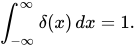
Schematic representation of the Dirac delta function by a line surmounted by an arrow. The height of the arrow is usually meant to specify the value of any multiplicative constant, which will give the area under the function. The other convention is to write the area next to the arrowhead. In mathematical analysis, the Dirac delta function (or distribution), also known as the unit impulse, is a generalized function on the real numbers, whose value is zero everywhere except at zero, where it is infinite, and whose integral over the entire real line is equal to one. Thus it can be represented heuristically assuch that
Since no function has this property, modelling the delta "function" rigorously involves the use of limits or, as is common in mathematics, measure theory and the theory of distributions. (Full article...)
The Wignacourt Aqueduct (Maltese: L-Akwedott ta' Wignacourt) is a 17th-century aqueduct in Malta, which was built by the Order of Saint John to carry water from springs in Dingli and Rabat to the newly built capital city Valletta. The aqueduct carried water through underground pipes and over arched viaducts across depressions in the ground.
The first attempts to build the aqueduct were made by Grand Master Martin Garzez in 1596, but construction was suspended before being continued in 1610. The watercourse was inaugurated five years later on 21 April 1615. Several engineers took part in the project, including Bontadino de Bontadini, Giovanni Attard and Natale Tomasucci. The aqueduct was named after Grand Master Alof de Wignacourt, who partially financed its construction. (Full article...)
Image 13
ODB++ is a proprietary CAD-to-CAM data exchange format used in the design and manufacture of electronic devices. Its purpose is to exchange printed circuit board design information between design and manufacturing and between design tools from different EDA/ECAD vendors. It was originally developed by Valor Computerized Systems, Ltd. (acquired in 2010 by Mentor Graphics which was later acquired by Siemens in 2016) as the job description format for their CAM system.
ODB stands for open database, but its openness is disputed, as discussed below. The '++' suffix, evocative of C++, was added in 1997 with the addition of component descriptions. There are two versions of ODB++: the original (now controlled by Mentor) and an XML version called ODB++(X) that Valor developed and donated to the IPC organization in an attempt to merge GenCAM (IPC-2511) and ODB++ into Offspring (IPC-2581). (Full article...)
Bell was an energetic and skilful entrepreneur as well as an innovative metallurgist. He was involved in multiple partnerships with his brothers to make iron and alkali chemicals, and with other pioneers including Robert Stirling Newall to make steel cables. He pioneered the large-scale manufacture of aluminium at his Washington works, conducting experiments in its production, and in the production of other chemicals such as the newly discovered element thallium. He was a director of major companies including the North Eastern Railway and the Forth Bridge company, then the largest bridge project in the world. (Full article...)
William Barton Rogers founded MIT to accelerate American industrialization through scientific knowledge. Initially funded by a federal land grant, the institute adopted a German polytechnic model emphasizing laboratory instruction in applied science and engineering, and moved from Boston's Back Bay to its current campus in Cambridge in 1916. Early growth came through research contracts with private industry, though the institute remained financially constrained and focused primarily on practical engineering education into the 1930s. (Full article...)
Image 4Archimedes is regarded as one of the leading scientists in classical antiquity whose ideas have underpinned much of the practice of engineering. (from Engineer)
Image 5A water-powered mine hoist used for raising ore, Germany, c.1556 (from Engineering)
Image 8The application of the steam engine allowed coke to be substituted for charcoal in iron making, lowering the cost of iron, which provided engineers with a new material for building bridges. This bridge was made of cast iron, which was soon displaced by less brittle wrought iron as a structural material. (from Engineering)
Image 10Hoover Dam is regarded as a major accomplishment in civil engineering (from Engineering)
Image 11Engineers conferring on prototype design, 1954 (from Engineer)
Image 12A drawing for a steam locomotive. Engineering is applied to design, with emphasis on function and the utilization of mathematics and science. (from Engineering)
Image 16Design of a turbine requires collaboration of engineers from many fields, as the system involves mechanical, electro-magnetic and chemical processes. The blades, rotor and stator as well as the steam cycle all need to be carefully designed and optimized. (from Engineering)
This list was generated from these rules. Questions and feedback are always welcome! The search is being run daily with the most recent ~14 days of results. Note: Some articles may not be relevant to this project.


 Featured articles are displayed here, which represent some of the best content on English Wikipedia.


.jpg)




.jpg)


.jpg)


 Commons
 Wikibooks
 Wikidata
 Wikiquote
 Wikisource
 Wikiversity
 Wiktionary


