


// Workers AI · dad joke modeWhat did the hermitian wavelet say? "I'm self-adjoint to meeting you
 | This article has multiple issues. Please help improve it or discuss these issues on the talk page. (Learn how and when to remove these messages)
|


Hermitian wavelets are a family of discrete and continuous wavelets used in the constant and discrete Hermite wavelet transforms. The Hermitian wavelet is defined as the normalized derivative of a Gaussian distribution for each positive :[1]where denotes the probabilist's Hermite polynomial. Each normalization coefficient is given by The function is said to be an admissible Hermite wavelet if it satisfies the admissibility condition:[2]







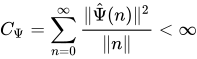
where are the terms of the Hermite transform of .


In computer vision and image processing, Gaussian derivative operators of different orders are frequently used as a basis for expressing various types of visual operations; see scale space and N-jet.[3]
Examples
[edit]The first three derivatives of the Gaussian function with :are:and their norms .
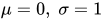

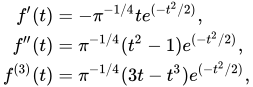


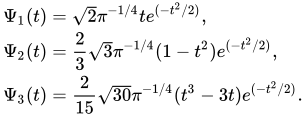
Normalizing the derivatives yields three Hermitian wavelets:
See also
[edit]- Wavelet
- The Ricker wavelet is the Hermitian wavelet

References
[edit]- ↑ Brackx, F.; De Schepper, H.; De Schepper, N.; Sommen, F. (2008-02-01). "Hermitian Clifford-Hermite wavelets: an alternative approach". Bulletin of the Belgian Mathematical Society, Simon Stevin. 15 (1). doi:10.36045/bbms/1203692449. ISSN 1370-1444.
- ↑ "Continuous and Discrete Wavelet Transforms Associated with Hermite Transform". International Journal of Analysis and Applications. 2020. doi:10.28924/2291-8639-18-2020-531.
- ↑ Wah, Benjamin W., ed. (2007-03-15). Wiley Encyclopedia of Computer Science and Engineering (1 ed.). Wiley. doi:10.1002/9780470050118.ecse609. ISBN 978-0-471-38393-2.