


Ricker wavelet

In mathematics and numerical analysis, the Ricker wavelet,[1] Mexican hat wavelet, or Marr wavelet (for David Marr) [2][3]
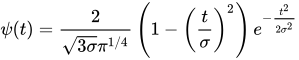
is the negative normalized second derivative of a Gaussian function, i.e., up to scale and normalization, the second Hermite function. It is a special case of the family of continuous wavelets (wavelets used in a continuous wavelet transform) known as Hermitian wavelets. The Ricker wavelet is frequently employed to model seismic data and as a broad-spectrum source term in computational electrodynamics.

The Ricker wavelet has two vanishing moments,

and is therefore insensitive to any linear trends in the analyzed signal.[4]

The 2-dimensional generalization


of this wavelet is called the Laplacian of Gaussian function. In practice, this wavelet is sometimes approximated by the difference of Gaussians (DoG) function, because the DoG is separable.[5] It can therefore save considerable computation time in two or more dimensions.[citation needed][dubious – discuss] The scale-normalized Laplacian (in -norm) is frequently used as a blob detector and for automatic scale selection in computer vision applications; see Laplacian of Gaussian and scale space. The relation between this Laplacian of the Gaussian operator and the difference-of-Gaussians operator is explained in appendix A in Lindeberg (2015).[6] Derivatives of cardinal B-splines can also approximate the Mexican hat wavelet.[7]

Frequency domain
[edit]

Since Ricker wavelet is, up to a scaling factor, the second derivative of a Gaussian function, according to the properties of the Fourier transform, its spectrum is equal to the spectrum of a Gaussian function multiplied by the square of the frequency. The spectrum of a Gaussian function with a given parameter σ is a Gaussian function with parameter . Thus, the wavelet spectrum has the shape [8]


The term is responsible for suppressing low frequencies, while the Gaussian term is responsible for suppressing high frequencies. Thus, the Ricker wavelet acts as a band-pass filter with a peak transmission frequency . The frequency band for half amplitude transmission level is , , its width .


See also
[edit]References
[edit]- ↑ "Ricker, Ormsby, Klauder, Butterworth - A Choice of Wavelets" (PDF). Archived from the original (PDF) on 2014-12-27. Retrieved 2014-12-27.
- ↑ "Basics of Wavelets" (PDF). Archived (PDF) from the original on 2005-03-12. Retrieved 2014-12-27.
- ↑ "13. Wavdetect Theory".
- ↑ Antoine, Jean-Pierre; Murenzi, Romain; Vandergheynst, Pierre; Ali, Syed Twareque (2004). Two-Dimensional Wavelets and Their Relatives. Cambridge University Press. pp. 8–10. ISBN 9780521624060.
- ↑ Fisher, Perkins, Walker and Wolfart. "Spatial Filters - Gaussian Smoothing". Retrieved 23 February 2014.
{{cite web}}: CS1 maint: multiple names: authors list (link) - ↑ Lindeberg, Tony (2015). "Image Matching Using Generalized Scale-Space Interest Points". Journal of Mathematical Imaging and Vision. 52: 3–36. doi:10.1007/s10851-014-0541-0. S2CID 254657377.
- ↑ Brinks R: On the convergence of derivatives of B-splines to derivatives of the Gaussian function, Comp. Appl. Math., 27, 1, 2008
- ↑ Wang, Yanghua (2015). "The Ricker wavelet and the Lambert W function". Geophysical Journal International. 200 (1): 111–115. doi:10.1093/gji/ggu384.