


Talk:Hermitian wavelet
Add topic | This article is rated Start-class on Wikipedia's content assessment scale. It is of interest to the following WikiProjects: | ||||||||||
| |||||||||||

Untitled
[edit]You have to describe which kind of normalization you use for these wavelets. Is it the normalization, i.e. or the normalization, i.e. ?

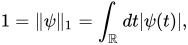

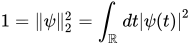
Is the "probabilists' Hermite polynomials" or the "physicists' Hermite polynomials" used? 155.245.44.87 (talk) 09:03, 16 October 2008 (UTC)
- Which one is used is only defined by the starting point chosen, both are valid, but not interchangeable within a proof. WroscMPhys (talk) 22:35, 29 March 2024 (UTC)
I cannot seem to find any sort of mathematical object called a "perfector" anywhere on the internet. anyone else know about it? WroscMPhys (talk) comment added 21:31, 29 March 2024 (UTC)
(Addition to above) I have since found a reference that contains related derivations of both continuous and discrete wavelet transforms and added in the admissibility condition which i believe is what could be meant by perfector? The page needs some work sorting out Discrete proof from continuous proof at the mo.--WroscMPhys (talk) 22:36, 29 March 2024 (UTC)