


Hermite transform
In mathematics, the Hermite transform is an integral transform named after the mathematician Charles Hermite that uses Hermite polynomials as kernels of the transform.

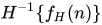
The Hermite transform of a function is


The inverse Hermite transform is given by

Computational complexity
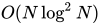
[edit]Direct evaluation of a discrete Hermite transform with coefficients and sample points requires arithmetic operations. Leibon, Rockmore, Park, Taintor, and Chirikjian developed fast algorithms for the forward and inverse transforms requiring operations, exploiting the three-term recurrence satisfied by the Hermite polynomials.[1]


Jain, Iyer, Somma, Bao, and Jordan developed a quantum algorithm that implements an approximate discrete Hermite transform using a number of quantum gates polynomial in and , where is the number of Hermite modes and is the approximation error. The algorithm uses fast-forwarding of the quantum harmonic oscillator. It transforms information encoded in the amplitudes of a quantum state, rather than producing an explicit classical list of transform coefficients; the gate bound does not include preparing an arbitrary input state from classical data.[2]


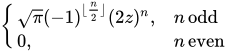
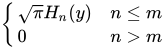
Some Hermite transform pairs
[edit]| [3] | |
| [4] | |
| [5] | |
| [6] | |
| [7][8] | |


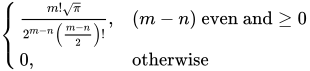


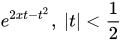


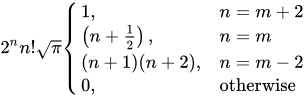




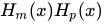






![{\displaystyle e^{x^{2}}{\frac {d}{dx}}\left[e^{-x^{2}}{\frac {d}{dx}}F(x)\right]\,}](https://wikimedia.org/api/rest_v1/media/math/render/svg/b2c7d97bfe8587a9904ba8332c64f693b13eba3c)


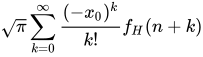

![{\displaystyle {\sqrt {\pi }}(-1)^{n}\left[2^{2n+1}\Gamma \left(n+{\frac {3}{2}}\right)\right]^{-1}f_{H}(n)g_{H}(n)\,}](https://wikimedia.org/api/rest_v1/media/math/render/svg/81c4c392666d42cce6c9dc6ea75b4c88215bfebc)
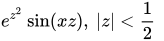
![{\displaystyle (1-z^{2})^{-1/2}\exp \left[{\frac {2xyz-(x^{2}+y^{2})z^{2}}{(1-z^{2})}}\right]\,}](https://wikimedia.org/api/rest_v1/media/math/render/svg/103e6fef22d2baa4b64de7f7956c46e8ff9ede7f)


References
[edit]- ↑ Leibon, Gregory; Rockmore, Daniel N.; Park, Wooram; Taintor, Robert; Chirikjian, Gregory S. (2008). "A fast Hermite transform". Theoretical Computer Science. 409 (2): 211–228. doi:10.1016/j.tcs.2008.09.010. PMC 2630232.
- ↑ Jain, Siddhartha; Iyer, Vishnu; Somma, Rolando D.; Bao, Ning; Jordan, Stephen P. (2026). "Efficient Quantum Hermite Transform". Proceedings of the 58th Annual ACM Symposium on Theory of Computing. Association for Computing Machinery. pp. 541–552. arXiv:2510.04929. doi:10.1145/3798129.3800772.
- ↑ McCully, Joseph Courtney; Churchill, Ruel Vance (1953), Hermite and Laguerre integral transforms : preliminary report
- ↑ Feldheim, Ervin (1938). "Quelques nouvelles relations pour les polynomes d'Hermite". Journal of the London Mathematical Society (in French). s1-13: 22–29. doi:10.1112/jlms/s1-13.1.22.
- ↑ Bailey, W. N. (1939). "On Hermite polynomials and associated Legendre functions". Journal of the London Mathematical Society. s1-14 (4): 281–286. doi:10.1112/jlms/s1-14.4.281.
- ↑ Glaeske, Hans-Jürgen (1983). "On a convolution structure of a generalized Hermite transformation" (PDF). Serdica Bulgariacae Mathematicae Publicationes. 9 (2): 223–229.
- ↑ Erdélyi et al. 1955, p. 194, 10.13 (22).
- ↑ Mehler, F. G. (1866), "Ueber die Entwicklung einer Function von beliebig vielen Variabeln nach Laplaceschen Functionen höherer Ordnung" [On the development of a function of arbitrarily many variables according to higher-order Laplace functions], Journal für die Reine und Angewandte Mathematik (in German) (66): 161–176, ISSN 0075-4102, ERAM 066.1720cj. See p. 174, eq. (18) and p. 173, eq. (13).
Sources
[edit]- Erdélyi, Arthur; Magnus, Wilhelm; Oberhettinger, Fritz [in German]; Tricomi, Francesco G. (1955), Higher transcendental functions (PDF), vol. II, McGraw-Hill, ISBN 978-0-07-019546-2, archived from the original (PDF) on 2011-07-14, retrieved 2023-11-09
{{citation}}: ISBN / Date incompatibility (help)