


Quasitriangular Hopf algebra
 | This article needs more citations. (December 2009) |
In mathematics, a quasitriangular Hopf algebra is a particular kind of Hopf algebra , equipped with a special element , called the R-matrix. The R-matrix naturally provides the structure of a braiding on the rigid category of representations of , which makes quasitriangular Hopf algebras useful in knot theory.


The most important examples of quasitriangular Hopf algebras are quantum groups.[1]
Definition
[edit]A Hopf algebra H is quasitriangular[2] if there exists an invertible element such that
- for all , where is the coproduct on H, and the linear map is given by ,





- ,

- ,

where , , and , where , , and , are algebra morphisms determined by
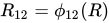
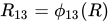
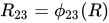






R is called the R-matrix.
Properties
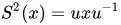
[edit]As a consequence of the properties of quasitriangularity, the R-matrix, R, is a solution of the Yang–Baxter equation (and so a module V of H can be used to determine quasi-invariants of braids, knots and links). Also as a consequence of the properties of quasitriangularity, ; moreover , , and . One may further show that the antipode S must be a linear isomorphism, and thus S2 is an automorphism. In fact, S2 is given by conjugating by an invertible element: where (cf. Ribbon Hopf algebras).





It is possible to construct a quasitriangular Hopf algebra from a Hopf algebra and its dual, using the Drinfeld quantum double construction.
If the Hopf algebra H is quasitriangular, then the category of modules over H is braided with braiding
- .

Twisting
[edit]The property of being a quasi-triangular Hopf algebra is preserved by twisting via an invertible element such that and satisfying the cocycle condition
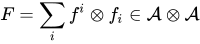


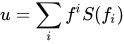
Furthermore, is invertible and the twisted antipode is given by , with the twisted comultiplication, R-matrix and co-unit change according to those defined for the quasi-triangular quasi-Hopf algebra. Such a twist is known as an admissible (or Drinfeld) twist.

See also
[edit]Notes
[edit]- ↑ Strictly speaking, the standard Drinfeld-Jimbo quantum group is not quasitriangular, because its R-matrix is given by a formal infinite series which is not an actual element of . However, in practice this does not cause any issues, and there are also many other kinds of quantum groups which do not suffer from this technicality.
- ↑ Montgomery & Schneider (2002), p. 72.


References
[edit]- Montgomery, Susan (1993). Hopf algebras and their actions on rings. Regional Conference Series in Mathematics. Vol. 82. Providence, RI: American Mathematical Society. ISBN 0-8218-0738-2. Zbl 0793.16029.
- Montgomery, Susan; Schneider, Hans-Jürgen (2002). New directions in Hopf algebras. Mathematical Sciences Research Institute Publications. Vol. 43. Cambridge University Press. ISBN 978-0-521-81512-3. Zbl 0990.00022.