


Prime constant
The prime constant is the real number whose th binary digit is 1 if is prime and 0 if is composite or 1.[1]


In other words, is the number whose binary expansion corresponds to the indicator function of the set of prime numbers. That is,
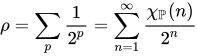
where indicates a prime and is the characteristic function of the set of prime numbers.


The beginning of the decimal expansion of ρ is: (sequence A051006 in the OEIS)[1]

The beginning of the binary expansion is: (sequence A010051 in the OEIS)

Irrationality
[edit]The number is irrational.[2]
Proof by contradiction
[edit]Suppose were rational.
Denote the th digit of the binary expansion of by . Then since is assumed rational, its binary expansion is eventually periodic, and so there exist positive integers and such that for all and all .


Since there are an infinite number of primes, we may choose a prime . By definition we see that . As noted, we have for all . Now consider the case . We have , since is composite because . Since we see that is irrational.





References
[edit]- 1 2 Weisstein, Eric W. "Prime Constant". mathworld.wolfram.com. Retrieved 2025-01-31.
- ↑ Hardy, G. H. (2008). An Introduction to the Theory of Numbers. E. M. Wright, D. R. Heath-Brown, Joseph H. Silverman (6th ed.). Oxford: Oxford University Press. ISBN 978-0-19-921985-8. OCLC 214305907.