


Omega constant
The omega constant is a mathematical constant defined as the unique real number that satisfies the equation

It is the value of W(1), where W is Lambert's W function. The name is derived from the alternate name for Lambert's W function, the omega function. The numerical value of Ω is given by
Properties
[edit]Fixed point representation
[edit]The defining identity can be expressed, for example, as

or

as well as

Computation
[edit]One can calculate Ω iteratively, by starting with an initial guess Ω0, and considering the sequence

This sequence will converge to Ω as n approaches infinity. This is because Ω is an attractive fixed point of the function e−x.
It is much more efficient to use the iteration
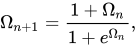
because the function
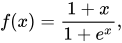
in addition to having the same fixed point, also has a derivative that vanishes there. This guarantees quadratic convergence; that is, the number of correct digits is roughly doubled with each iteration.
Using Halley's method, Ω can be approximated with cubic convergence (the number of correct digits is roughly tripled with each iteration): (see also Lambert W function § Numerical evaluation).

Integral representations
[edit]An identity due to Victor Adamchik[citation needed] is given by the relationship
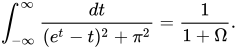
Other relations due to Mező[1][2] and Kalugin-Jeffrey-Corless[3] are:


The latter two identities can be extended to other values of the W function (see also Lambert W function § Representations).
Transcendence
[edit]The constant Ω is transcendental. This can be seen as a direct consequence of the Lindemann–Weierstrass theorem. For a contradiction, suppose that Ω is algebraic. By the theorem, e−Ω is transcendental, but Ω = e−Ω, which is a contradiction. Therefore, it must be transcendental.[4]
References
[edit]- ↑ Mező, István. "An integral representation for the principal branch of the Lambert W function". Retrieved 24 April 2022.
- ↑ Mező, István (2020). "An integral representation for the Lambert W function". arXiv:2012.02480 [math.CA]..
- ↑ Kalugin, German A.; Jeffrey, David J.; Corless, Robert M. (2011). "Stieltjes, Poisson and other integral representations for functions of Lambert W". arXiv:1103.5640 [math.CV]..
- ↑ Mező, István; Baricz, Árpád (November 2017). "On the Generalization of the Lambert W Function" (PDF). Transactions of the American Mathematical Society. 369 (11): 7928. doi:10.1090/tran/6911. Retrieved 28 April 2023.
External links
[edit]- Weisstein, Eric W. "Omega Constant". MathWorld.
- "Omega constant (1,000,000 digits)", Darkside communication group (in Japan), retrieved 2017-12-25