


Nilsemigroup
 | This article includes a list of general references but lacks sufficient corresponding inline citations. (April 2018) |
In mathematics, and more precisely in semigroup theory, a nilsemigroup or nilpotent semigroup is a semigroup whose every element is nilpotent.
Definitions
[edit]Formally, a semigroup S is a nilsemigroup if:
- S contains 0 and
- for each element a∈S, there exists a positive integer k such that ak=0.
Finite nilsemigroups
[edit]Equivalent definitions exists for finite semigroup. A finite semigroup S is nilpotent if, equivalently:
- for each , where is the cardinality of S.
- The zero is the only idempotent of S.



Examples
[edit]The trivial semigroup of a single element is trivially a nilsemigroup.
The set of strictly upper triangular matrix, with matrix multiplication is nilpotent.
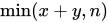
Let a bounded interval of positive real numbers. For x, y belonging to I, define as . We now show that is a nilsemigroup whose zero is n. For each natural number k, kx is equal to . For k at least equal to , kx equals n. This example generalize for any bounded interval of an Archimedean ordered semigroup.
![{\displaystyle I_{n}=[a,n]}](https://wikimedia.org/api/rest_v1/media/math/render/svg/422f57d99edf36def5981349afdbce061b4ec2ba)



Properties
[edit]A non-trivial nilsemigroup does not contain an identity element. It follows that the only nilpotent monoid is the trivial monoid.
The class of nilsemigroups is:
- closed under taking subsemigroups
- closed under taking quotients
- closed under finite products
- but is not closed under arbitrary direct product. Indeed, take the semigroup , where is defined as above. The semigroup S is a direct product of nilsemigroups, however its contains no nilpotent element.


It follows that the class of nilsemigroups is not a variety of universal algebra. However, the set of finite nilsemigroups is a variety of finite semigroups. The variety of finite nilsemigroups is defined by the profinite equalities .

References
[edit]- Pin, Jean-Éric (2018-06-15). Mathematical Foundations of Automata Theory (PDF). p. 198.
- Grillet, P A (1995). Semigroups. CRC Press. p. 110. ISBN 978-0-8247-9662-4.