


Free Republic of Wackerland
Free Republic of Wackerland Freie Republik Wackerland | |
|---|---|
| Micronation (unrecognized entity) | |
_-_1985-86.JPG) | |
| Location | 49°19′24″N 12°13′50″E / 49.32333°N 12.23056°E |
| Area claimed | Camp in WAA-Wackersdorf, West Germany |
| Type | Protest camp |
| Dates claimed | 21 December 1985–7 January 1986 |
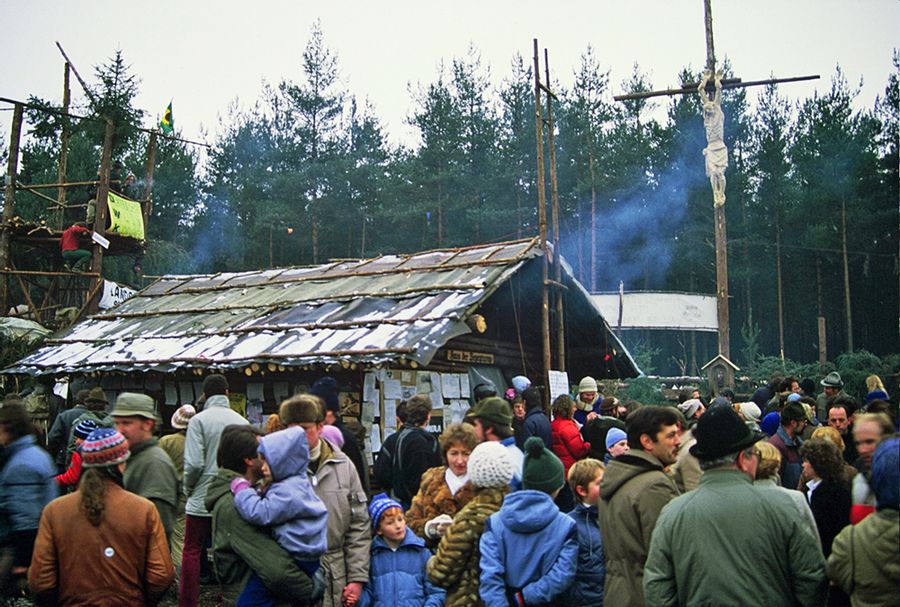
The Free Republic of Wackerland (German: Freie Republik Wackerland) was a hut village on the construction site of the Wackersdorf reprocessing plant (WAA) in Bavaria (Germany). The builders intended to obstruct the construction of the nuclear facility and the clearing of the surrounding forest by occupying the site. The protest village in the Taxölden Forest (Bodenwöhr) existed for 18 days, from December 21, 1985, to January 7, 1986, and was cleared by a large contingent of police and Federal Border Guards.
Background
[edit]On February 4, 1985, the German Society for the Reprocessing of Nuclear Fuels (Deutsche Gesellschaft für Wiederaufarbeitung von Kernbrennstoffen) selected Wackersdorf as the site for the WAA (nuclear reprocessing plant). However, Hans Schuierer, the district administrator of Schwandorf, refused to grant the necessary water and building permits, whereupon the Bavarian State Parliament passed the "Lex Schuierer" on July 23, 1985. The Bavarian Ministry of the Environment then issued the first partial construction permit on September 27, 1985. On November 11, 1985, the Upper Palatinate government, exercising its new right of self-administration, was also able to issue the required permits in place of the Schwandorf district office. On December 10, 1985, the Bavarian Administrative Court approved the clearing of the Taxöldern Forest, and on December 11, 1985, DWK immediately began the clearing work.[1] As early as August 1985, demonstrators attempted an initial occupation of the construction site, but it was cleared by the police within a few hours.[2] The construction of a "friendship house" was intended to be a test before the start of the clearing.[3]
Free Republic of Wackerland
[edit]On December 21, 1985 (four days before Christmas), the clearing work was halted and a "Christmas truce" was declared.[4][5] As soon as the police withdrew, approximately 400 WAA opponents reoccupied the construction site and began building huts in freezing temperatures. Thus, the "Free Republic of Wackerland" (named after the Free Republic of Wendland, which existed in 1980)[6] was established, featuring numerous huts,[7] tents, tree houses, log cabins, observation towers, and more.[8] Building materials were scattered throughout the cleared forest, and thousands of locals supported the hut dwellers with building materials, tools, food, water, and all necessities, offering showers and washing facilities or even helping with hut construction themselves. Gradually, over 150 huts and tents were built during the 18 days, and the village's infrastructure was continuously expanded.[9][10]
Huts and facilities
[edit]Over the course of 18 days, more than 150 huts and tents were gradually built, and the village's infrastructure was continuously expanded.
 Village center
 Treehouse
![Günter Sare [de] house](https://upload.wikimedia.org/wikipedia/commons/thumb/0/02/Gemeinschaftshaus_-_%27G%C3%BCnter_Sare_Haus%27_-_in_der_%27Freien_Republik_Wackerland%27_gegen_die_Wiederaufarbeitungsanlage_Wackersdorf_%28WAA%29_-_1985-1986.JPG/250px-Gemeinschaftshaus_-_%27G%C3%BCnter_Sare_Haus%27_-_in_der_%27Freien_Republik_Wackerland%27_gegen_die_Wiederaufarbeitungsanlage_Wackersdorf_%28WAA%29_-_1985-1986.JPG?utm_source=en.wikipedia.org&utm_campaign=parser&utm_content=thumbnail) Günter Sare house
Günter Sare house Meinhof hut
 Supply hut
_-_(1985-1986).JPG)
_-_1985-86.JPG)
![Günter Sare [de] house](/restyle/wiki/File:Gemeinschaftshaus_-_'G%C3%BCnter_Sare_Haus'_-_in_der_'Freien_Republik_Wackerland'_gegen_die_Wiederaufarbeitungsanlage_Wackersdorf_(WAA)_-_1985-1986.JPG)
_-_1985-86.JPG)
_---_1985-86.JPG)
Village cross
[edit]From December 26 to 29, 1985, the Burglengenfeld wood sculptor Stefan Preisl carved a 1.60 m tall figure of Christ from a spruce trunk in freezing temperatures.[11] The figure was attached to a ten-meter-high spruce cross and erected in the Wackerland hut village.[12] The crucifix, consecrated by the catholic priest Andreas Schlagenhaufer, stood for a week.[13] During the clearing of the shantytown on January 7, 1986, it was sawn off by the police and carried away. A police chaplain had previously desecrated the cross and overseen its dignified transport.[14] The Christ figure, returned shortly afterward, was taken by demonstrators to the Franziskus-Marterl and erected there. On the night of February 20, 1986, the Christ figure disappeared. Only the broken hands remained.[15][16] Shortly after the theft, Stefan Preisl carved the Cross of Wackersdorf.
_-_1985.JPG)
_1985_(Herbert_Grabe).jpg)
_-_1986.JPG)
_-_gestohlen_am_20-02-1986.JPG)
_-_1986.JPG)
_im_Haus_der_Bayerischen_Geschichte_-_(2025).JPG)
Nativity Scene
[edit]At Christmas 1985, approximately 1,500 citizens from near and far arrived to celebrate Christmas Eve in the tent village.[20] The official Christmas service was conducted by two Catholic and three Protestant clergy members outside the tent village at the Red Cross site, without the knowledge of their church leadership.[21] Riot police officers celebrated in their quarters on the outskirts of Wackersdorf.[22] Christmas trees were decorated, and a nativity scene made of clay figures was set up beneath the "Keffiyeh Cross".[23] The original nativity figures - Mary with the infant Jesus and Joseph (without a hat) - are on display at the House of Bavarian History in Regensburg.
 Mary - Jesus - Joseph
 Nativity Scene
 Kufiya-Cross / Nativity Scene
_-_Haus_der_Bayerischen_Geschichte_2025.JPG)
_-_(1985-86).JPG)
_---_(1985-86).JPG)
_-_Haus_der_Bayerischen_Geschichte_--_2025.jpg)
Police Eviction
[edit]Following the Christmas truce, 2,000 police officers began clearing the shantytown early in the morning of January 7, 1986.[25][26] During the eviction, which lasted into the night, over 1,000 people (mostly from out of town) were detained for identification purposes.[27] Some treehouses were taken over from a helicopter, and special forces officers rappelled from the police helicopter onto the high treehouses. Batons and police dogs were used. Several WAA opponents were injured, some seriously, by the dogs.[28] District Administrator Hans Schuierer, who was also nearly bitten by a dog, described the police action as "terror in its purest form" and faced disciplinary proceedings for it, among other things.[29][30] On the day of the eviction, SPD state parliament member Christa Meier (MdL) drove to the hut village in the Taxölden Forest at 5:30 a.m. together with Otto Benner (MdL), Wolfgang Sieler (MdB), District Administrator Hans Schuierer and other residents of Schwandorf and described in the Bavarian State Parliament (Landtag of Bavaria) on February 20 how dramatically she had experienced the eviction of the hut village.[31]
Film and audio documents
[edit]- 1986: Wackersdorf – The Hut Village / Scenes from "The Police Go to Wackersdorf". Events from the start of the clearing to the clearing of the second hut village. Film by Victor Halb, 18 min[32]
- 1986: 18 Days of Free Wackersdorf. Media Workshop Franconia, Library of Resistance Volume 19, 4 min[33][34]
- 1986: 18 Days of Free Wackersdorf. Media Workshop Franconia, 13 min[35]
- 1986: 18 Days of Free Wackersdorf. Media Workshop Franconia, 11 min[36]
- 1986: Spaltprozesse (Division Processes) Documentary film 1986, Hut Village Construction, Hut Village Clearance, etc., 96 min[37]
- 1986: WAA Wackersdorf: A Bright Future for the Upper Palatinate. Monitor report, 15 min[38]
- 1986: Wackersdorf – A Myth. Medienwerkstatt Franken, 24 min[39]
- 1986: Konstantin Wecker: The Tree (WAA protest song about forest clearing, eviction of the shantytown, ...), 5 min[40]
- 1986: Biermösl Blosn: It Must Have Been a Sunday (WAA protest song), from min 2[41]
- 2006: The WAA Specter – Resistance in Wackersdorf. Medienwerkstatt Franken, Library of Resistance Volume 19, 25 min[42]
- 2012: Better Active Today Than Radioactive Tomorrow / The Nuclear Power Plant Protest Movement: From Wyhl to Wackersdorf, ttt, 6 min[43]
- 2017: Nuclear Dispute in Wackersdorf – The Story of an Escalation. ARD/BR, Documentary, 44 min[44]
- 2018: Uprising in Wackerland: Radio Story on Radio Z, 36 min[45]
References
[edit]- ↑ Oskar Duschinger, Bernhard von Zech-Kleber: Wiederaufbereitungsanlage Wackersdorf, in: Historisches Lexikon Bayerns, 7 December 2021
- ↑ Janine Gaumer: Vom Hüttendorf zur Eskalation. Protestdynamik am Bauzaun. in: Janine Gaumer: Wackersdorf. Atomkraft und Demokratie in der Bundesrepublik 1980–1989. p. 155
- ↑ Erna Wellnhofer: Das "Freundschaftshaus" wird geräumt. in: Werner Grassl, Klaus Kaschel: Kein Friede den Hütten... Die Tage der freien Republik Wackerland. Burglengenfeld 1986, p. 11
- ↑ Jakob Felsberger: Die Wiederaufarbeitungsanlage in Wackersdorf in: Tschernobyl in Erlangen - Reaktionen und Dynamiken im lokalen Umfeld 1986–1989. Hrsg. Friedrich-Alexander-Universität Erlangen-Nürnberg 2020, p. 57 f.
- ↑ Der andere Weg nach Bethlehem – Weihnachten vor 20 Jahren auf dem WAA-Gelände – Der Christbaum im Hüttendorf in: Der neue Tag (Weiden in der Oberpfalz), 30 December 2005.
- ↑ Werner Grassl, Klaus Kaschel: Kein Friede den Hütten... Die Tage der "Freien Republik Wackerland". Burglengenfeld 1986, ISBN 3-925603-02-6
- ↑ Weck die tote Christenheit - Anfang dieser Woche wurden in Wackersdorf die Besetzer von der Polizei vertrieben., Die Zeit, 10 January 1986.
- ↑ Frei statt Bayern - Wackerland im Widerstand, Radi Aktiv (magazine) 6/1986, p. 19
- ↑ Oskar Duschinger: Unbestechlich - Hans Schuierer. Ein Leben für die Bürger und gegen die WAA. Burglengenfeld 1986, p. 136–138.
- ↑ 18 Tage Freies Wackerland (3/3), film Medienwerkstatt Franken 1986 on YouTube, 11 min
- ↑ Image: "Erstes Kreuz von Wackersdorf" im Hüttendorf (Image: "First Cross of Wackersdorf" in the hut village Wackerland), BUND
- ↑ Vor 20 Jahren kam das Aus für die WAA (Twenty years ago, the WAA project was shut down.), Mittelbayerische Zeitung, 23 April 2009
- ↑ 31 December 1985: Segnung des Holzkreuzes und Jahresschlussandacht mit Prof. Norbert Brox (Blessing of the wooden cross and year-end service with Prof. Norbert Brox) - see Culture against the WAA)
- ↑ Stefan Preisl - interview 2015, HdBG
- ↑ Bischof für wen? Die Amtskirche hatte es schwer mit WAA-Gegnern in den eigenen Reihen (Bishop for whom? The official church had a difficult time with WAA opponents within its own ranks.), Bund Naturschutz - Mittelbayerische Zeitung, July 1989, p. 31..)
- ↑ Das Kreuz von Wackersdorf (The Cross of Wackersdorf), Chrismon (magazine), August 2011
- ↑ The cross was stolen from the Franziskus-Marterl on February 20, 1986.
- ↑ Inscription beneath the Stolen Cross of Wackersdorf: I was erected (in the Free Republic of Wackerland) a memorial to nonviolent action consecrated for prayer ...then sawed down (by the police during the eviction of the shantytown) and re-erected (at the Franziskus-Marterl) as a memorial to nonviolent action consecrated for prayer ...and then brutally torn down (stolen by unknown persons) But my hands still command nonviolent action.
- ↑ A model from Stefan Preisl of the Christ figure, which was stolen on February 20, 1986, next to the Franziskus-Marterl, can now be seen in the House of Bavarian History (HdBG) in Regensburg.
- ↑ Der andere Weg nach Bethlehem - Weihnachten vor 20 Jahren auf dem WAA-Gelände - Der Christbaum im Hüttendorf. (The Other Way to Bethlehem - Christmas 20 Years Ago at the WAA Site - The Christmas Tree in the Hut Village.), Oberpfalznetz, 30 December 2005
- ↑ Ansprache von Pfarrer Leo Feichtmeier am Roten Kreuz: Heiligabend im Taxöldener Forst. in: Werner Grassl, Klaus Kaschel: Kein Friede den Hütten... Die Tage der freien Republik Wackerland. Burglengenfeld 1986, p. 36 f.
- ↑ Oskar Duschinger: Unbestechlich - Hans Schuierer. Ein Leben für die Bürger und gegen die WAA / WAAldweihnacht, Burglengenfeld 1986, p. 136–138.
- ↑ WAAihnacht in Wackersdorf: Das Christkind im Hüttendorf - Männer und Frauen haben die Krippe in den Wald geholt. Für die Staatsregierung sind es Chaoten, doch es geht fröhlich zu im Taxöldener Forst. An Heiligabend 1985, vor 33 Jahren, wird im Hüttendorf bei Wackersdorf ein Zeichen gesetzt: Ein atomares Großprojekt ist in der Oberpfalz unerwünscht. (Christmas in Wackersdorf: The Christkind in the hut village - men and women brought the nativity scene into the forest. To the state government, they are troublemakers, yet the atmosphere in the Taxölden Forest is cheerful. On Christmas Eve 1985 - 33 years ago - a statement was made at the hut village near Wackersdorf: a major nuclear project was unwanted in the Upper Palatinate.) in: Der neue Tag, 26 December 2018.
- ↑ Also a model from Stefan Preisl of the Christ figure (Stolen Cross of Wackersdorf), which was stolen on February 20, 1986, next to the Franziskus-Marterl, can now be seen in the House of Bavarian History (HdBG) in Regensburg.
- ↑ 2000 Polizisten beenden den Traum vom Wackerland - Von 14. Dezember 1985 bis 7. Januar 1986 leisteten 500 WAA-Gegner in der "Freien Republik Wackerland" Widerstand., Mittelbayerische Zeitung, 5 January 2006
- ↑ Vor 20 Jahren begann die Eskalation am WAA-Zaun - Polizei reißt im Januar 1986 Hüttendorf "Freies Wackerland" ein, Mittelbayerische Zeitung, 10 January 2006
- ↑ Es begann im Morgengrauen - Am 7. Januar 1986 zogen über 2000 Sicherheitskräfte zur Räumung des WAA-Hüttendorfes auf., Oberpfalznetz, 11 January 2006
- ↑ Hans Schuierer - interview 2014, Hans Schuierer berichtet über die Räumung des zweiten Hüttendorfs, das harte Durchgreifen der Polizei, die Strafanträge gegen Polizisten und verletzte Demonstranten. HdBG, 3 min
- ↑ Dietmar Zierer: Radioaktiver Zerfall der Freiheit "WAA Wackersdorf". Lokal-Verlag Burglengenfeld 1988, p. 108 ..
- ↑ Hans Schuierer - Interview 2014, Hans Schuierer berichtet über die Räumung des zweiten Hüttendorfs, das harte Durchgreifen der Polizei, die Strafanträge gegen Polizisten und verletzte Demonstranten. HdBG 2014, 3 min
- ↑ Dringlichkeitsantrag betreffend Bericht des Herrn Staatsministers des Innern (Karl Hillermeier) zu Vorgängen auf dem WAA-Gelände, Landtag of Bavaria, 99. Sitzung vom 20 February 1986, Plenarprotokoll, p. 6146, 6148, 6157, 6167.
- ↑ Wackersdorf - Das Hüttendorf (Freie Oberpfalz und Freies Wackerland), Victor Halb 1986/2017 auf YouTube 18 min Victor Halbs Super-8-Seite
- ↑ 18 Tage Freies Wackerland 1-3 und Freie Oberpfalz, YouTube 4 Min
- ↑ Lieber heute aktiv als morgen radioaktiv II, Chronologie einer Bewegung, Bibliothek des Widerstands Band 19, March 2012, ISBN 978-3-942281-17-1.
- ↑ 18 Tage Freies Wackerland 2-3, YouTube 13 min
- ↑ 18 Tage Freies Wackerland 3-3, YouTube 11 Min
- ↑ Spaltprozesse. Dokumentarfilm Spaltprozesse 1986 on YouTube 96 min
- ↑ WAA Wackersdorf: Strahlende Zukunft für die Oberpfalz, Monitor-Beitrag von Gabriele Krone-Schmalz, Ekkehard Sieker, Helge Cramer, YouTube 15 min
- ↑ Wackersdorf – ein Mythos, Medienwerkstatt Franken 1986, 24 min
- ↑ Konstantin Wecker: Der Baum Live 1986, YouTube 5 min
- ↑ Es muss ein Sonntag g'wesen sein, Biermösl Blosn im Wackerland auf der WAALDBÜHNE, Medienwerkstatt Franken 1986, YouTube 11 Min
- ↑ Schreckgespenst WAA, Medienwerkstatt Franken, 25 min Schreckgespenst WAA, YouTube 4 min
- ↑ Lieber heute aktiv als morgen radioaktiv, ttt - titel, thesen, temperamente, Lars Friedrich, 14 February 2012, YouTube 6 min
- ↑ Atomstreit in Wackersdorf, ARD Mediathek, 44 min
- ↑ Aufstand im Wackerland, Hörgeschichte, Radio Z, July 2018, 36 min
External links
[edit]
- Frei statt Bayern - Wackerland im Widerstand (Free instead of Bavaria - Wackerland in resistance), Radi Aktiv (magazine), 6/1986
- Wiederaufbereitungsanlage Wackersdorf (Wackersdorf Reprocessing Plant), Historisches Lexikon Bayerns
- Kulturelle Aktivitäten während der Platzbesetzungen und im Hüttendorf "Wackerland" 1985 und 1986 (Cultural activities during the occupations of the square and in the hut village "Wackerland" in 1985 and 1986). Uli Otto: Culture against the WAA