Cross of Wackersdorf
 Kreuz von Wackersdorf (2013) | |
| Location | Bavaria, Germany |
|---|---|
| Coordinates | 49°18′47.4″N 12°14′40.6″E / 49.313167°N 12.244611°E |
| Designer | Stefan Preisl |
| Type | WAA-Protest-Cross |
| Material | Wood |
| Height | 7 m (23 ft) |
| Opening date | 5 May 1986 |
The Cross of Wackersdorf (German: Das Kreuz von Wackersdorf) is a protest cross against the nuclear Wackersdorf reprocessing plant (WAA) in Bavaria. It stands next to the Franziskus-Marterl (St. Francis wayside shrine) near the former WAA construction site in the Taxölderner Forest, east of Wackersdorf.
History
[edit]Stolen Cross of Wackersdorf
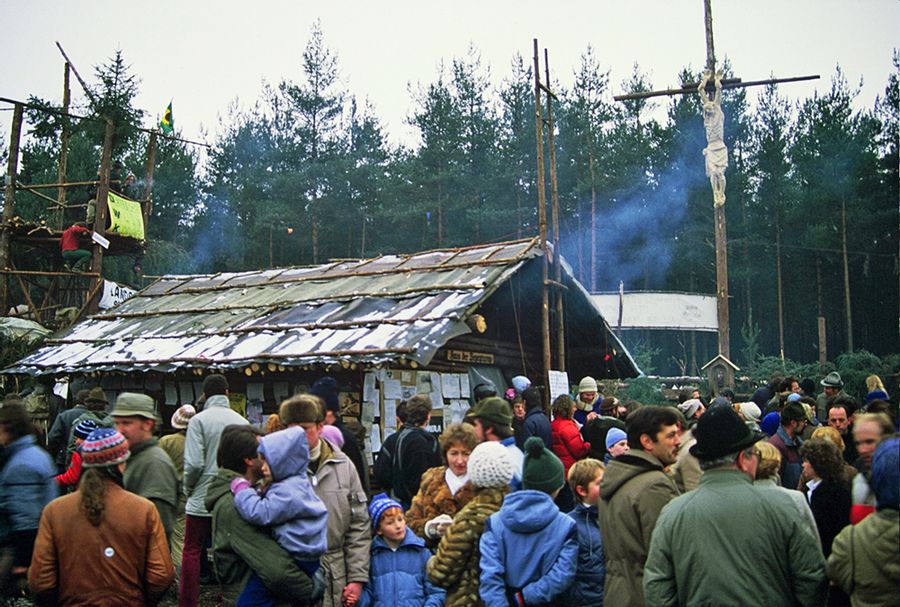
[edit]From 26 to 29 December 1985, the Burglengenfeld wood sculptor Stefan Preisl carved a 1.60 m tall figure of Christ from a spruce trunk in freezing temperatures.[1] The figure was attached to a ten-meter-high spruce cross and erected in the WAA protest village Free Republic of Wackerland.[2] The crucifix, consecrated by the catholic priest Andreas Schlagenhaufer, stood for a week.[3] During the clearing of the shantytown on 7 January 1986, it was sawn off by the police and carried away. A police chaplain had previously desecrated the cross and overseen its dignified transport.[4] The Christ figure, returned shortly afterward, was taken by demonstrators to the Franziskus-Marterl and erected there. On the night of 20 February 1986, the Christ figure disappeared. Only the broken hands remained.[5][6]
 creation
 Wacker-land cross
 removal by police
 theft[7]
 info[8]
 model[9]
_-_1985.JPG)
_1985_(Herbert_Grabe).jpg)
_-_1986.JPG)
_-_gestohlen_am_20-02-1986.JPG)
_-_1986.JPG)
_im_Haus_der_Bayerischen_Geschichte_-_(2025).JPG)
Cross of Wackersdorf
[edit]_-1986-.JPG)
When wood sculptor Preisl learned in February 1986 that his Christ figure had been torn from the tree, he began to make a new, more imposing cross. He didn't want the new, multi-ton cross to be so easily taken and made to disappear.[10] He bought massive blocks of Weymouth pine (pinus strobus) and glued them together. Preisl worked in his parents' garden until Easter. The second Christ figure was significantly larger and heavier than its predecessor. Meanwhile, a carpenter friend constructed the wooden cross for the corpus. The cross was transported by low-loader to the Franziskus-Marterl, where steelworkers from the Maxhütte steelworks had erected iron supports. Fifty men used steel cables to raise the enormous crucifix.[11] On Easter Sunday 1986, when 100,000 people demonstrated at the Easter March in Wackersdorf, the seven-meter-high crucifix stood next to the Franziskus-Marterl.[12][13] The members of the Franziskus-Marterl community built a round roof over the cross and continue to ensure its upkeep to this day.[14]
Artist – Stefan Preisl
[edit]Stefan Preisl (born 1956) trained as a wood sculptor starting in 1976 and has worked as a freelance sculptor in his hometown of Burglengenfeld since 1981.[15] From the beginning, he participated in the resistance actions against the WAA (nuclear reprocessing plant) in Wackersdorf. Later, Preisl also worked as an arborist and tree climber.[16][17] In 2003, Preisl, together with the artist group "Dünger" (Fertilizer), created the Burglengenfeld Art Forest Garden, a year-round open-air art exhibition.[18]
Location
[edit]_am_Franziskus-Marterl_bei_der_Wiederaufarbeitungsanlage_Wackersdorf_(WAA)_-_'Raus_aus_EURATOM'_-_10-2025.JPG)
The Wackersdorf Cross is part of the Franziskus-Marterl (St. Francis wayside shrine ensemble), which includes the St. Francis Chapel, the Stolen Cross of Wackersdorf, the Torn Man sculpture, the memorial cross for the Stations of the Cross from Wackersdorf to Gorleben, the "WAA-NO"-heart, the Bow of God in thanksgiving for the cancellation of the WAA, and other memorial plaques and protest trees. The Franziskus-Marterl is located on the former property of Michael Meier in the district of Altenschwand (Bodenwöhr).[19]
Documentaries
[edit]Interviews with the artist Stefan Preisl (HdBG 2015)
- Erection of the wooden cross with the first Christ figure he carved in the Free Republic of Wackerland shantytown and its removal by the police during the eviction.[20]
- Creation and erection of the second Christ figure made of Weymouth pine (Pinus strobus) wood, which can still be seen today at the Franziskus-Marterl in the Taxöldern Forest, east of Wackersdorf.[21]
- Violence by the demonstrators, especially against property, and the use of force by the police, particularly by the Berlin special unit in Wackersdorf.[22]
- The demonstrators' attitude against the Wackersdorf nuclear reprocessing plant (WAA), which did not even allow for the possibility of failure.[23]
- The use of water cannons, CN/CS gas, and police violence in Wackersdorf led to the radicalization of the population.[24]
More documents:
- 40 years ago: Environmental protests in Wackersdorf, 3 min[25]
See also
[edit]References
[edit]- ↑ Image: "Erstes Kreuz von Wackersdorf" im Hüttendorf (Image: "First Cross of Wackersdorf" in the hut village Wackerland), BUND
- ↑ Vor 20 Jahren kam das Aus für die WAA (Twenty years ago, the WAA project was shut down.), Mittelbayerische Zeitung, 23 April 2009
- ↑ 31 December 1985: Segnung des Holzkreuzes und Jahresschlussandacht mit Prof. Norbert Brox (Blessing of the wooden cross and year-end service with Prof. Norbert Brox) - see Culture against the WAA)
- ↑ Stefan Preisl - interview 2015, HdBG
- ↑ Bischof für wen? Die Amtskirche hatte es schwer mit WAA-Gegnern in den eigenen Reihen (Bishop for whom? The official church had a difficult time with WAA opponents within its own ranks.), Bund Naturschutz - Mittelbayerische Zeitung, July 1989, p. 31..)
- ↑ Das Kreuz von Wackersdorf (The Cross of Wackersdorf), Chrismon (magazine), August 2011
- ↑ The cross was stolen from the Franziskus-Marterl on February 20, 1986.
- ↑ Inscription beneath the Stolen Cross of Wackersdorf: I was erected (in the shantytown Free Republic of Wackerland) a memorial to nonviolent action consecrated for prayer ...then sawed down (by the police during the eviction of the shantytown) and re-erected (at the Franziskus-Marterl) as a memorial to nonviolent action consecrated for prayer ...and then brutally torn down (stolen by unknown persons) But my hands still command nonviolent action.
- ↑ A model from Stefan Preisl of the Christ figure, which was stolen on February 20, 1986, next to the Franziskus-Marterl, can now be seen in the House of Bavarian History (HdBG) in Regensburg.
- ↑ Stefan Preisl - interview 2015, HdBG
- ↑ Erfolgsmodell Wackersdorf - Die geplante atomare Wiederaufbereitungsanlage entfachte einen unerhörten Bürgerprotest. Vor genau 25 Jahren wurde der Baustopp verfügt (Wackersdorf: A Success Story – The planned nuclear reprocessing plant sparked unprecedented public protest. Exactly 25 years ago, construction was halted.), Die Welt, 1 June 2014
- ↑ Das Kreuz von Wackersdorf - Zigtausende Menschen demonstrierten 1986 gegen die atomare Aufbereitungsanlage Wackersdorf, unter ihnen sehr viele Christen: Ihr Kruzifix im Hüttendorf wurde zu einem umstrittenen Symbol (The Cross of Wackersdorf - Tens of thousands of people demonstrated against the Wackersdorf nuclear reprocessing plant in 1986, among them many Christians: Their crucifix in the hut village became a controversial symbol.), Julius Schophoff in: Chrismon, August 2011, p. 68..
- ↑ Das war Wackersdorf. (That was Wackersdorf.), Mittelbayerische Zeitung – Bund für Umwelt und Naturschutz Deutschland e. V. (BUND)
- ↑ Image: Cross of Wackersdorf, Mittelbayerische Zeitung, p. 4, BUND.
- ↑ Bildhauer Stefan Preisl - personal page
- ↑ Stefan Preisl aus Burglengenfeld und seine alles andere als hölzerne Leidenschaft: Holzbildhauer und Gipfelstürmer. (Stefan Preisl from Burglengenfeld and his anything but wooden passion: wood sculptor and mountaineer), Der neue Tag (Weiden in der Oberpfalz), 13 June 2008
- ↑ Kunstleidenschaft: Holz-Künstler feilt an seinen Hobbys - Stefan Preisl kletterte in Burglengenfeld jahrzehntelang auf Bäume. Nun konzentriert er sich wieder auf die Bildhauerei. (Passion for art: Wood artist hones his hobbies - Stefan Preisl climbed trees in Burglengenfeld for decades. Now he is concentrating on sculpture again.), Mittelbayerische Zeitung, 6 March 2021
- ↑ Kunstwaldgarten im Raffa (Art Forest Garden in Raffa), Schwandorf (district)
Abenteuer im Kunstwaldgarten (Adventures in the Art Forest Garden), Oberpfalz TV, 17 August 2020 - ↑ Naturpark Oberer Bayerischer Wald (Upper Bavarian Forest Nature Park), Regierung der Oberpfalz 2026.
Mitglieder im Naturpark (Members in the nature park), Upper Bavarian Forest Nature Park 2026. - ↑ Stefan Preisl - interview 1, HdBG
- ↑ Stefan Preisl - interview 2, HdBG
- ↑ Stefan Preisl - interview 3, HdBG
- ↑ Stefan Preisl - interview 4, HdBG
- ↑ Stefan Preisl - interview 5, HdBG
- ↑ Vor 40 Jahren: Umweltproteste in Wackersdorf (40 years ago: Environmental protests in Wackersdorf with Andreas Schlagenhaufer and Wolfgang Nowak), BR24, 1 April 2026, YouTube, 3 min
External links
[edit] Media related to Cross of Wackersdorf at Wikimedia Commons
- Media related to Stolen Cross of Wackersdorf at Wikimedia Commons
- Media related to Franziskus-Marterl at Wikimedia Commons
- Julius Schophoff: Das Kreuz von Wackersdorf (The Cross of Wackersdorf), Chrismon (magazine), August 2011, p. 68–69
- Das Kreuz von Wackersdorf (The Cross of Wackersdorf), Chrismon (magazine), August 2011
- Katja Auer: Als die Bürger über die Politik siegten (When the citizens triumphed over politics), Die Welt, 31 May 2014