


Filtration (probability theory)
In the theory of stochastic processes, a subdiscipline of probability theory, filtrations are totally ordered collections of subsets that are used to model the information that is available at a given point and therefore play an important role in the formalization of random (stochastic) processes.
Definition
[edit]Let be a probability space and let be an index set with a total order (often , , or a subset of ).


For every let be a sub-σ-algebra of . Then


is called a filtration, if for all . So filtrations are families of σ-algebras that are ordered non-decreasingly.[1] If is a filtration, then is called a filtered probability space.


Example
[edit]Let be a stochastic process on the probability space . Let denote the σ-algebra generated by the random variables . Then

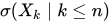


is a σ-algebra and is a filtration.
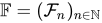
really is a filtration, since by definition all are σ-algebras and


This is known as the natural filtration of with respect to .
Types of filtrations
[edit]Right-continuous filtration
[edit]If is a filtration, then the corresponding right-continuous filtration is defined as[2]

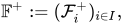
with

The filtration itself is called right-continuous if .[3]

Complete filtration
[edit]Let be a probability space, and let


be the set of all sets that are contained within a -null set.

A filtration is called a complete filtration, if every contains . This implies is a complete measure space for every (The converse is not necessarily true.)


Augmented filtration
[edit]A filtration is called an augmented filtration if it is complete and right continuous. For every filtration there exists a smallest augmented filtration refining .

If a filtration is an augmented filtration, it is said to satisfy the usual hypotheses or the usual conditions.[3]
See also
[edit]References
[edit]- ↑ Klenke, Achim (2008). Probability Theory. Berlin: Springer. p. 191. doi:10.1007/978-1-84800-048-3. ISBN 978-1-84800-047-6.
- ↑ Kallenberg, Olav (2017). Random Measures, Theory and Applications. Probability Theory and Stochastic Modelling. Vol. 77. Switzerland: Springer. p. 350-351. doi:10.1007/978-3-319-41598-7. ISBN 978-3-319-41596-3.
- 1 2 Klenke, Achim (2008). Probability Theory. Berlin: Springer. p. 462. doi:10.1007/978-1-84800-048-3. ISBN 978-1-84800-047-6.