


Index set
In mathematics, an index set is a set whose members label (or index) members of another set.[1][2] For instance, if the elements of a set A may be indexed or labeled by means of the elements of a set J, then J is an index set. The indexing consists of a surjective function from J onto A, and the indexed collection is typically called an indexed family, often written as {Aj}j∈J.
Examples
[edit]- An enumeration of a set S gives an index set , where f : J → S is the particular enumeration of S.
- Any countably infinite set can be (injectively) indexed by the set of natural numbers .
- For , the indicator function on r is the function given by


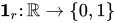
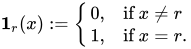
The set of all such indicator functions, , is an uncountable set indexed by .


Other uses
[edit]In computational complexity theory and cryptography, an index set is a set for which there exists an algorithm I that can sample the set efficiently; e.g., on input 1n, I can efficiently select a poly(n)-bit long element from the set.[3]
See also
[edit]References
[edit]- ↑ Weisstein, Eric. "Index Set". Wolfram MathWorld. Wolfram Research. Retrieved 30 December 2013.
- ↑ Munkres, James R. (2000). Topology. Vol. 2. Upper Saddle River: Prentice Hall.
- ↑ Goldreich, Oded (2001). Foundations of Cryptography: Volume 1, Basic Tools. Cambridge University Press. ISBN 0-521-79172-3.