


Compound Poisson process
 | This article relies on a single source. (March 2026) |
A compound Poisson process is a continuous-time stochastic process with jumps. The jumps arrive randomly according to a Poisson process and the size of the jumps is also random, with a specified probability distribution. To be precise, a compound Poisson process, parameterised by a rate and jump size distribution G, is a process given by


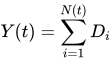
where, is the counting variable of a Poisson process with rate , and are independent and identically distributed random variables, with distribution function G, which are also independent of [1]


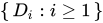

When are non-negative integer-valued random variables, then this compound Poisson process is known as a stuttering Poisson process. [citation needed]

Properties of the compound Poisson process
[edit]The expected value of a compound Poisson process can be calculated using a result known as Wald's equation as:

Making similar use of the law of total variance, the variance can be calculated as:
![{\displaystyle {\begin{aligned}\operatorname {var} (Y(t))&=\operatorname {E} (\operatorname {var} (Y(t)\mid N(t)))+\operatorname {var} (\operatorname {E} (Y(t)\mid N(t)))\\[5pt]&=\operatorname {E} (N(t)\operatorname {var} (D))+\operatorname {var} (N(t)\operatorname {E} (D))\\[5pt]&=\operatorname {var} (D)\operatorname {E} (N(t))+\operatorname {E} (D)^{2}\operatorname {var} (N(t))\\[5pt]&=\operatorname {var} (D)\lambda t+\operatorname {E} (D)^{2}\lambda t\\[5pt]&=\lambda t(\operatorname {var} (D)+\operatorname {E} (D)^{2})\\[5pt]&=\lambda t\operatorname {E} (D^{2}).\end{aligned}}}](https://wikimedia.org/api/rest_v1/media/math/render/svg/5a818cc242b7003a3d5f043f431fdf57801e9734)
Lastly, using the law of total probability, the moment generating function can be given as follows:

![{\displaystyle {\begin{aligned}\operatorname {E} (e^{sY})&=\sum _{i}e^{si}\Pr(Y(t)=i)\\[5pt]&=\sum _{i}e^{si}\sum _{n}\Pr(Y(t)=i\mid N(t)=n)\Pr(N(t)=n)\\[5pt]&=\sum _{n}\Pr(N(t)=n)\sum _{i}e^{si}\Pr(Y(t)=i\mid N(t)=n)\\[5pt]&=\sum _{n}\Pr(N(t)=n)\sum _{i}e^{si}\Pr(D_{1}+D_{2}+\cdots +D_{n}=i)\\[5pt]&=\sum _{n}\Pr(N(t)=n)M_{D}(s)^{n}\\[5pt]&=\sum _{n}\Pr(N(t)=n)e^{n\ln(M_{D}(s))}\\[5pt]&=M_{N(t)}(\ln(M_{D}(s)))\\[5pt]&=e^{\lambda t\left(M_{D}(s)-1\right)}.\end{aligned}}}](https://wikimedia.org/api/rest_v1/media/math/render/svg/5b8480ad2cecd8cd45d38ad108824ed88fda17cc)
Exponentiation of measures
[edit]Let N, Y, and D be as above. Let μ be the probability measure according to which D is distributed, i.e.

Let δ0 be the trivial probability distribution putting all of the mass at zero. Then the probability distribution of Y(t) is the measure

where the exponential exp(ν) of a finite measure ν on Borel subsets of the real line is defined by
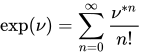
and
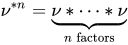
is a convolution of measures, and the series converges weakly.
See also
[edit]- Poisson process
- Poisson distribution
- Compound Poisson distribution
- Non-homogeneous Poisson process
- Campbell's formula for the moment generating function of a compound Poisson process
References
[edit]- ↑ Ross, Sheldon M. (1996). Stochastic processes. Wiley series in probability and statistics (2nd ed.). New York: Wiley. ISBN 978-0-471-12062-9.