


Correlation swap
A correlation swap is an over-the-counter financial derivative that allows one to speculate on or hedge risks associated with the observed average correlation, of a collection of underlying products, where each product has periodically observable prices, as with a commodity, exchange rate, interest rate, or stock index.
Payoff Definition
[edit]The fixed leg of a correlation swap pays the notional times the agreed strike , while the floating leg pays the realized correlation . The contract value at expiration from the pay-fixed perspective is therefore



Given a set of nonnegative weights on securities, the realized correlation is defined as the weighted average of all pairwise correlation coefficients :


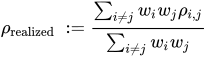
Typically would be calculated as the Pearson correlation coefficient between the daily log-returns of assets i and j, possibly under zero-mean assumption.
Most correlation swaps trade using equal weights, in which case the realized correlation formula simplifies to:
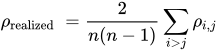
The specificity of correlation swaps is somewhat counterintuitive, as the protection buyer pays the fixed, unlike in usual swaps.
Pricing and valuation
[edit]No industry-standard models yet exist that have stochastic correlation and are arbitrage-free.
See also
[edit]Sources
[edit]- Meissner, Gunter (2014). Correlation risk modeling and management : an applied guide including the Basel III correlation framework-- with interactive models in Excel/VBA. Wiley. p. 11. ISBN 978-1118796900.
