


Consistent pricing process
A consistent pricing process (CPP) is any representation of (frictionless) "prices" of assets in a market. It is a stochastic process in a filtered probability space such that at time the component can be thought of as a price for the asset.



Mathematically, a CPP in a market with d-assets is an adapted process in if Z is a martingale with respect to the physical probability measure , and if at all times such that is the solvency cone for the market at time .[1][2]


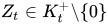

The CPP plays the role of an equivalent martingale measure in markets with transaction costs.[3] In particular, there exists a 1-to-1 correspondence between the CPP and the EMM .[citation needed]


References
[edit]- ↑ Schachermayer, Walter (November 15, 2002). "The Fundamental Theorem of Asset Pricing under Proportional Transaction Costs in Finite Discrete Time".
{{cite journal}}: Cite journal requires|journal=(help) - ↑ Yuri M. Kabanov; Mher Safarian (2010). Markets with Transaction Costs: Mathematical Theory. Springer. p. 114. ISBN 978-3-540-68120-5.
- ↑ Jacka, Saul; Berkaoui, Abdelkarem; Warren, Jon (2008). "No arbitrage and closure results for trading cones with transaction costs". Finance and Stochastics. 12 (4): 583–600. arXiv:math/0602178. doi:10.1007/s00780-008-0075-7. S2CID 17136711.
 | This Econometrics-related article is a stub. You can help Wikipedia by adding missing information. |