


Zeta function (operator)
The zeta function of a mathematical operator is a function defined as


for those values of s where this expression exists, and as an analytic continuation of this function for other values of s. Here "tr" denotes a functional trace.
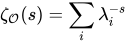
The zeta function may also be expressible as a spectral zeta function[1] in terms of the eigenvalues of the operator by

- .
It is used in giving a rigorous definition to the functional determinant of an operator, which is given by

The Minakshisundaram–Pleijel zeta function is an example, when the operator is the Laplacian of a compact Riemannian manifold.
One of the most important motivations for Arakelov theory is the zeta functions for operators with the method of heat kernels generalized algebro-geometrically.[2]
See also
[edit]References
[edit]- ↑ Lapidus & van Frankenhuijsen (2006) p.23
- ↑ Soulé, C. (1992), Lectures on Arakelov geometry, Cambridge Studies in Advanced Mathematics, vol. 33, with the collaboration of D. Abramovich, J.-F. Burnol and J. Kramer, Cambridge: Cambridge University Press, pp. viii+177, ISBN 0-521-41669-8, MR 1208731
- Lapidus, Michel L.; van Frankenhuijsen, Machiel (2006), Fractal geometry, complex dimensions and zeta functions. Geometry and spectra of fractal strings, Springer Monographs in Mathematics, New York, NY: Springer-Verlag, ISBN 0-387-33285-5, Zbl 1119.28005
- Fursaev, Dmitri; Vassilevich, Dmitri (2011), Operators, Geometry and Quanta: Methods of Spectral Geometry in Quantum Field Theory, Theoretical and Mathematical Physics, Springer-Verlag, p. 98, ISBN 978-94-007-0204-2
 | This mathematical analysis–related article is a stub. You can help Wikipedia by adding missing information. |