


Zeldovich regularization
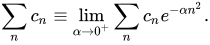
Zeldovich regularization refers to a regularization method to calculate divergent integrals and divergent series, that was first introduced by Yakov Zeldovich in 1961.[1] Zeldovich was originally interested in calculating the norm of the Gamow wave function which is divergent since there is an outgoing spherical wave. Zeldovich regularization uses a Gaussian type-regularization and is defined, for divergent integrals, by[2]

and, for divergent series, by[3][4][5]
See also
[edit]References
[edit]- ↑ Zel’Dovich, Y. B. (1961). On the theory of unstable states. Sov. Phys. JETP, 12, 542.
- ↑ Garrido, E., Fedorov, D. V., Jensen, A. S., & Fynbo, H. O. U. (2006). Anatomy of three-body decay III: Energy distributions. Nuclear Physics A, 766, 74-96.
- ↑ Mur, V. D., Pozdnyakov, S. G., Popruzhenko, S. V., & Popov, V. S. (2005). Summation of divergent series and Zeldovich’s regularization method. Physics of Atomic Nuclei, 68, 677-685.
- ↑ Mur, V. D., Pozdnyakov, S. G., Popov, V. S., & Popruzhenko, S. V. E. (2002). On the Zel’dovich regularization method in the theory of quasistationary states. Journal of Experimental and Theoretical Physics Letters, 75, 249-252.
- ↑ Orlov, Y. V., & Irgaziev, B. F. (2008). On the normalization of the Gamov resonant wave function in the configuration space. Bulletin of the Russian Academy of Sciences: Physics, 72, 1539-1543.