


Young model
 | This article needs more citations. (December 2009) |
Young model is a radio propagation model that was built on the data collected on New York City. It typically models the behaviour of cellular communication systems in large cities.
Applicable to/under conditions
[edit]This model is ideal for modeling the behaviour of cellular communications in large cities with tall structures.
Coverage
[edit]Frequency: 150 MHz to 3700 MHz
History
[edit]Young model was built on the data of 1952 in New York City.[1]
Mathematical formulation
[edit]The mathematical formulation for Young model is:
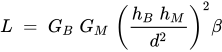
Where,
- L = path loss. Unit: decibel (dB)
- GB = gain of base transmitter. Unit: decibel (dB)
- GM = gain of mobile transmitter. Unit: decibel (dB)
- hB = height of base station antenna. Unit: meter (m)
- hM = height of mobile station antenna. Unit: meter (m)
- d = link distance. Unit: kilometer (km)
- = clutter factor

See also
[edit]References
[edit]- ↑ Comparison of Mobile Radio Transmission at 150, 450, 900, and 3700 Mc, W. Rae Young, Jr., 1952, Bell System Technical Journal