


Whitham equation
In mathematical physics, the Whitham equation is a non-local model for non-linear dispersive waves.[1][2][3]
The equation is notated as follows:

This integro-differential equation for the oscillatory variable η(x,t) is named after Gerald Whitham who introduced it as a model to study breaking of non-linear dispersive water waves in 1967.[4] Wave breaking – bounded solutions with unbounded derivatives – for the Whitham equation has recently been proven.[5]
For a certain choice of the kernel K(x − ξ) it becomes the Fornberg–Whitham equation.
Water waves
[edit]Using the Fourier transform (and its inverse), with respect to the space coordinate x and in terms of the wavenumber k:
- For surface gravity waves, the phase speed c(k) as a function of wavenumber k is taken as:[4]
- while
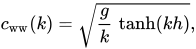
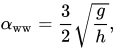
- with g the gravitational acceleration and h the mean water depth. The associated kernel Kww(s) is, using the inverse Fourier transform:[4]
- since cww is an even function of the wavenumber k.

- The Korteweg–de Vries equation (KdV equation) emerges when retaining the first two terms of a series expansion of cww(k) for long waves with kh ≪ 1:[4]
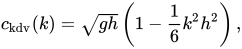

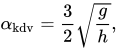
- with δ(s) the Dirac delta function.
- Bengt Fornberg and Gerald Whitham studied the kernel Kfw(s) – non-dimensionalised using g and h:[6]
- and with
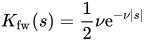
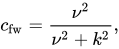

- The resulting integro-differential equation can be reduced to the partial differential equation known as the Fornberg–Whitham equation:[6]

- This equation is shown to allow for peakon solutions – as a model for waves of limiting height – as well as the occurrence of wave breaking (shock waves, absent in e.g. solutions of the Korteweg–de Vries equation).[6][3]
Notes and references
[edit]Notes
[edit]- ↑ Debnath (2005, p. 364)
- ↑ Naumkin & Shishmarev (1994, p. 1)
- 1 2 Whitham (1974, pp. 476–482)
- 1 2 3 4 Whitham (1967)
- ↑ Hur (2017)
- 1 2 3 Fornberg & Whitham (1978)
References
[edit]- Debnath, L. (2005), Nonlinear Partial Differential Equations for Scientists and Engineers, Springer, ISBN 9780817643232
- Fetecau, R.; Levy, Doron (2005), "Approximate Model Equations for Water Waves", Communications in Mathematical Sciences, 3 (2): 159–170, doi:10.4310/CMS.2005.v3.n2.a4
- Fornberg, B.; Whitham, G.B. (1978), "A Numerical and Theoretical Study of Certain Nonlinear Wave Phenomena", Philosophical Transactions of the Royal Society A, 289 (1361): 373–404, Bibcode:1978RSPTA.289..373F, CiteSeerX 10.1.1.67.6331, doi:10.1098/rsta.1978.0064, S2CID 7333207
- Hur, Vera Mikyoung (2017), "Wave breaking in the Whitham equation", Advances in Mathematics, 317: 410–437, arXiv:1506.04075, doi:10.1016/j.aim.2017.07.006, S2CID 119121867
- Moldabayev, D.; Kalisch, H.; Dutykh, D. (2015), "The Whitham Equation as a model for surface water waves", Physica D: Nonlinear Phenomena, 309: 99–107, arXiv:1410.8299, Bibcode:2015PhyD..309...99M, doi:10.1016/j.physd.2015.07.010, S2CID 55302388
- Naumkin, P.I.; Shishmarev, I.A. (1994), Nonlinear Nonlocal Equations in the Theory of Waves, American Mathematical Society, ISBN 9780821845738
- Whitham, G.B. (1967), "Variational methods and applications to water waves", Proceedings of the Royal Society A, 299 (1456): 6–25, Bibcode:1967RSPSA.299....6W, doi:10.1098/rspa.1967.0119, S2CID 122802187
- Whitham, G.B. (1974), Linear and nonlinear waves, Wiley-Interscience, Bibcode:1974lnw..book.....W, doi:10.1002/9781118032954, ISBN 978-0-471-94090-6