


Universal embedding theorem
The universal embedding theorem, or Krasner–Kaloujnine universal embedding theorem, is a theorem from the mathematical discipline of group theory first published in 1951 by Marc Krasner and Lev Kaluznin.[1] The theorem states that any group extension of a group H by a group A is isomorphic to a subgroup of the regular wreath product A Wr H. The theorem is named for the fact that the group A Wr H is said to be universal with respect to all extensions of H by A.
Statement
[edit]Let H and A be groups, let K = AH be the set of all functions from H to A, and consider the action of H on itself by multiplication. This action extends naturally to an action of H on K, defined as where and g and h are both in H. This is an automorphism of K, so we can construct the semidirect product K ⋊ H, which is termed the regular wreath product, and denoted A Wr H or The group K = AH (which is isomorphic to ) is called the base group of the wreath product.


The Krasner–Kaloujnine universal embedding theorem states that if G has a normal subgroup A and H = G/A, then there is an injective homomorphism of groups such that A maps surjectively onto [2] This is equivalent to the wreath product A Wr H having a subgroup isomorphic to G, where G is any extension of H by A.


Proof
[edit]This proof comes from Dixon–Mortimer.[3]
Define a homomorphism whose kernel is A. Choose a set of (right) coset representatives of A in G, where Then for all x in G, For each x in G, we define a function such that Then the embedding is given by





We now prove that this is a homomorphism. If x and y are in G, then Now so for all u in H,


so fx fy = fxy. Hence is a homomorphism as required.
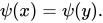
The homomorphism is injective. If then both fx(u) = fy(u) (for all u) and Then but we can cancel and from both sides, so x = y, hence is injective. Finally, precisely when in other words when (as ).



Generalizations and related results
[edit]- The Krohn–Rhodes theorem is a statement similar to the universal embedding theorem, but for semigroups. A semigroup S is a divisor of a semigroup T if it is the image of a subsemigroup of T under a homomorphism. The theorem states that every finite semigroup S is a divisor of a finite alternating wreath product of finite simple groups (each of which is a divisor of S) and finite aperiodic semigroups.
- An alternate version of the theorem exists which requires only a group G and a subgroup A (not necessarily normal).[4] In this case, G is isomorphic to a subgroup of the regular wreath product A Wr (G/Core(A)).
References
[edit]- ↑ Kaloujnine & Krasner (1951a).
- ↑ Dixon & Mortimer (1996, p. 47).
- ↑ Dixon & Mortimer (1996, pp. 47–48).
- ↑ Kaloujnine & Krasner (1951b).
Bibliography
[edit]- Dixon, John; Mortimer, Brian (1996). Permutation Groups. Springer. ISBN 978-0387945996.
- Kaloujnine, Lev; Krasner, Marc (1951a). "Produit complet des groupes de permutations et le problème d'extension de groupes II". Acta Sci. Math. Szeged. 14: 39–66. Archived from the original on 2024-11-19. Retrieved 2019-07-07.
- Kaloujnine, Lev; Krasner, Marc (1951b). "Produit complet des groupes de permutations et le problème d'extension de groupes III". Acta Sci. Math. Szeged. 14: 69–82.
- Praeger, Cheryl; Schneider, Csaba (2018). Permutation groups and Cartesian Decompositions. Cambridge University Press. ISBN 978-0521675062.