


Unit demand
In economics, a unit demand agent is an agent who wants to buy a single item, which may be of one of different types. A typical example is a buyer who needs a new car. There are many different types of cars, but usually a buyer will choose only one of them, based on the quality and the price.
If there are m different item-types, then a unit-demand valuation function is typically represented by m values , with representing the subjective value that the agent derives from item . If the agent receives a set of items, then his total utility is given by:


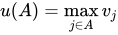
since he enjoys the most valuable item from and ignores the rest.
Therefore, if the price of item is , then a unit-demand buyer will typically want to buy a single item – the item for which the net utility is maximized.


Ordinal and cardinal definitions
[edit]A unit-demand valuation is formally defined by:
- For a preference relation: for every set there is a subset with cardinality , such that .
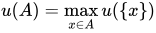
- For a utility function: For every set :[1]


Connection to other classes of utility functions
[edit]A unit-demand function is an extreme case of a submodular set function.
It is characteristic of items that are pure substitute goods.
See also
[edit]References
[edit]- ↑ Koopmans, T. C.; Beckmann, M. (1957). "Assignment Problems and the Location of Economic Activities" (PDF). Econometrica. 25 (1): 53–76. doi:10.2307/1907742. JSTOR 1907742.