


Two-dimensional singular-value decomposition
In linear algebra, two-dimensional singular-value decomposition (2DSVD) computes the low-rank approximation of a set of matrices such as 2D images or weather maps in a manner almost identical to SVD (singular-value decomposition) which computes the low-rank approximation of a single matrix (or a set of 1D vectors).
SVD
[edit]Let matrix contains the set of 1D vectors which have been centered. In PCA/SVD, we construct covariance matrix and Gram matrix
![{\displaystyle X=[\mathbf {x} _{1},\ldots ,\mathbf {x} _{n}]}](https://wikimedia.org/api/rest_v1/media/math/render/svg/e44d067caca6bc1bbc0be71cce550a956d24ab9e)


- ,


and compute their eigenvectors and . Since and we have
![{\displaystyle U=[\mathbf {u} _{1},\ldots ,\mathbf {u} _{n}]}](https://wikimedia.org/api/rest_v1/media/math/render/svg/f9dc5fc2189d286ffdb668ed255b64877a97b697)
![{\displaystyle V=[\mathbf {v} _{1},\ldots ,\mathbf {v} _{n}]}](https://wikimedia.org/api/rest_v1/media/math/render/svg/e48e3539f0d6433cdc44453d64e5ce241c006bb2)



If we retain only principal eigenvectors in , this gives low-rank approximation of .


2DSVD
[edit]Here we deal with a set of 2D matrices . Suppose they are centered . We construct row–row and column–column covariance matrices
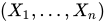

- and
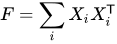
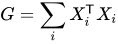
in exactly the same manner as in SVD, and compute their eigenvectors and . We approximate as



in identical fashion as in SVD. This gives a near optimal low-rank approximation of with the objective function
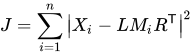
Error bounds similar to Eckard–Young theorem also exist.
2DSVD is mostly used in image compression and representation.
References
[edit]- Chris Ding and Jieping Ye. "Two-dimensional Singular Value Decomposition (2DSVD) for 2D Maps and Images". Proc. SIAM Int'l Conf. Data Mining (SDM'05), pp. 32–43, April 2005. http://ranger.uta.edu/~chqding/papers/2dsvdSDM05.pdf
- Jieping Ye. "Generalized Low Rank Approximations of Matrices". Machine Learning Journal. Vol. 61, pp. 167–191, 2005.