


Transvectant
 | This article includes a list of references, related reading, or external links, but its sources remain unclear because it lacks inline citations. (May 2017) |
In mathematical invariant theory, a transvectant is an invariant formed from n invariants in n variables using Cayley's Ω process.
Definition
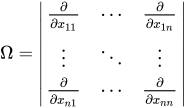
[edit]If Q1,...,Qn are functions of n variables x = (x1,...,xn) and r ≥ 0 is an integer then the rth transvectant of these functions is a function of n variables given bywhereis Cayley's Ω process, and the tensor product means take a product of functions with different variables x1,..., xn, and the trace operator Tr means setting all the vectors xk equal.

Examples
[edit]The zeroth transvectant is the product of the n functions.The first transvectant is the Jacobian determinant of the n functions.The second transvectant is a constant times the completely polarized form of the Hessian of the n functions.


When , the binary transvectants have an explicit formula:[1]which can be more succinctly written aswhere the arrows denote the function to be taken the derivative of. This notation is used in Moyal product.



Applications
[edit]First Fundamental Theorem of Invariant Theory ([2])—All polynomial covariants and invariants of any system of binary forms can be expressed as linear combinations of iterated transvectants.
References
[edit]- ↑ Olver 1999, p. 88.
- ↑ Olver 1999, p. 90.
- Olver, Peter J. (1999), Classical invariant theory, Cambridge University Press, ISBN 978-0-521-55821-1
- Olver, Peter J.; Sanders, Jan A. (2000), "Transvectants, modular forms, and the Heisenberg algebra", Advances in Applied Mathematics, 25 (3): 252–283, CiteSeerX 10.1.1.46.803, doi:10.1006/aama.2000.0700, ISSN 0196-8858, MR 1783553