


Transition-rate matrix
In probability theory, a transition-rate matrix (also known as a Q-matrix,[1] intensity matrix,[2] or infinitesimal generator matrix[3]) is an array of numbers describing the instantaneous rate at which a continuous-time Markov chain transitions between states.
In a transition-rate matrix (sometimes written [4]), element (for ) denotes the rate departing from and arriving in state . The rates , and the diagonal elements are defined such that


- ,
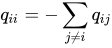
and therefore the rows of the matrix sum to zero.
Up to a global sign, a large class of examples of such matrices is provided by the Laplacian of a directed, weighted graph. The vertices of the graph correspond to the Markov chain's states.
Properties
[edit]The transition-rate matrix has following properties:[5]
- There is at least one eigenvector with a vanishing eigenvalue, exactly one if the graph of is strongly connected.
- All other eigenvalues fulfill .
- All eigenvectors with a non-zero eigenvalue fulfill .
- The Transition-rate matrix satisfies the relation where P(t) is the continuous stochastic matrix.




Example
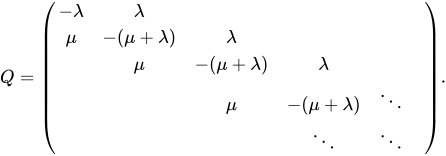
[edit]An M/M/1 queue, a model which counts the number of jobs in a queueing system with arrivals at rate λ and services at rate μ, has transition-rate matrix
See also
[edit]References
[edit]- ↑ Suhov & Kelbert 2008, Definition 2.1.1.
- ↑ Asmussen, S. R. (2003). "Markov Jump Processes". Applied Probability and Queues. Stochastic Modelling and Applied Probability. Vol. 51. pp. 39–59. doi:10.1007/0-387-21525-5_2. ISBN 978-0-387-00211-8.
- ↑ Trivedi, K. S.; Kulkarni, V. G. (1993). "FSPNs: Fluid stochastic Petri nets". Application and Theory of Petri Nets 1993. Lecture Notes in Computer Science. Vol. 691. p. 24. doi:10.1007/3-540-56863-8_38. ISBN 978-3-540-56863-6.
- ↑ Rubino, Gerardo; Sericola, Bruno (1989). "Sojourn Times in Finite Markov Processes" (PDF). Journal of Applied Probability. 26 (4). Applied Probability Trust: 744–756. doi:10.2307/3214379. JSTOR 3214379. S2CID 54623773.
- ↑ Keizer, Joel (1972-11-01). "On the solutions and the steady states of a master equation". Journal of Statistical Physics. 6 (2): 67–72. Bibcode:1972JSP.....6...67K. doi:10.1007/BF01023679. ISSN 1572-9613. S2CID 120377514.
- Norris, J. R. (1997). Markov Chains. doi:10.1017/CBO9780511810633.005. ISBN 9780511810633.
- Suhov, Yuri; Kelbert, Mark (2008). Markov chains: a primer in random processes and their applications. Cambridge University Press.
- Syski, R. (1992). Passage Times for Markov Chains. IOS Press. ISBN 90-5199-060-X.
 | This probability-related article is a stub. You can help Wikipedia by adding missing information. |