


Talk:Venus/Archive 4
 | This is an archive of past discussions about Venus. Do not edit the contents of this page. If you wish to start a new discussion or revive an old one, please do so on the current talk page. |
| Archive 1 | Archive 2 | Archive 3 | Archive 4 |
Lead too long
The lead strikes me as rather too long and lacking concision. For example, how essential is the prospect of being devoured by future solar expansion? 𝕁𝕄𝔽 (talk) 08:48, 7 September 2025 (UTC)
- Agreed. Here is a proposed split of which topics could be kept, versus which ones could be moved in the rest of the article if they aren't already covered there. Don't hesitate to modify this list in place, I may have decimated too much? What do you think?
- Could be kept in the lead
- second planet, closest passing planet, Earth's twin
- extreme heat + pressure, no liquid water, thick CO₂ atmosphere, runaway greenhouse, sulfuric acid clouds
- no internal dynamo, volcanism heat escape
- orbital period, retrograde rotation, solar day
- brightest object after Sun and Moon, morning/evening star
- cultural significance, and some “firsts” in its exploration
- Could rather appear elsewhere in the article
- supercritical atmosphere at surface
- synodic Earth period, Mercury is closer on average, gravity assists, no moons
- cause of today's spin state
- internal structure, early water/habitability (because both largely unknown)
- phosphine debate
- future fate with Sun evolution
- geocentrism/heliocentrism
- more details of its exploration (past and future)
- LazyAssed Contender (talk) 10:07, 7 September 2025 (UTC)
- "Not my field" so I'll leave it to the planetary scientists to decide what's important. WP: LEAD says the the lead should summarise the essentials of the body. These are the current section heads:
- Physical characteristics
- Atmosphere and climate
- Orbit and rotation
- Observability
- Observation and exploration history
- Search for life
- In culture
- Which seems as good a guide as any to what should be highlighted for readers who need the essential information? 𝕁𝕄𝔽 (talk) 15:02, 7 September 2025 (UTC)
- Yes, the lead should summarize the article at an accessible level. Thus the table of contents should be the guide. Any material in the lead that is not in the table of contents should be added to the body of the article first or removed.
- But in this case the two lists are similar. I suggest stepwise trimming so other editors can object to individual deletes. Johnjbarton (talk) 15:50, 7 September 2025 (UTC)
- "Not my field" so I'll leave it to the planetary scientists to decide what's important. WP: LEAD says the the lead should summarise the essentials of the body. These are the current section heads:
Greyscale photo?
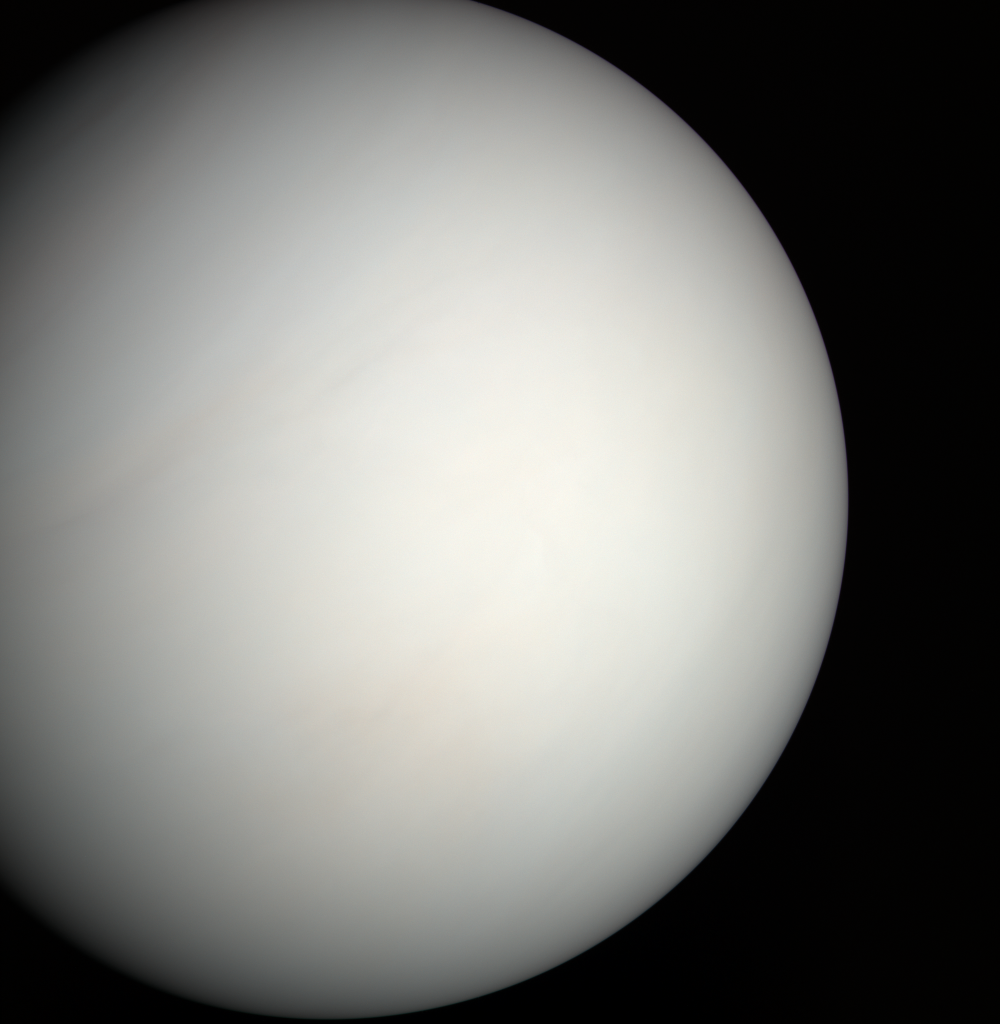
Is there a reason a greyscale photo is used here instead of true colour like for the other planets? I thought this same photo used to be labelled true colour before. Looking at commons it seems most of the good Venus photos are false/UV ones so I'm not sure what would be a better one to use. Ringtail Raider (talk) 02:20, 23 October 2025 (UTC)
- Someone has reverted the edit that said the photo was greyscale, stating that the editor "forgot to check the commons description". Said description states it's "part of a color sequence".
- I'm not sure if it's just the JPEG compression, but over-saturating the image has very little effect, only revealing a few thin strips of colour that look a lot like some kind of artifact: https://commons.wikimedia.org/wiki/File:Oversaturated_Venus_approach_image.png
- I doubt it's actually a colour photo. Venus can't be THAT grey. There is a colour version of this photo here accessible through user kinokomushroom's comment on this Reddit post but I'm not sure how to trace back the origins of this version. It does appear to be more realistic though. TrueColorTools has data for Venus based on three studies and it's a bright dull yellow according to that. Oberorka (talk) 06:00, 29 October 2025 (UTC)
- The source of the image is claimed to be NASA, https://science.nasa.gov/photojournal/approaching-venus-image-2/ which says
This single frame is part of a color sequence taken to help the MESSENGER team calibrate the camera in preparation for the spacecraft's first flyby of Mercury on January 14, 2008.
- Johnjbarton (talk) 15:27, 29 October 2025 (UTC)
- The image is still completely black-and-white though. I opened the tiff file in paint.net and cranked up the saturation several times, nothing changed. Should it really be captioned as a colour image? Oberorka (talk) 15:48, 29 October 2025 (UTC)
- Please check the images at the NASA site linked. To me the image on https://science.nasa.gov/venus/ is way more fun and obviously in color. Same or similar image appears on https://science.nasa.gov/venus/venus-facts/. Why don't we use that one? Johnjbarton (talk) 15:54, 29 October 2025 (UTC)
- Oh I see, https://science.nasa.gov/resource/newly-processed-views-of-venus-from-mariner-10/
- This view is a false color composite created by combining images taken using orange and ultraviolet spectral filters on the spacecraft's imaging camera. These were used for the red and blue channels of the color image, respectively, with the green channel synthesized by combining the other two images.
- Johnjbarton (talk) 15:59, 29 October 2025 (UTC)
- All I'm suggesting is that the obviously greyscale image not be labelled as a colour image. Perhaps we could change it to just say "Photo of Venus by MESSENGER" to avoid any more back-and-forth edits. Oberorka (talk) 16:07, 29 October 2025 (UTC)
- I think I've sorted out the mystery. On this page https://messenger.jhuapl.edu/Explore/Science-Images-Database/gallery-image-327.html it says
- During the MESSENGER mission's second flyby of Venus, the Wide Angle Camera (WAC) of the Mercury Dual Imaging System (MDIS) acquired images through all of its 11 narrow-band color filters of the approaching planet. The surface of Venus is shrouded in clouds, and the WAC images returned from the encounter show this cloud covered view, as seen in this previously released image. However, by processing the WAC images and "stretching" the gray scale used to display the images, subtle differences in the clouds of Venus are revealed, as seen in the image here. This WAC image was taken through a narrow-band filter centered at 630 nanometers, and in this stretched image, global circulation patterns can be seen in the atmosphere of Venus.
- Our images is "this previously released image" mentioned. So my interpretation is that the color sequence mentioned is the 11 greyscale images and thus the image we show is one of these 11. They are all greyscale behind an color filter and only show color when combined. This is how Viking's camera worked as well. Johnjbarton (talk) 16:13, 29 October 2025 (UTC)
- If only JUICE was able to capture its own full-disc visible light Venus images like I'm pretty sure it originally intended to for instrument testing, sigh. ArkHyena (she/they) 18:11, 29 October 2025 (UTC)
- I believe our supposed former 'true color' image is confused with this one by Gordan Ugarkovic: https://www.planetary.org/space-images/venus_messenger_3447783055_7201387b94_o .
- It's under Creative Commons Attribution-NonCommercial-NoDerivs 3.0 Unported License, don't really know much about licenses so can't tell if it's allowed or not.
- Also, the new infobox image isn't true color either from what I could gather in the comments at this talk page. IvarTheBoneless123 (talk) 19:44, 20 November 2025 (UTC)
- Yes I agree, I've always thought that Ugarkovic's image would be more fitting than any other option out here, but I did not found enough details to justify it. In any case, I would be on board to make it the main article image. Contrary to the previously used Messenger image, this one is is a color image, and probably is a rare case where they used only visible light filters. LazyAssed Contender (talk) 10:30, 21 November 2025 (UTC)
- Ugarkovic most likely used the imagery from the 630, 560, and 480 nm filters alone in order to try and approximate human RGB cones. MESSENGER didn't have any filters that more closely match genuine human eye vision, so it's probably the best we can do. XiphosuraTalk∞Edits 07:03, 23 November 2025 (UTC)
- WP can't use Non-commercial images, so we'd need to contact him in order to use the image. Though that runs into issues of citation reliability. Amateur processing, no matter how "accurate", will always be less preferable in the citation hierarchy WP imposes than "inaccurate" images from an established source. XiphosuraTalk∞Edits 07:07, 23 November 2025 (UTC)
- Like I said in a comment below, the fact that Venus is pearl white in true color anyway (+ space being pitch black) makes me think that we should simply restore the previous greyscale image (with the appropriate comments and sources of course) - if ever there was a case for using a black-and-white image in an infobox, it's this IMO. IvarTheBoneless123 (talk) 09:38, 26 November 2025 (UTC)
- Yes I agree, I've always thought that Ugarkovic's image would be more fitting than any other option out here, but I did not found enough details to justify it. In any case, I would be on board to make it the main article image. Contrary to the previously used Messenger image, this one is is a color image, and probably is a rare case where they used only visible light filters. LazyAssed Contender (talk) 10:30, 21 November 2025 (UTC)
- I did something similar. Johnjbarton (talk) 16:21, 29 October 2025 (UTC)
- I think we should just change it back to the greyscale MESSENGER image - Venus is featureless white in true color anyway, so a black-and-white image doesn't really make much of a difference.
- I get the appeal of the current image, but like I said in my previous comment, that doesn't seem to be true color either. IvarTheBoneless123 (talk) 10:19, 21 November 2025 (UTC)
- Please note that my change was to select the greyscale MESSENGER image. Another editor has made a change to a different image. Johnjbarton (talk) 17:24, 21 November 2025 (UTC)
- I think I've sorted out the mystery. On this page https://messenger.jhuapl.edu/Explore/Science-Images-Database/gallery-image-327.html it says
- Oh I see, https://science.nasa.gov/resource/newly-processed-views-of-venus-from-mariner-10/
- Please check the images at the NASA site linked. To me the image on https://science.nasa.gov/venus/ is way more fun and obviously in color. Same or similar image appears on https://science.nasa.gov/venus/venus-facts/. Why don't we use that one? Johnjbarton (talk) 15:54, 29 October 2025 (UTC)
- The image is still completely black-and-white though. I opened the tiff file in paint.net and cranked up the saturation several times, nothing changed. Should it really be captioned as a colour image? Oberorka (talk) 15:48, 29 October 2025 (UTC)
- The source of the image is claimed to be NASA, https://science.nasa.gov/photojournal/approaching-venus-image-2/ which says


How reliable is the source for the new main image of Venus?
The source of the new main image of Venus appears to be a personal website by a certain Ricardo Nunes. However, with all due respect to the owner, I have doubts on the reliability of the website. The owner likewise rendered Mercury as orange-brown instead of grey which makes me doubt the website even more. IapetusCallistus (talk) 14:46, 28 November 2025 (UTC)
- For the record the "new main image of Venus" is image #1 in the post #Why was the image changed?. @IapetusCallistus please post your issues with that topic. Johnjbarton (talk) 18:04, 28 November 2025 (UTC)
Why was the image changed?
The colour of the image before the change was also closer to what the human eye would see, so I don't understand why it was changed. LobedHomunculus (talk) 17:26, 22 November 2025 (UTC)
- The main issue with the previous image is that it was in greyscale and presented as true colour (which especially fooled me), the current image at least has a caption accurate to the image itself. XiphosuraTalk∞Edits 06:57, 23 November 2025 (UTC)
- @LobedHomunculus @Xiphosura I can not figure out from your posts which image / caption you object to. Also @IvarTheBoneless123 @Oberorka @Ringtail Raider maybe we can settle this?


- Is there any source for the true color of Venus? Johnjbarton (talk) 17:30, 26 November 2025 (UTC)
- @Johnjbarton There are several sources for the spectra of Venus, and there's also plenty of amateur image processings which approximate true colour quite well using synthetic spectrums based on monochrome imagery. The main problem is there's no way to get a more accurate image without relying on less established sources or dabbling in SYNTH/OR with something like TrueColourTools.
- I don't object to either image, the primary issue was that the vague description of the monochrome image suggested it was a colour image when this was not the case. Currently we have a decent image and an accurate caption, so I have no objections.
- Apologies for any jank, replying on mobile. XiphosuraTalk∞Edits 18:12, 26 November 2025 (UTC)
- We don't need several sources, one specific one we can cite in the caption will do. I put the recent candidate images in my post; I assume you are supporting #1 with the current caption. (I'm just trying to put this issue to rest). Johnjbarton (talk) 18:24, 26 November 2025 (UTC)
- I support no. 2 as you might've guessed already. My biggest problem with no. 1 is its claim of 'true color'. My biggest reasons for supporting no. 2 are already explained in the comments above. IvarTheBoneless123 (talk) 12:02, 28 November 2025 (UTC)
- Also, BTW, why do we even need a consensus to change back to an image an user (Ee100duna) changed unilaterally? You already added the appropriate source and caption for the previous image before they made the change. IvarTheBoneless123 (talk) 12:06, 28 November 2025 (UTC)
- If I change it, my change would be equally unilateral. Let's agree on an image. Ping @Ee100duna Johnjbarton (talk) 18:07, 28 November 2025 (UTC)
- I also support no. 2. Double sharp (talk) 08:29, 2 December 2025 (UTC)
- @Johnjbarton I'm happy to support any of them so long as they're appropriately captioned. I would steer clear of using "real colour" terminology for the first though, I don't know why they decided to go with that when it is a false colour image.
- Another mobile reply, apologies for jank
- XiphosuraTalk∞Edits 21:29, 10 December 2025 (UTC)
- I know I'm a bit late to this but I support no. 2 as its the closest to what the human eye would see. LobedHomunculus (talk) 20:02, 21 December 2025 (UTC)
- We don't need several sources, one specific one we can cite in the caption will do. I put the recent candidate images in my post; I assume you are supporting #1 with the current caption. (I'm just trying to put this issue to rest). Johnjbarton (talk) 18:24, 26 November 2025 (UTC)
- I'm not sure what happened, as I was gone from astronomy Wikipedia for a while, but I can say that these colors on image 1 and 3 are ridiculous.
- I got into an EDIT WAR over this, because it was already established to not use "Rough approximations" and instead use true color. Where's REMSENSE when you need him?
- Look, the point is, I do not care if number 2 is off center. Number 1 is inaccurate and it is the only planet where we will not lose information for cropped or grey scale images.
- Image 1 is a false color image and is such mis leading. Informing And Uniting (talk) 16:01, 24 December 2025 (UTC)
- Is there any source for the true color of Venus? Johnjbarton (talk) 17:30, 26 November 2025 (UTC)
- Ok I changed the image to #2 per the discussion here. As it stands the color issue is not supported one way or another by reliable sources. Johnjbarton (talk) 19:21, 24 December 2025 (UTC)
A Commons file used on this page or its Wikidata item has been nominated for deletion
The following Wikimedia Commons file used on this page or its Wikidata item has been nominated for deletion:

Participate in the deletion discussion at the nomination page. —Community Tech bot (talk) 18:52, 26 December 2025 (UTC)

- Deleted from this article, not critical and probably going to be deleted. Johnjbarton (talk) 19:05, 26 December 2025 (UTC)
Semi-protected edit request on 15 January 2026
 | This edit request to Venus has been answered. Set the |answered= parameter to no to reactivate your request. |
Typo under "Active and planned missions": Change "planned to be launched not earlier then 2031" to "planned to be launched not earlier than 2031" Meez15 (talk) 00:18, 15 January 2026 (UTC)
- done Tbhotch™ (CC BY-SA 4.0) 04:33, 15 January 2026 (UTC)
Potential replacement of current Infobox image with File:Venus 2nd Fly-By - NASA's Messenger 2007 (52510845125).png?
The title says it all, I am aware there was a discussion about this, however this is a separate issue and I think we need to discuss this. The current image is fine, and I think it does an okay job of representing Venus, however, there still should be a discussion to discuss, should we use the one I have suggested, or keep the old one?
.png)
Grandly and Sincerely, Informing and Uniting. (talk) 14:05, 22 January 2026 (UTC)
"Habitability for Humans" paragraph redundant?
I feel like this paragraph is a bit redundant since the floating cities are mentioned only a few paragraphs earlier, perhaps this information should be combined into one paragraph 7takes (talk) 10:26, 27 January 2026 (UTC)
Main Photo Change
I think that the main image for Venus should be changed to this:

I know the subject of changing Venus' image has been brought up before but I think this image is a better fit than the other suggested images. It is closer to what the human eye can see (pure white) and is better cropped, allowing for the full disc of Venus to be shown. TheCinnamonRollz (talk) 04:36, 14 February 2026 (UTC)
- I support, as it is simply a photo of the full disc, while being true color Grandly and Sincerely, Informing and Uniting. (talk) 14:22, 4 March 2026 (UTC)
- After consideration, I know Support File:Venus 2nd Fly-By - NASA's Messenger 2007 (52510845125).png. Grandly and Sincerely, Informing and Uniting. (talk) 15:11, 4 March 2026 (UTC)
- Support File:Venus 2nd Fly-By - NASA's Messenger 2007 (52510845125).png, also a full disc image of the entire side of the planet but not photo processed as the proposed image has been. Randy Kryn (talk) 14:59, 4 March 2026 (UTC)
- As far as I can tell Venus 2nd Fly-By - NASA's Messenger 2007 (52510845125).png was color mixed by Andrea Luck. Johnjbarton (talk) 17:05, 4 March 2026 (UTC)
- IR1 is the infrared 1 μm camera on Akatsuki (spacecraft). It is my understanding that the consensus for intro images specifies natural color. Johnjbarton (talk) 17:00, 4 March 2026 (UTC)
- I support a little bit My planet is Homlos (talk) 07:25, 13 March 2026 (UTC)
- because Venus is in the center of the image unlike the current one, but it's not natural color My planet is Homlos (talk) 07:26, 13 March 2026 (UTC)
- Um there's no one in this conversation for 5 days, I'm scared of changing the image now, I think Ill tag @Nrco0e, @Renerpho, @ArkHyena, @Kwamikagami, @Double sharp Homlos (Message me bro) 12:37, 19 March 2026 (UTC)
- because Venus is in the center of the image unlike the current one, but it's not natural color My planet is Homlos (talk) 07:26, 13 March 2026 (UTC)
- Oppose. This is an infrared image. I support an improved image, but it should be natural color. — kwami (talk) 12:46, 19 March 2026 (UTC)
- I didn't realize it's an infrared image so I changed my opinion Homlos (Message me bro) 13:18, 19 March 2026 (UTC)
- Oppose, per Kwami. I see no need to change the picture, the current one is fine. Renerpho (talk) 12:59, 19 March 2026 (UTC)
- Comment I wonder why amateur astronomers don't provide a nice image. Maybe it is not interesting? Johnjbarton (talk) 15:31, 19 March 2026 (UTC)
- @Johnjbarton: Not really. Venus doesn't look particularly interesting through a telescope, except when it's at high phase and you see a crescent. Even images of Venus that are taken with large ground-based telescopes look rather bland. Besides, it would be strange to do this for Venus but not any of the other planets. We usually pick a close-up image that's as close to "natural" or "true" color as possible/available.
- We currently have File:Mercury_in_true_color.jpg (by the MESSENGER spacecraft), File:Mars_-_August_30_2021_-_Flickr_-_Kevin_M._Gill.png (by Hope), File:Jupiter_OPAL_2024.png (by the Hubble Space Telescope), File:Saturn_during_Equinox.jpg (by Cassini), File:Uranus_Voyager2_color_calibrated.png (by Voyager 2), File:Neptune_Voyager2_color_calibrated.png (also by Voyager 2); also, File:Ceres_-_RC3_-_Haulani_Crater_(22381131691)_(cropped).jpg (by Dawn) and File:Pluto_in_True_Color_-_High-Res.png (by New Horizons) for the two dwarf planets for which resolved images exist.
- So, choosing a MESSENGER image for Venus is the obvious choice. Of course, we should have images taken by amateur astronomers or ground-based observatories further down in the article. We currently use File:Phases_Venus.jpg (a very nice collection of what Venus looks like through a telescope from Earth at various phases), File:Lunar_Occultation_of_Venus_(NHQ201512070001).jpg, File:Transit_of_Venus_viewed_in_Wagga_Wagga_(2).jpg and File:Venus-pacific-levelled.jpg. None of them, I think, would be a good pick for the infobox. Renerpho (talk) 15:49, 19 March 2026 (UTC)
- The one good reason I see for choosing a different image is that File:Venus_2_Approach_Image.jpg (the current infobox image) is cropped and doesn't show the full disk. If another MESSENGER image is found that has the full disk and is also "natural" color, I would support using that instead. The suggested image is not that. Finding images from other spacecraft will be difficult due to licensing issues (MESSENGER was a NASA spacecraft, so its images are in the public domain). The image suggested by Randy Kryn is also cropped so it doesn't solve that (besides the other problems that might exist with it). Renerpho (talk) 15:55, 19 March 2026 (UTC)
- Our approach to infobox images for planets is different than for, say, comets. See Talk:Halley's_Comet#Choice_of_infobox_image., where the spacecraft image File:1PHalley-Vega2Flyby.png (a resolved image of the comet taken by Vega 2) was replaced by File:Lspn_comet_halley.jpg (an image of the comet taken by an amateur astronomer from Earth), based on MOS:LEADIMAGE. I think the arguments brought forward there are not really applicable here, but it's still worth noting. Renerpho (talk) 16:01, 19 March 2026 (UTC)
- The one good reason I see for choosing a different image is that File:Venus_2_Approach_Image.jpg (the current infobox image) is cropped and doesn't show the full disk. If another MESSENGER image is found that has the full disk and is also "natural" color, I would support using that instead. The suggested image is not that. Finding images from other spacecraft will be difficult due to licensing issues (MESSENGER was a NASA spacecraft, so its images are in the public domain). The image suggested by Randy Kryn is also cropped so it doesn't solve that (besides the other problems that might exist with it). Renerpho (talk) 15:55, 19 March 2026 (UTC)
- oppose - as the person who added this image to wikipedia, it is not true colour, thus would be unsuitable - anonymsiy.user - (talk) 15:52, 19 March 2026 (UTC)


_(cropped).jpg)


.jpg)
.jpg)


Opening part
The twin sister part feels like it was brought up too early in the article. Dandasohhhh (talk) 15:06, 28 March 2026 (UTC)
- Plus, it's brought up later with basically the same wording.. Dandasohhhh (talk) 15:12, 28 March 2026 (UTC)
i would like this article o be changed
to Venus (Planet) ~2026-27150-66 (talk) 02:26, 26 May 2026 (UTC)
- See WP:RM. Although there was already a previous move discussion and this title was rejected. Mellk (talk) 02:33, 26 May 2026 (UTC)
New info on Venus's rift valleys
I'm not sure where to put it though
https://ethz.ch/en/news-and-events/eth-news/news/2026/07/venus-dead-far-from-it.html Serendipodous 12:04, 5 August 2026 (UTC)