


Talk:Solid oxygen
Add topicLatest comment: 2 years ago by Forbes72 in topic Wrong space group in source
 | This article is rated B-class on Wikipedia's content assessment scale. It is of interest to the following WikiProjects: | ||||||||||
| |||||||||||

 | It is requested that a photograph be included in this article to improve its quality.
The external tool WordPress Openverse may be able to locate suitable images on Flickr and other websites. |
Untitled
[edit]There is something puzzling me about the facts presented in this article: it describes several high pressure phases that solid oxygen displays and then relates this to room temperature. However room temperature is over 100 C above the critical temperature of O2. Can solid O4 really exist at 20 C?--AssegaiAli (talk) 13:21, 23 August 2008 (UTC)
- High pressure can solidify everything. —Preceding unsigned comment added by 81.236.230.234 (talk) 05:48, 15 December 2008 (UTC)
- cough except for water cough --Nickotte (talk) 19:34, 29 August 2012 (UTC)
- It will solidify that too, see Ice#Phases, Graeme Bartlett (talk) 22:00, 29 August 2012 (UTC)
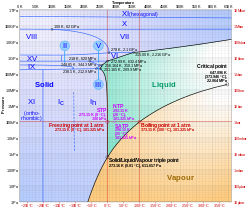
Blue is solid - Maybe not helium (does solid helium exist at all?); but high pressure can solidify most substances. — Tonymec (talk) 06:39, 1 February 2021 (UTC)
- P.S. Even helium can be solidified but not at atmospheric pressure regardless of temperature. According to the page Helium a pressure of 2.5 MPa (25 bar) is required at about 1 to 1.5 K, or about 114,000 atm at room temperature. Tonymec (talk) 06:51, 1 February 2021 (UTC)
- Maybe not helium (does solid helium exist at all?); but high pressure can solidify most substances. — Tonymec (talk) 06:39, 1 February 2021 (UTC)
- It will solidify that too, see Ice#Phases, Graeme Bartlett (talk) 22:00, 29 August 2012 (UTC)
- cough except for water cough --Nickotte (talk) 19:34, 29 August 2012 (UTC)

Wrong space group in source
[edit]The article currently talks about γ-phase of oxygen being Pm3m (No. 221), citing a paper from the MDPI journal oxygen. But the paper has a typo, the space group is Pm3n (No. 223), as comparison with the A15 structure should make clear. See also and . 〈 Forbes72 | Talk 〉 02:21, 23 November 2023 (UTC)