


Talk:Romanians
Add topic | This article is rated B-class on Wikipedia's content assessment scale. It is of interest to the following WikiProjects: | ||||||||||||||||||||||||||||||||||||||||||||||||||||||||||||||
| |||||||||||||||||||||||||||||||||||||||||||||||||||||||||||||||


,_early_1900s,_Central_Africa,_Democratic_Republic_of_the_Congo,_Pende_people,_wood,_fiber_-_Cleveland_Museum_of_Art_-_DSC08700.JPG)
 | Romanians was a good articles nominee, but did not meet the good article criteria at the time. There may be suggestions below for improving the article. Once these issues have been addressed, the article can be renominated. Editors may also seek a reassessment of the decision if they believe there was a mistake. | |||||||||
| ||||||||||

Romanians are a nationality not a ethnic group.
[edit]Any race can be Romanian. There is black Romanians, Chinese Romanians, Jewish Romanians and many Gypsy Romani Romanians. Most Romanians are of Roma (Gypsy) ethnicity born in Romania. Roma Gypsies are the fastest growing ethnic group in Romania. Jews are historically from Romania too. Please remove or change Romanians the first sentence stating that Romanian is a ethnic group. Romanian is a nationality. — Preceding unsigned comment added by 45.145.4.233 (talk) 08:09, 28 June 2022 (UTC)
- Whoever unsigned coward wrote this should take his pill. Romanian is a term which denotes both the nationality and the ethnicity. And no, most Romanians are not of Rromani (or Gypsy) ethnicity. This is clearly proven by many genetic tests for larger population cohorts/groups. For your reference, there are also Hungarian Romanians and German Romanians. We are all more or less intermixed, if you ever had the slightest interest on delving into genetics a bit, so there is no such thing as a pure race. Welcome to the real world (a brief introduction coupled with scientific facts as well). Rosenborg BK Fan (talk) 10:44, 9 February 2023 (UTC)
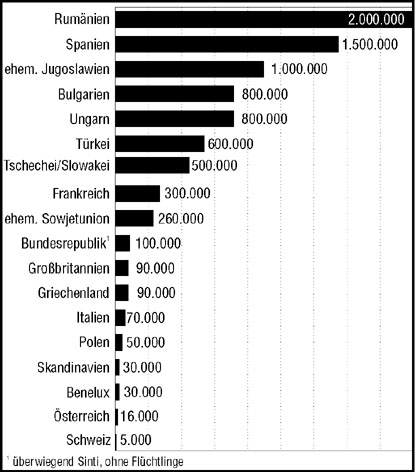
- I totally agree with you @Rosenborg BK Fan. When I read "Most Romanians are of Roma (Gypsy) ethnicity born in Romania" I couldn't believe my eyes. How about Gypsies from Spain? Gitanos (estimated 720,000-1,500,000) [1][2][3][4]
- Or Romani Americans (est. 1,000,000)? The Romani or Roma are a nomadic ethnic group, commonly known as Gypsies, who have been in the Americas since the first Romani people reportedly arrived on Christopher Columbus’ third voyage in 1498.[5][6]
- This user @45.145.4.233 is cunning. Trying to sound "leftist" to seem that what he just said is in good faith but it's actually only masked as such, but it's actually written in bad faith aka vandalism on wikipedia, in order to insult Romanians (taunting , baiting and lying as per Wikipedia:Civility#Identifying incivility). Genetically and linguistically Roma people originated in the Indian subcontinent; in particular, the region of Rajasthan. [7][8][9][10][11] The Roma began to leave India about 1,000 years ago. They most likely left to escape the invasion of Afghan general Mahmud of Ghazni early in the 11th century. Mahmud's troops probably pushed the Roma out of northern India and into the area that is now Pakistan, Afghanistan, and Iran.[12] The Roma people arrived in Europe around the 14th century.[13]
- According to a triple analysis – autosomal, mitochondrial and paternal — of available data from large-scale studies, the whole genome SNP data situates Romanians are most closely related to Bulgarians, Macedonians, followed by other European populations, which form a coherent cluster among worldwide populations.[14]
- Most West Slavs, Hungarians, and Austrians were found to share as many identical by-descent DNA segments with South Slavs as with Romanians, Torbeshi and Gagauzes.[15]
- In 2021, the largest genetic genealogy company in the world, Ancestry.com, contradicted the 2017 study based on more recent genetic findings, placing Romania (including Transylvania), Hungary and Slovakia (in Central Europe) in the Balkan DNA region: "Formally Romania and Hungary were not considered part of the region but they now are considered Balkan in terms of their DNA." Slovakia was also included in the Balkan DNA region.[16]
- So no, genetically most ethnic Romanians are not Roma/Gypsies. Like you said: " Romanian is a term which denotes both the nationality and the ethnicity." The ethnicity of Romanians is not Roma (old term: Gypsy). Ninhursag3 (talk) 19:19, 27 April 2023 (UTC)
- Thank you very much for your comment! I will get back to you with a more detailed response later today. And also, that is not to say that we have something against the Romani people (I on the contrary). At the same time, the respective edit was done by someone who did not even register as a user on Wikipedia, and therefore should all the more not be taken that much seriously (at least by some like you and me). All the best! Rosenborg BK Fan (talk) 04:57, 28 April 2023 (UTC)
- Indeed, very thorough and well-organised comment! Much respect for it! As for the genetics, it is as you mentioned as per my understanding and documentation as well. Also, I think that it would be counterproductive to focus more on that comment on that thread. I think a wise and intelligent decision would be to leave the discussion as it is at this point because we are both scientifically and encyclopaedically correct. Best regards! Rosenborg BK Fan (talk) 06:56, 28 April 2023 (UTC)
- Of course, what I wrote was in good faith and I see positive things in all ethnicities, including the Roma/Gypsies. I only brought genetic and historic facts without insulting the Roma in anyway. My sister's highschool English teacher was a teacher of Roma descent and she was/is very admired by her students. The facts say that in all regards: genetically, geographically, linguistically, historically and culturally the Roma/Gypsies are different from Romanians and that's not a good or a bad thing. It's a netural fact of life like breathing air is a neutral fact of life. Ninhursag3 (talk) 07:34, 28 April 2023 (UTC)
- Yes, you are correct, neutrally and encyclopaedically. All the best here on Wikipedia and in general! I wish you happy editing and plenty of positive experiences and edits here! Much respect once again! Rosenborg BK Fan (talk) 11:17, 28 April 2023 (UTC)
- Thank you so much, hope you'll reply to my new comment on the German versions of Romanians wikipedia page. Best regards ^^ Ninhursag3 (talk) 11:22, 28 April 2023 (UTC)
- I certainly will! All the best and keep up the good work! You can see the threads that I started there as well. For example, I previously added the fact that Romanians and Italians are related (genetically as well, as a fun/trivia fact I'm mostly Italian per my recent genetic test), but it was deleted... I will add references next time... Hopefully, that information won't be deleted, but even with reliable references it can be (from my personal experience). It's sad but it's true as well... Rosenborg BK Fan (talk) 11:53, 28 April 2023 (UTC)
- Genetically, Romanians are closest to Bulgarians and Macedonians. I'm sure you know that the Dacians were a sub-group of the Thracians (the region where Thracians lived is now Bulgaria) so it makes sense. Romanian is a Latin/Romance language but trying to prove we're very close to Italians genetically when genetically we're the closest to Bulgarians and Macedonians seems superfluous to me. In antiquity Thracians and Dacians were known for having red and light hair. Bulgarians aren't less white than other Europeans, even if the rulers were ethnic Turkic people/Bulgars, the majority of the population was Slavic (formerly Scythian) and Balkan (formerly Thracian). Also I was very suprised when I read you wrote "my country and home region (i.e. Bukovina)". Bukovina is indeed a region but not a country, even if you did a DNA test and have some Italian blood the truth is that your home country is Romania, not Bukovina and you're Romanian from the region of Bukovina. You should be proud of being Romanian ^^ My grandfather was Hungarian/Székely from Harghita but you don't see me jumping up and down of how special and non-Romanian I am. Best regards <3 Ninhursag3 (talk) 12:13, 28 April 2023 (UTC)
- I meant Romania and Bukovina, respectively, I apologise if I let myself be misunderstood. It was meant in that order. Genetically, I am mostly Italian. And yes, of course I know about the Dacians. And yes, you are right about the genetic similarities between Romanians and South Slavs, that is also factually correct. But, historically, since the Roman conquest, Romanians are also related to the Italians (also per larger genetic studies). In this regard, please see: https://www.romania-insider.com/new-genetic-map-of-the-world-shows-romanians-ties-to-lithuanian-finnish-south-italian (this article seems interesting because it sort of explains why I am a bit Finnish as well, according to my genetic test). All the best! Rosenborg BK Fan (talk) 12:22, 28 April 2023 (UTC)
- P.S.: I am not a nationalist, but I respect my home country as best as I can, in as many contexts as I can, here as well (while adhering and striving to respect the rules of neutrality and factual accuracy of Wikipedia, at the same time). Truth was it was a bit peculiar for me to discover an overwhelming Italian ancestry, but it was a very positive surprise I must admit. And a significant German one as well... Rosenborg BK Fan (talk) 12:26, 28 April 2023 (UTC)
- It's not so strange hearing about your DNA. Romania in the 19th century especially after the Unification of Moldavia and Wallachia in 1859 and the first half of the 20th century had many immigrants looking for better work conditions and better pay. And as a new kingdom, the Kingom of Romania was an ideal place to set up shop and start businesses. Case and point, the famous painter Romanian Nicolae Grigorescu (1838-1907) was an apprentice at the workshop of the Czech painter Anton Chladek (who migrated to Romania). The case of Anton Chladek is not an isolated one. Best regards, we will continue this discussion on your page. Ninhursag3 (talk) 13:29, 28 April 2023 (UTC)
- I know the history of the Kingdom of Romania very well! Thank you for mentioning more on the early history of the Romanian kingdom. It is best however to continue to continue this topic, if you wish, that is, on my discussion page! Regardless of those trivia facts regarding my ancestry (genetically speaking), the genetics' section of this article can and must be improved (I previously did that as well) and I am willing and intend to do that in the future as well. I hope I will be able to improve it. All the best! Rosenborg BK Fan (talk) 13:50, 28 April 2023 (UTC)
- I hope you will be let by those German admins to improve the German page as well but is seem unlikely since they just don't respond and refuse to improve the article. You should show them these messages and let them known how we Romanians are disappointed at their lack of quality in their wikipedia articles and their admins. Ninhursag3 (talk) 14:20, 28 April 2023 (UTC)
- This feels repetitive, but please read WP:NOTFORUM. This conversation should not be on an article talk page. From the policy page:
bear in mind that article talk pages exist solely to discuss how to improve articles; they are not for general discussion about the subject of the article
and indeed are not there for discussing other pages in other wikiprojects. Sirfurboy🏄 (talk) 14:27, 28 April 2023 (UTC)- You are right, I agree! If @Ninhursag3 want to discuss this subject more in-depth she should feel free to do so on my discussion page, wholeheartedly. All the best! Rosenborg BK Fan (talk) 14:29, 28 April 2023 (UTC)
- That wouldn't influence their turn of mind anyhow, unfortunately. They don't seem so sensitive at how other users or readers feel... that's life. But, on the brighter side of things, more and more of my edits are approved there, so that's quite a new beginning. We'll see what happens in the future... Hopefully for good. All the best! Rosenborg BK Fan (talk) 14:28, 28 April 2023 (UTC)
- This feels repetitive, but please read WP:NOTFORUM. This conversation should not be on an article talk page. From the policy page:
- I hope you will be let by those German admins to improve the German page as well but is seem unlikely since they just don't respond and refuse to improve the article. You should show them these messages and let them known how we Romanians are disappointed at their lack of quality in their wikipedia articles and their admins. Ninhursag3 (talk) 14:20, 28 April 2023 (UTC)
- I know the history of the Kingdom of Romania very well! Thank you for mentioning more on the early history of the Romanian kingdom. It is best however to continue to continue this topic, if you wish, that is, on my discussion page! Regardless of those trivia facts regarding my ancestry (genetically speaking), the genetics' section of this article can and must be improved (I previously did that as well) and I am willing and intend to do that in the future as well. I hope I will be able to improve it. All the best! Rosenborg BK Fan (talk) 13:50, 28 April 2023 (UTC)
- I meant Romania and Bukovina, respectively, I apologise if I let myself be misunderstood. It was meant in that order. Genetically, I am mostly Italian. And yes, of course I know about the Dacians. And yes, you are right about the genetic similarities between Romanians and South Slavs, that is also factually correct. But, historically, since the Roman conquest, Romanians are also related to the Italians (also per larger genetic studies). In this regard, please see: https://www.romania-insider.com/new-genetic-map-of-the-world-shows-romanians-ties-to-lithuanian-finnish-south-italian (this article seems interesting because it sort of explains why I am a bit Finnish as well, according to my genetic test). All the best! Rosenborg BK Fan (talk) 12:22, 28 April 2023 (UTC)
- Genetically, Romanians are closest to Bulgarians and Macedonians. I'm sure you know that the Dacians were a sub-group of the Thracians (the region where Thracians lived is now Bulgaria) so it makes sense. Romanian is a Latin/Romance language but trying to prove we're very close to Italians genetically when genetically we're the closest to Bulgarians and Macedonians seems superfluous to me. In antiquity Thracians and Dacians were known for having red and light hair. Bulgarians aren't less white than other Europeans, even if the rulers were ethnic Turkic people/Bulgars, the majority of the population was Slavic (formerly Scythian) and Balkan (formerly Thracian). Also I was very suprised when I read you wrote "my country and home region (i.e. Bukovina)". Bukovina is indeed a region but not a country, even if you did a DNA test and have some Italian blood the truth is that your home country is Romania, not Bukovina and you're Romanian from the region of Bukovina. You should be proud of being Romanian ^^ My grandfather was Hungarian/Székely from Harghita but you don't see me jumping up and down of how special and non-Romanian I am. Best regards <3 Ninhursag3 (talk) 12:13, 28 April 2023 (UTC)
- I certainly will! All the best and keep up the good work! You can see the threads that I started there as well. For example, I previously added the fact that Romanians and Italians are related (genetically as well, as a fun/trivia fact I'm mostly Italian per my recent genetic test), but it was deleted... I will add references next time... Hopefully, that information won't be deleted, but even with reliable references it can be (from my personal experience). It's sad but it's true as well... Rosenborg BK Fan (talk) 11:53, 28 April 2023 (UTC)
- Thank you so much, hope you'll reply to my new comment on the German versions of Romanians wikipedia page. Best regards ^^ Ninhursag3 (talk) 11:22, 28 April 2023 (UTC)
- Yes, you are correct, neutrally and encyclopaedically. All the best here on Wikipedia and in general! I wish you happy editing and plenty of positive experiences and edits here! Much respect once again! Rosenborg BK Fan (talk) 11:17, 28 April 2023 (UTC)
- Thank you very much for your comment! I will get back to you with a more detailed response later today. And also, that is not to say that we have something against the Romani people (I on the contrary). At the same time, the respective edit was done by someone who did not even register as a user on Wikipedia, and therefore should all the more not be taken that much seriously (at least by some like you and me). All the best! Rosenborg BK Fan (talk) 04:57, 28 April 2023 (UTC)
- Only if this is done for every other ethnic group in Europe on Wikipedia where ethnicity and mationality match.
- So this is the list
- Albanians
- Belarus
- Bulgarians
- Croats
- Czechs
- Danes
- Dutch
- Estonians
- Finns
- Germans
- Greeks
- Hungarians
- Italians
- Icelanders
- Irish
- Latvians
- Lithuanians
- Macedonians
- Maltese
- Montenegrins
- Norwegians
- Poles
- Portuguese
- Romanians
- Slovaks
- Slovenians
- Serbians
- Spaniards
- Swedes
- Turks
- You can start with letter A Albanians 178.221.76.14 (talk) 00:38, 8 August 2023 (UTC)
- Romanian is both an ethnicity and a nationality. 87.13.120.58 (talk) 16:54, 15 July 2025 (UTC)
References
- ↑ "Diagnóstico social de la comunidad gitana en España" (PDF). Msc.es. Archived from the original (PDF) on 2017-10-10. Retrieved 2016-05-21.
- ↑ "Estimations" (JPG). Gfbv.it. Retrieved 2016-05-21.
- ↑ "The Situation of Roma in Spain" (PDF). Open Society Institute. 2002. Archived from the original (PDF) on 1 December 2007. Retrieved 15 September 2010.
The Spanish government estimates the number of Gitanos at a maximum of 650,000.
- ↑ Recent Migration of Roma in Europe, A study by Mr. Claude Cahn and Professor Elspeth Guild, page 87-8 (09.2010 figures)
- ↑ "Romani Realities in The United States" (PDF). Harvard University. November 24, 2020. Retrieved December 10, 2020.
- ↑ Deutsch, James (April 8, 2022). "Romani Rights and the Roosevelts: The Case of Steve Kaslov". Smithsonian Institution. Retrieved May 25, 2022.
- ↑ Marinov, Aleksandar G. (2019-10-03). Inward Looking: The Impact of Migration on Romanipe from the Romani Perspective. Berghahn Books. p. 31. ISBN 978-1-78920-362-2.
It is unclear what made this people leave the Indian sub-continent but they are generally believed to have originated from central India, possibly in the modern Indian state of Rajasthan, migrating to the northwest around 250 BC.
- ↑ Hancock 2002, p. xx: 'While a nine century removal from India has diluted Indian biological connection to the extent that for some Romani groups, it may be hardly representative today, Sarren (1976:72) concluded that we still remain together, genetically, Asian rather than European'
- ↑ Simon Broughton; Mark Ellingham; Richard Trillo (1999). World Music: Africa, Europe and the Middle East. Rough Guides. p. 147. ISBN 978-1-85828-635-8. Retrieved 8 December 2015.
- ↑ Silverman, Carol (2012-05-24). Romani Routes: Cultural Politics and Balkan Music in Diaspora. OUP USA. p. 49. ISBN 978-0-19-530094-9.
- ↑ Snodgrass, Mary Ellen (2016-08-08). The Encyclopedia of World Folk Dance. Rowman & Littlefield. p. 260. ISBN 978-1-4422-5749-8.
- ↑ "Migrations of the Romani People" (PDF).
- ↑ Kenrick, Donald (5 July 2007). Historical Dictionary of the Gypsies (Romanies) (2nd ed.). Scarecrow Press. p. xxxvii. ISBN 978-0-8108-6440-5.
- ↑ Kushniarevich, Alena; Utevska, Olga; Chuhryaeva, Marina; Agdzhoyan, Anastasia; Dibirova, Khadizhat; Uktveryte, Ingrida; Möls, Märt; Mulahasanovic, Lejla; Pshenichnov, Andrey; Frolova, Svetlana; Shanko, Andrey; Metspalu, Ene; Reidla, Maere; Tambets, Kristiina; Tamm, Erika; Koshel, Sergey; Zaporozhchenko, Valery; Atramentova, Lubov; Kučinskas, Vaidutis; Davydenko, Oleg; Goncharova, Olga; Evseeva, Irina; Churnosov, Michail; Pocheshchova, Elvira; Yunusbayev, Bayazit; Khusnutdinova, Elza; Marjanović, Damir; Rudan, Pavao; Rootsi, Siiri; et al. (2015). "Genetic Heritage of the Balto-Slavic Speaking Populations: A Synthesis of Autosomal, Mitochondrial and Y-Chromosomal Data". PLOS ONE. 10 (9): e0135820. Bibcode:2015PLoSO..1035820K. doi:10.1371/journal.pone.0135820. PMC 4558026. PMID 26332464.
{{cite journal}}: CS1 maint: article number as page number (link) "Most South Slavs are separated from the rest of the Balto-Slavic populations and form a sparse group of populations with internal differentiation into western (Slovenians, Croatians and Bosnians) and eastern (Macedonians and Bulgarians) regions of the Balkan Peninsula with Serbians placed in-between... Furthermore, Slovenians lie close to the non-Slavic-speaking Hungarians, whereas eastern South Slavs group is located together with non-Slavic-speaking but geographically neighboring Romanians and, to some extent, with Greeks." - ↑ Cite error: The named reference
slavwas invoked but never defined (see the help page). - ↑ "What is the Balkans DNA Ethnicity on Ancestry?". namecensus.com. September 2021. Retrieved 4 April 2023.
Historiography section
[edit]In all fairness, what is that, for real? Should it even be there? The impression I get from reading it is that it was on purpose placed there and that is biased. Any thoughts?
Any thoughts please on this? Thank you very much in advance!
Genetics section
[edit]Regarding these studies. I need a direct quote within the reference brackets (not the main text) to verify them as they go against mainstream genetic findings.
In your edit summary you basically say the whole new section you added is WP:Original research. (Wikipedia doesn't want direct quotes but to explain scientific data but now you don't want scientific data explained from studies used as source reference) RF354 (talk) 08:03, 4 September 2024 (UTC)
- Well, friend, it is hard to distinguish between Romanians and Hungarians based upon their DNA, and even harder to distinguish between Romanians and Bulgarians. I speak of 21st century people. tgeorgescu (talk) 09:16, 4 September 2024 (UTC)
- But
modern Bulgarians, highlighting highest resemblance between them and Romanians, Northern Italians and Northern Greeks?
This seems to be a rough generalization and WP:Original Research. RF354 (talk) 09:43, 4 September 2024 (UTC)
- But
Vlachs
[edit]Sometimes Vlachs means Wallachians. But some other times it does not. It's murky. tgeorgescu (talk) 19:57, 26 March 2025 (UTC)
- I think one way of putting it is "all Romanians were Vlachs, but not all Vlachs were Romanians." Aristeus01 (talk) 20:52, 26 March 2025 (UTC)
- My point: the word "Vlachs" is ambiguous. Usually, when Romanians say "Vlachs" (Vlahi) they mean some other ethnicity than Romanians (Valahi). And even then, Wallachians only mean Romanians from one province of Romania. So, for supporting or rejecting the use of "Vlachs", it has to be clear what the source means by such a word. tgeorgescu (talk) 20:58, 26 March 2025 (UTC)
The 2023 study on balkan genetics
[edit]Are you aware how QPADM models work? that study is unreliable and i can easily show you why 86.124.128.55 (talk) 15:39, 19 October 2025 (UTC)
- Hi, please read: Wikipedia:No original research and Wikipedia:Identifying reliable sources (medicine). An ordinary IP-user can not prove that such source is unreliable. If you want, bring it for discussion on Wikipedia:Reliable sources/Noticeboard. Jingiby (talk) 17:14, 19 October 2025 (UTC)
- User:86.124.128.55, please discuss here your ideas and do not edit-war. Cell is a peer-reviewed scientific journal. You can not just removing the study, claiming it is unreliable and Slavic propaganda. The chef of the equip Iñigo Olalde is a Basque, i.e. Research Fellow at the BIOMICS research group, University of Basque Country. It includes a dozens of other researchers as: I.; Carrión, P.; Mikić, I.; Rohland, N.; Mallick, S.; Lazaridis, I.; Mah, M.; Korać, M.; Golubović, S.; Petković, S.; Miladinović-Radmilović, N.; Vulović, D.; Alihodžić, T.; Ash, A.; Baeta, M.; Bartík, J.; Bedić, Ž.; Bilić, M.; Bonsall, C.; Bunčić, M.; Bužanić, D.; Carić, M.; Čataj, L.; Cvetko, M.; Drnić, I.; Dugonjić, A.; Đukić, A.; Đukić, K.; Farkaš, Z.; Jelínek, P.; Jovanovic, M.; Kaić, I.; Kalafatić, H.; Krmpotić, M.; Krznar, S.; Leleković, T.; M. de Pancorbo, M.; Matijević, V.; Milošević Zakić, B.; Osterholtz, A.J.; Paige, J.M.; Tresić Pavičić, D.; Premužić, Z.; Rajić Šikanjić, P.; Rapan Papeša, A.; Paraman, L.; Sanader, M.; Radovanović, I.; Roksandic, M.; Šefčáková, A.; Stefanović, S.; Teschler-Nicola, M.; Tončinić, D.; Zagorc, B.; Callan, K.; Candilio, F.; Cheronet, O.; Fernandes, D.; Kearns, A.; Lawson, A.M.; Mandl, K.; Wagner, A.; Zalzala, F.; Zettl, A.; Tomanović, Ž.; Keckarević, D.; Novak, M.; Harper, K.; McCormick, M.; Pinhasi, R.; Grbić, M.; Lalueza-Fox, C.; Reich, D., etc. David Reich (geneticist) for example is is known for his studies of population genetics of ancient humans, including their migrations and the mixing of populations. He is professor in the department of genetics at the Harvard Medical School. Jingiby (talk) 03:30, 20 October 2025 (UTC)
- B-Class European history articles
- Mid-importance European history articles
- All WikiProject European history pages
- B-Class Romania articles
- Top-importance Romania articles
- All WikiProject Romania pages
- B-Class Ethnic groups articles
- High-importance Ethnic groups articles
- WikiProject Ethnic groups articles
- B-Class Anthropology articles
- Mid-importance Anthropology articles
- Former good article nominees