


Talk:Rho
Add topic | This article is rated Start-class on Wikipedia's content assessment scale. It is of interest to the following WikiProjects: | ||||||||||||||||||||
| |||||||||||||||||||||


Wrong symbol for MATHEMATICAL SANS-SERIF BOLD ITALIC CAPITAL RHO
[edit]https://en.wikipedia.org/wiki/Rho#Mathematical_Rho There is a capital theta in the middle of rhos.
Well, I changed that...
ρ or ϱ
[edit]When ρ, when ϱ? --Abdull 14:31, 15 November 2007 (UTC)
- I am not an expert, but... summarising History of the Greek alphabet, modern lower case letters developed from cursive script. Here's a 6th-century example:
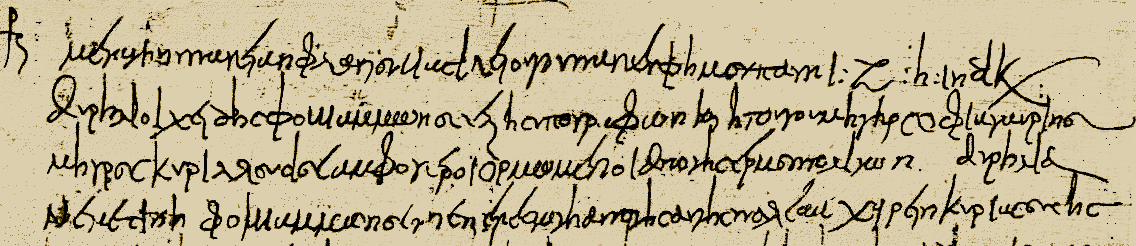
- Note that in this sample the tail of the rho in some instances goes downward-leftish, but in others bends to the top-right in the direction of the next letter.
- This script morphed into the more formal minuscule. Here's a 10th-centure sample:
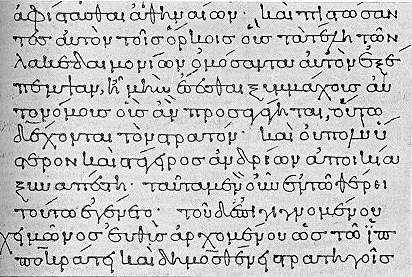
- Note that here the rho always goes downwards with the teensiest of little flicks to the top-right at the end, just a tiny serif.
- In this 15th-century sample the tail is sometimes shaped like in the 6th-century sample, but also sometimes as an extravagant swash:

- Early printers (mostly from the rest of Europe) imitated the cursive or minuscule style at first. This is from 1566 Swiss print:
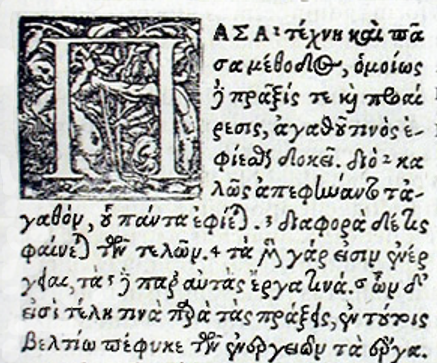
- Later on printers generally started to use more straight tails. Candara has a bit of vestigial curve: ρ Palatino and FreeSerif have a swash: ρ ρ Junicode has a comma-like swash: ρ (If any of these appear as ρ that font isn't installed on your computer.) FreeMono has a slab-serif: ρ (If it appears as ρ the font isn't installed.)
- The thing is, a lot of scientists who use the letter rho as a symbol are accustomed to it having a swash tail. (I remember that during my physics studies at university most people used a tailed rho for things like density. A straight rho in handwriting is very easily confused with a lower case p for pressure and both often appeared together in equations, so maybe that was part of the reason. But I suspect tradition played a major part as well.) So you've got a conundrum. Both (non-Greek) scientists and Greek writers use, let's say, Arial, in their documents. Greek writers want their rhos to be straight but a scientist might want it swashy. And that's where ϱ comes in: this displays with a swash tail in most fonts. But don't expect a Greek spellchecker to like it.
- And of course it can be a matter of preference and style, much like the shape of the a in Arial versus Futura.


Breathings over internal rho
[edit]"a double rho within a word is written with a smooth breathing over the first rho and a rough breathing over the second — ῤῥ"
In my own reading of ancient Greek texts I've never seen breathings over rhos within a word, e.g. ἔρραψα (Hdt. 9.17), nor have ever heard of such a convention. I don't want to remove it, if it actually holds for medieval manuscripts or something, but I'm dubious. Dd42 (talk) 23:14, 19 February 2008 (UTC)
Latex \Rho
[edit]In Latex, there is no \Rho. Also, I fixed the symbols to correspond with the actual Latex output —Preceding unsigned comment added by 128.6.168.245 (talk) 19:47, 29 February 2008 (UTC)
Plastic Number
[edit]Shouldn't the article have something about the letter's relation to the plastic number? Skittlesrgood4uTalk Page/Contributions/Sandbox 22:55, 6 March 2008 (UTC)
Pronunciation
[edit]We need an IPA pronunciation for this... Corovan (talk) 10:17, 28 November 2008 (UTC)
Momentum
[edit]Isn't rho also the symbol for momentum in physics?
Ashwin N (talk) 19:49, 15 July 2010 (UTC)
Nope, that's just p
71.109.146.251 (talk) 10:46, 3 December 2010 (UTC)
No he's right, it is rho and should be added to the list. My Uni text book says so — Preceding unsigned comment added by HobbsO (talk • contribs) 12:34, 25 February 2011 (UTC)
Move + histmerge
[edit]Up to 2004-05-08, the page at Rho was the page about the letter. It was cut-and-paste-moved to Rho (letter), and Rho was turned into a disambiguation page. I have now divided and re-merged the edit histories, moving the history of the disambiguation page to Rho (disambiguation), and merging the more recent history of Rho (letter) back into Rho, per WP:PRIMARYTOPIC. Fut.Perf. ☼ 22:42, 4 October 2010 (UTC)
R shaped Rho
[edit]The image on the page has a rho which looks the latin R. Is there a glyph for this?Naraht (talk) 15:38, 5 April 2017 (UTC)
- By "glyph", do you mean a separate Unicode codepoint? No, there isn't. What we do have here on Wikipedia, for purposes of articles like Archaic Greek alphabets, is a set of svg image files for all sorts of epigraphic letter shapes, which you can embed in text if you need them, like this:
 . See commons:Category:Greek epigraphic Rho for more variants. Fut.Perf. ☼ 15:52, 5 April 2017 (UTC)

Fixed vandalism
[edit]In 2007, this article was vandalized, but rather than remove the vandalism, it was changed to a different word which I have now removed. (I haven't yet confirmed that rho is used to represent the discount rate of future cash flows; it would be nice to have a reference.) S Philbrick(Talk) 15:46, 22 January 2025 (UTC)
- I have decided to remove the statement:
In economics to represent the discount rate of future cash flows
- Given that rho is one of "the greeks (Greeks (finance)), While admittedly one of the less important ones, it has a different meaning in finance and it seems very difficult to believe that it would be used for a different concept in economics which is not exactly finance but it's pretty darn close. Someone needs to find a good solid reference to support the assertion about the discount rate of future cash flows in order to return this statement to the list. S Philbrick(Talk) 22:23, 7 February 2026 (UTC)