Cloudflare fetched the original article and streamed it through HTMLRewriter to apply an entirely new visual system without rebuilding the source page.
This article is within the scope of WikiProject Statistics, a collaborative effort to improve the coverage of statistics on Wikipedia. If you would like to participate, please visit the project page, where you can join the discussion and see a list of open tasks.StatisticsWikipedia:WikiProject StatisticsTemplate:WikiProject StatisticsStatistics
Latest comment: 10 years ago1 comment1 person in discussion
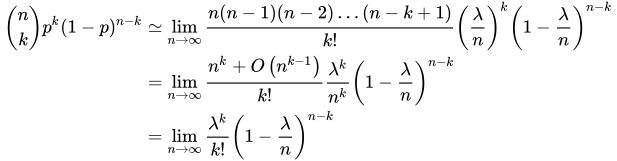
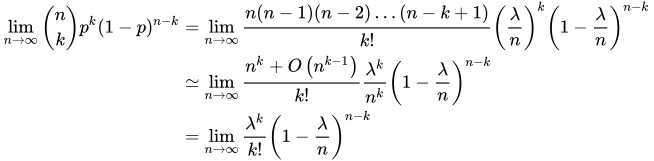
It's been a little hard for me to understand why this example is an application of the theorem, so I thought I could suggest an extra sentence explaining a intermediate step of reasoning for the not-so-much-into-the-field people like me. Something like:
"
Suppose that in an interval [0, 1000], 500 points are placed randomly. Now what is the number of points that will be placed in [0, 10]?
Intuitively, it will be most likely , but other amounts are possible too, so the number should be instead a distribution. More correctly phrased, the probabilistically precise way of describing the number of points in the sub-interval would be to describe it as a binomial distribution .
"
As I'm not sure whether it is worth to include such an impreciseness, I'm writing this in the talk page, asking for approval/rejection. But I think the implicit idea (expressed like this or in a better way) would be indeed useful.