


Talk:Neijin
Add topic | This article has not yet been rated on Wikipedia's content assessment scale. It is of interest to the following WikiProjects: | |||||||||||||||||
| ||||||||||||||||||


"Jing" or "Jin"?
[edit]I don't speak Chinese, but I've notice that other Wikipedia articles translate the 勁 character to pinyin as "jìn" (see Fa jin, jing). A web dictionary offers both jìn and jìng, jìn meaning "strength" (noun) and jìng meaning "sturdy" (adjective). If that's the distinction, then this article should be using "jin". That would also help prevent confusion with Jīng (精). Moismyname (talk) 02:29, 28 January 2011 (UTC)
- This article should be moved to "Nei Jin" - the term 勁 is pronounced Jin in mandarin. Perhaps more importantly, calling it Nei Jing mat create confusion with 内经, Nei Jing as in the Yellow Emperor's Internal Classic, Huang Di Nei Jing.Herbxue (talk) 17:20, 2 September 2011 (UTC)
- According to the MDBG entry, jing4 connotates "strong" and "powerful", as well as "sturdy". It doesn't seem like the correct pronounciation - if there is one - is obvious to native Chinese speakers either, so it might be best to go with the most common term appearing in the literature in recent times, until an expert can clarify? Destynova (talk) 13:02, 5 September 2011 (UTC)
- Agreed, this article should be moved to "Neijin". This is not controversial and should have been done long ago. Any Chinese dictionary will confirm that the noun form of 勁 is "jìn" without the "g". This article has many other problems, but at least we can stop confusing the world with this mispelling. I will attempt the move, which also requires deleting a redirect for "Neijin" that's in the way so this may take some time. Jōkepedia (talk) 21:47, 14 May 2024 (UTC)
- Article has been moved to "Neijin". Jōkepedia (talk) 15:01, 15 May 2024 (UTC)
kung fu "neijing" vs neigong "neijing"
[edit]Arnt they different?
~~Ted~~ 2607:FEA8:4A2:4100:D017:BDE4:D0DA:225F (talk) 20:27, 3 April 2023 (UTC)
- The new disambiguation page "Neijing" may contain the answer to your question. Jōkepedia (talk) 17:45, 15 May 2024 (UTC)
The Technical / Scientific Information Is Wrong
[edit]Whoever wrote this article presented a lot of technical / scientific information on how neijin works... all of it wrong. LOL!
That is NOT how neijin works. LOL!
Article writers need to stick to facts, not present opinions based on ignorance. 24.214.109.196 (talk) 00:16, 24 August 2025 (UTC)
- It may be a bit hard finding 'facts' on a fictional topic. The very concept of Qi is very clearly pseudoscience. But if there's some good source, please share.
- It might be good to remove some parts of the page as it seem unreliable. Anothercat613 (talk) 16:35, 4 November 2025 (UTC)
Qi, pseudoscience, or not?
[edit]@Jōkepedia Let's discuss the issue of whether Qi is involved or not. It seem like there's some disagreement on what Neijin is.
The source in the lead paragraph is unclear on how exactly Qi is used in Neijin. I've looked into the chinese version of the page. Most of the source there mentioned 氣 in some form. For example, '以心行氣' is mentioned in more than one source (like 十三勢行動心解 and 太極拳論). I've looked into 十三勢行動心解 and verified that it did indeed mention 以心行氣. Just to be certain, I checked baidu as well, making sure the text I found is indeed the original.
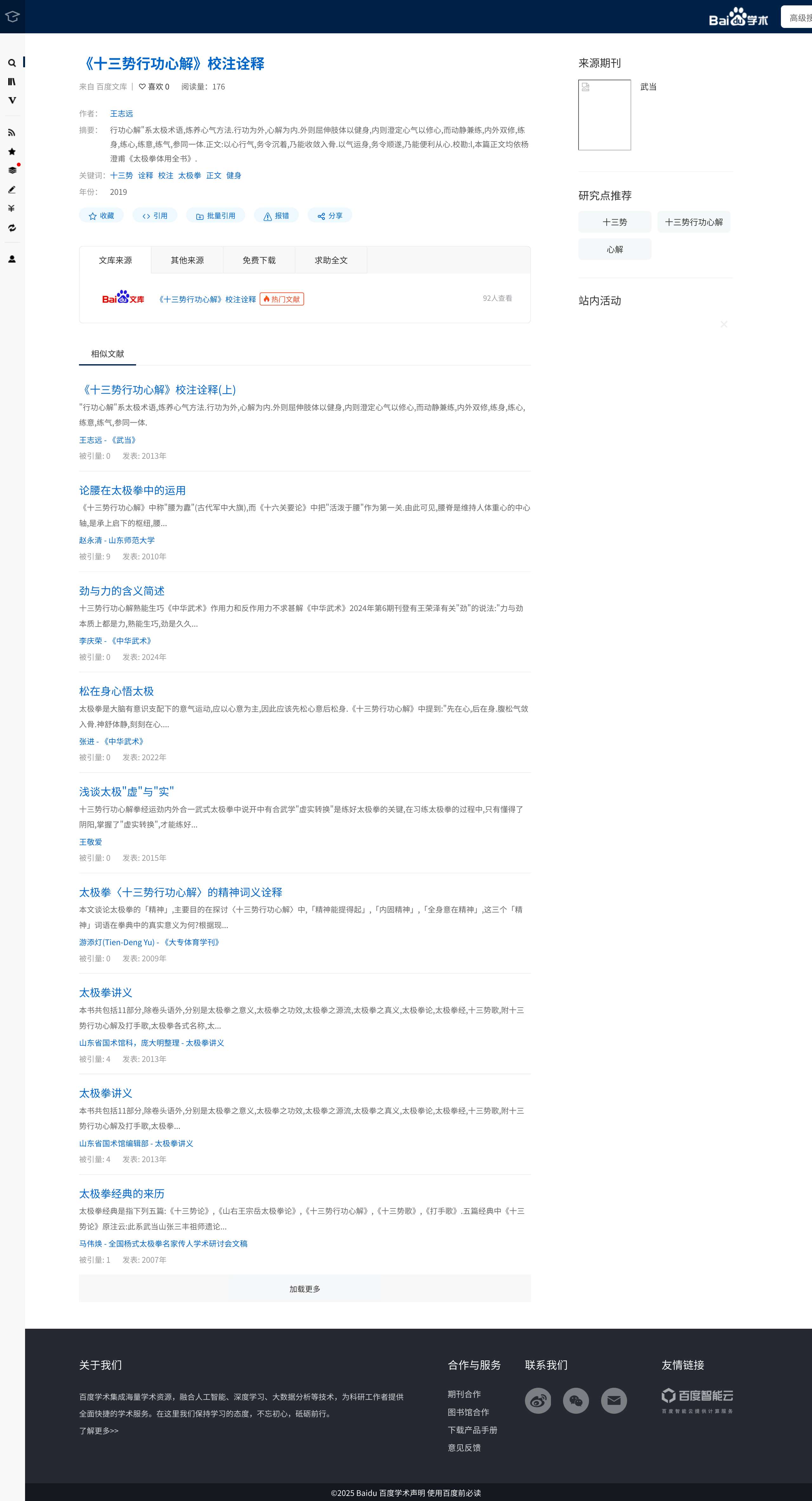
The exact text: 以心行氣,務令沉著,乃能收斂入骨;以氣運身,務令順遂,乃能便利從心
The chinese page even outright call Neijin 內氣. Though, it uses a book for source, but I'm unable to find a copy of the book online to verify if the source is true or not.
I believe it is fair to translate it '氣' as 'Qi' in this context. Removing Qi from the concept of Neijin seem like intentional crippling of chinese culture for easier consumption for western audience.
Multiple source on the page also mentioned Qi. While I have yet verify the sources are valid, it seems unfair to strike them all as unreliable without any proof.
If you can find source that prove Qi isn't involved, please cite. Anothercat613 (talk) 09:30, 5 November 2025 (UTC)