


Talk:List of Solar System objects by size
Add topic | List of Solar System objects by size (final version) received a peer review by Wikipedia editors, which was archived on 15 October 2022. It may contain ideas you can use to improve this article. |
 | This article is rated List-class on Wikipedia's content assessment scale. It is of interest to the following WikiProjects: | ||||||||||||||||||||||||||||||||||||
| |||||||||||||||||||||||||||||||||||||

.jpg)


EN131090
[edit]This page talks about a meteoroid designated EN131090, which has a diameter between 28.5 and 30 cm. Should it be included on this page or not? LobedHomunculus (talk) 19:38, 18 December 2025 (UTC)
- I don’t know if I’m qualified to say this, but I think yes. Fred1000000000 (talk) 14:15, 20 December 2025 (UTC)
- I just added it ~2026-13475-59 (talk) 00:07, 13 March 2026 (UTC)
Some stuff I did on my free time for TNOs and possible Dwarfs
[edit]I did this for no reason so use this if y’all want. The “-” objects are objects that aren't on the list and maybe should be, all the numbers are in radius and in km.
Albion - 68.75
- Arawn - 69.5
Chaos - 280
Varuna - 330.5
Ixion - 354.8
- Rhadamanthus - 90.75
Huya - 207.35
Typhon - 81
Lempo - 136
Quaoar - 548.8
- Deucalion - 85.75
Aya - 384
Uni - 329.5
Logos - 38.5
Ceto - 99.25
Borasisi - 65.7
Xewioso - 282.5
Sila-Nunam - 121.25
Teharonhiawako - 87.83
Sedna - 482.75
Orcus - 456.75
Goibniu - 340
Salacia - 425
Pluto - 1,188.3
Haumea - 798
Eris - 1,163
Makemake - 715
Rumina - 292
Ritona - 339.5
Altjira - 144.25
Varda - 370
- Mbabamwanawaresa - 91.717
Achlys - 386
Gonggong - 615
Gǃkúnǁʼhòmdímà - 321
Máni - 398
- Mors–Somnus - 112.4
Manwë - 75
- Otrera - 43.5
- Clete - 49.25
- Praamzius - 128
ǂKá̦gára - 69
Dziewanna - 278.5
- Taowu - 88.5
- Zhulong - 85.595
- Alicanto - 124
Arrokoth - 9.948
Chiminigagua - 371
Leleākūhonua - 110
- “Drac” - 38.5
“DeeDee” - 317.5
“Buffy” - 277.125
- “FarFarOut” - 200
“Farout” - 296.67
“Ammonite” - 150
“Biden” - 225
- “Caju” - 277
Chariklo - 124.8
Bienor - 86.83
Chiron - 98
- Thereus - 38.21125
- Asbolus - 39.110833
Hylonome - 36
Echeclus - 30
Okyrhoe - 24.5
Hidalgo - 28.4625
Pholus - 49.5
- Damocles - 7.5
Ceres - 469.7
Vesta - 262.7
Pallas - 256
Hygiea - 216.75
Interamnia - 166 Rocket Practice (talk) 11:15, 10 January 2026 (UTC)
- cool Homlos (Message me bro) 08:56, 7 April 2026 (UTC)
- btw, I really don't think radius under 200 km is a possible dwarf planet, but it's up to you Homlos (Message me bro) 13:57, 7 April 2026 (UTC)
A Commons file used on this page or its Wikidata item has been nominated for deletion
[edit]The following Wikimedia Commons file used on this page or its Wikidata item has been nominated for deletion:

Participate in the deletion discussion at the nomination page. —Community Tech bot (talk) 18:52, 22 January 2026 (UTC)

Does 'mean radius' mean volumetric?
[edit]Actual mean radius would be basically useless, so I'm assuming it's shorthand for volumetric, but wanted to be sure. (In our Jupiter ref, the 'mean' radius is not the mean of the radii, in either 2 or 3 dimensions, so that's what I suspect they mean.) — kwami (talk) 21:27, 25 February 2026 (UTC)
- I think some of them are volume equivalent radius but some aren't like those TNOs Homlos (Message me bro) 04:30, 15 March 2026 (UTC)
- Im not really sure too Homlos (Message me bro) 04:31, 15 March 2026 (UTC)
- But I think Jupiter one is the volume equivalent radius not area equivalent because if it's area equivalent then its radius should be 69126 km not 69886 km, but if it's volume equivalent diameter it should have axes of 71488×71431×66842 then it'd be a bit triaxial, but if it means mean radius then it should be 69165 km so Jupiter's 69886 km is not mean radius or area equivalent I guess this is Volume equivalent Homlos (Message me bro) 04:37, 15 March 2026 (UTC)
Someone is not using official names and refusing to let me put it in parentheses for the official name.
[edit]I added the Great Comet of 1811, but a user named @LobedHomunculus is reverting his name to not follow IAU terminology. He is deliberately forcing his nicknames to it, even if I revert it to the official name with parentheses for his nicknames, he is still going to say it is "unconstructive". I know, it was discovered by Honore Flaugergues, but this is before the system for comets to be named after the discoverer, and it doesn't even have a comet number. ~2026-13475-59 (talk) 17:56, 8 March 2026 (UTC)
- Please read the article for said comet. I am not "forcing a nickname onto the article," that's it's actual designation. I didn't come up with it. LobedHomunculus (talk) 18:00, 8 March 2026 (UTC)
- Also, I was talking about "Flaugergues", not C/1811 F1 ~2026-13475-59 (talk) 20:35, 8 March 2026 (UTC)
- After checking the Small Body Database Lookup, I'm not entirely sure if 'Flaugergues' is apart of its name, but C/1811 F1 is it's actual designation, so why not use that instead? LobedHomunculus (talk) 18:06, 8 March 2026 (UTC)
- Its because technicality is not consensus ~2026-13475-59 (talk) 20:33, 8 March 2026 (UTC)
- What do you mean? LobedHomunculus (talk) 20:34, 8 March 2026 (UTC)
- Well, I can not confirm the use of this nickname in databases. ~2026-13475-59 (talk) 21:07, 8 March 2026 (UTC)
- I already said that though.
- I won't continue this any further as I don't want to start an edit war. LobedHomunculus (talk) 21:08, 8 March 2026 (UTC)
- Its just not a edit war, its just a talk argument ~2026-13475-59 (talk) 23:27, 8 March 2026 (UTC)
- One final thing:
- Every other object in this article uses either their IAU names or scientific designations. It would make no sense to have C/1811 F1 as an exception here. Also, according to the Small Body Database Lookup and the Minor Planet Centre, the comet is officially named C/1811 F1 (Great comet). LobedHomunculus (talk) 16:58, 9 March 2026 (UTC)
- Its just not a edit war, its just a talk argument ~2026-13475-59 (talk) 23:27, 8 March 2026 (UTC)
- Well, I can not confirm the use of this nickname in databases. ~2026-13475-59 (talk) 21:07, 8 March 2026 (UTC)
- What do you mean? LobedHomunculus (talk) 20:34, 8 March 2026 (UTC)
- Its because technicality is not consensus ~2026-13475-59 (talk) 20:33, 8 March 2026 (UTC)
Some meteoroids
[edit]Hey @LobedHomunculus, @My planet is Homlos, is it okay if I add meteoroids? ~2026-13475-59 (talk) 22:53, 11 March 2026 (UTC)
- There are already several of them on the page. LobedHomunculus (talk) 23:19, 11 March 2026 (UTC)
- Like the ones without provisional designations like 2022 WJ1 or proper names like Duende ~2026-13475-59 (talk) 23:26, 11 March 2026 (UTC)
- I'm not sure, I'm not a master in editing My planet is Homlos (talk) 08:25, 12 March 2026 (UTC)
- I think you should ask someone like @Kwamikagami or @Renerpho My planet is Homlos (talk) 08:29, 12 March 2026 (UTC)
- I don't see why not, but then I'm not one of those policing this article.
- Personally, I think it would be interesting to see some examples of the really small stuff, even if this started out as a list of the largest objects in the SS. — kwami (talk) 08:32, 12 March 2026 (UTC)
- me too I don't see why not tbh My planet is Homlos (talk) 08:34, 12 March 2026 (UTC)
- Question: What do you mean by "ones without provisional designations"? How do you want to add them when they aren't known? Renerpho (talk) 08:45, 12 March 2026 (UTC)
- They're probably talking about objects that weren't given the typical provisional designations most minor planets get (e.g. 2014 UZ224 or 2012 VP113) LobedHomunculus (talk) 16:55, 12 March 2026 (UTC)
- @LobedHomunculus: There are a nearly infinite number of such objects hitting or missing Earth on a daily basis. Almost all of them aren't known as individual objects, and most of those that are probably shouldn't be in this list. It depends on what exactly we are talking about here.
- If the proposal is to turn this into a nondiscriminatory list of bolides (like 2026 Koblenz meteor) then I oppose strongly. If the proposal is to list some notable meteoroids that have been observed to nearly hit the Earth, but missed us, then I'd be okay with that. There aren't a lot of those. One such object, EN131090, is already in the list, but this is a Featured Article and for that reason alone I think it should be listed; but what else? Anything mentioned at Earth-grazing fireball#Known Earth-grazing fireballs? Renerpho (talk) 17:10, 12 March 2026 (UTC)
- Well then there should just be a small amount of notable meteroids (like EN131090). LobedHomunculus (talk) 17:30, 12 March 2026 (UTC)
- Thanks for EN131090. When I tried to get it to a red text, non-existent page 'link', it just sent me to this factory. Also for the image. ~2026-13475-59 (talk) 22:29, 12 March 2026 (UTC)
- Also, I have a proposal that this list doesn't go down below 10 centimeters (0.1 meters) in radius, because there are many ones, and it is too much for a single article. ~2026-13475-59 (talk) 22:32, 12 March 2026 (UTC)
- @~2026-13475-59: What would you like to include? Do you have a concrete example?
- The exact size of meteoroids is rarely known to better than within a factor of 2 or so, making it difficult to enforce a hard lower limit.
- Maybe it is better to base inclusion here on how notable the object is, and how much is known about the meteoroid. Maybe we should limit it to objects for which we have a Wikipedia article about the object that we can link to?
- We have a (very outdated) List of bolides, which hasn't really been updated since 2017. All the smaller events should probably go there. Renerpho (talk) 23:21, 12 March 2026 (UTC)
- IMO bolides should not be included, as they're no longer separate bodies in the SS. This should be for things with confirmed orbits. Lost bodies should not IMO be included. But if there's a 10-cm meteoroid with a confirmed orbit, sure, why not? — kwami (talk) 23:25, 12 March 2026 (UTC)
- @Kwamikagami: That's not an easy distinction to make.
They're no longer separate bodies in the SS
-- as are 2008 TC3, 2024 BX1 and 2022 WJ1, all of which are included in the table.Bolides should not be included
-- but EN131090 is (it still exists, and its pre- and post-encounter orbits are known). Renerpho (talk) 23:42, 12 March 2026 (UTC)- Whether EN131090 is a bolide is a matter of semantics. But we have a confirmed orbit, so that would fit my criteria. IMO the others should be moved to 'list of bolides'. But that is just a suggestion for what I think would merit inclusion. — kwami (talk) 00:40, 13 March 2026 (UTC)
- I tend to agree with you. I'd rather make this list shorter than longer, and would support removing anything that no longer exists (which includes the past impactors with MPC designations). I'd also remove things for which we have no way to give a reliable size estimate, like comet C/1811 F1. We have trouble determining the sizes of comet nuclei to within an order of magnitude with modern technology. There is no reason to assume that historic observations result in better estimates. Renerpho (talk) 01:10, 13 March 2026 (UTC)
- Re. C/1811 F1: The size estimate (15-20 km in radius) is based on absolute magnitude, which often leads to overestimation. Compare C/2013 A1, which was thought to have a diameter between 10 and 50 km based on absolute magnitude, which was later refined down to a range of 1 to 3 km. We now know that the comet has a diameter of about 0.4 km. The source for C/1811 F1's size estimate is Kronk, 1995, who is quoting even earlier estimates, and who wrote this before we knew anything concrete about comet nuclei. Renerpho (talk) 01:28, 13 March 2026 (UTC)
- As soon as any new estimates are made, this page may be updated to be more accurate if there is evidence to prove it on C/1811 F1 ~2026-13475-59 (talk) 01:55, 13 March 2026 (UTC)
- Re. C/1811 F1: The size estimate (15-20 km in radius) is based on absolute magnitude, which often leads to overestimation. Compare C/2013 A1, which was thought to have a diameter between 10 and 50 km based on absolute magnitude, which was later refined down to a range of 1 to 3 km. We now know that the comet has a diameter of about 0.4 km. The source for C/1811 F1's size estimate is Kronk, 1995, who is quoting even earlier estimates, and who wrote this before we knew anything concrete about comet nuclei. Renerpho (talk) 01:28, 13 March 2026 (UTC)
- I tend to agree with you. I'd rather make this list shorter than longer, and would support removing anything that no longer exists (which includes the past impactors with MPC designations). I'd also remove things for which we have no way to give a reliable size estimate, like comet C/1811 F1. We have trouble determining the sizes of comet nuclei to within an order of magnitude with modern technology. There is no reason to assume that historic observations result in better estimates. Renerpho (talk) 01:10, 13 March 2026 (UTC)
- Whether EN131090 is a bolide is a matter of semantics. But we have a confirmed orbit, so that would fit my criteria. IMO the others should be moved to 'list of bolides'. But that is just a suggestion for what I think would merit inclusion. — kwami (talk) 00:40, 13 March 2026 (UTC)
- @Kwamikagami: That's not an easy distinction to make.
- IMO bolides should not be included, as they're no longer separate bodies in the SS. This should be for things with confirmed orbits. Lost bodies should not IMO be included. But if there's a 10-cm meteoroid with a confirmed orbit, sure, why not? — kwami (talk) 23:25, 12 March 2026 (UTC)
- Also, I have a proposal that this list doesn't go down below 10 centimeters (0.1 meters) in radius, because there are many ones, and it is too much for a single article. ~2026-13475-59 (talk) 22:32, 12 March 2026 (UTC)
- Thanks for EN131090. When I tried to get it to a red text, non-existent page 'link', it just sent me to this factory. Also for the image. ~2026-13475-59 (talk) 22:29, 12 March 2026 (UTC)
- Well then there should just be a small amount of notable meteroids (like EN131090). LobedHomunculus (talk) 17:30, 12 March 2026 (UTC)
- They're probably talking about objects that weren't given the typical provisional designations most minor planets get (e.g. 2014 UZ224 or 2012 VP113) LobedHomunculus (talk) 16:55, 12 March 2026 (UTC)
Quick question.
[edit]Apparently while looking at sources, I noticed there were some objects that had proper names, like Hathor or Cardea, but apparently it hasn't made appearance in this table. Just try to correct the small text for minor planet numbers, because I use visual edit and spacings are messed up. ~2026-13475-59 (talk) 00:09, 13 March 2026 (UTC)
- I've fixed your entry for Nereus. I see no problems with the entries for Hathor and Cardea. Of course there are a lot of objects that have proper names, but which are not in this table; there is nothing wrong with that. Renerpho (talk) 00:31, 13 March 2026 (UTC)
- I know. Hathor and Cardea are just examples for my topic on the talk page. ~2026-13475-59 (talk) 01:56, 13 March 2026 (UTC)
Universe Guide's source for Sedna's mass? + Haumea and Titania switching places
[edit]Does anyone know where the Universe Guide gets its source for the Sedna mass estimate of "1.7x10²¹ to 6.1×10²¹ kg" (https://en.wikipedia.org/wiki/List_of_Solar_System_objects_by_size#Objects_with_radii_over_400_km , third paragraph)? IvarTheBoneless123 (talk) 03:50, 30 March 2026 (UTC)
- And I really dont know where the Universe Guide gets its source for the Sedna mass, they say 2.0 g/cm³ density is calculated but that's not possible Sedna has no moon, and if Sedna actually has (1.7–6.1)×10²¹ kg then its density need to be 4.37–15.67 g/cm³ based on a size of 906 km but there's no way that density is that absurd even if I use the early diameter estimates like 995 km its density would still need to be like 3.295 g/cm³ to reach a mass of 1.7×10²¹ kg, that's like mission impossible that's 35.64% higher than Eris's density, I kinda doubt if Universe Guide isn't even reliable, like 4.37–15.67 g/cm³ is super unrealistic, but if it's reliable then just keep using that because there's something called WP:VERIFIABILITY and WP:NOTTRUTH some policy Homlos (Message me bro) 00:22, 1 April 2026 (UTC)
- I just discovered that the ref says "1.7×6.1×10^21 kgkg" like why's there an extra "kg"? And they say it's based on "2.0 g/cm² g/cm³" Why's there 2 units? And it said Sedna temp is –12 K, it's actually supposed to be 12 k and not in negative, –12 K literally breaks the laws of physics Homlos (Message me bro) 04:22, 28 June 2026 (UTC)
- Also, that Universe Guide said that objects with bigger size have stronger gravity, which is not completely true, That Universe Guide probably thinks that Uranus has a stronger gravity than Earth when it's actually not, so that fact is not entirely true, And the mass is likely calculated from one of Sedna's diameter older estimates with 2.0 g/cm³, this is either outdated or unreliable Homlos (Message me bro) 04:28, 28 June 2026 (UTC)
- I think it's best to just delete that whole sentence about Sedna being this or that mass in the article. IvarTheBoneless123 (talk) 19:02, 30 June 2026 (UTC)
Also, someone should switch Haumea and Titania's places if we're using the ~780 km radius figure for Haumea - I don't know how without messing the table up. IvarTheBoneless123 (talk) 10:25, 30 March 2026 (UTC)
- Ok sorry I forgot to fix that Ill fix it now Homlos (Message me bro) 14:16, 31 March 2026 (UTC)
Discovery refs
[edit]Guys I have a question, do I need refs to prove that (in the main 400 km+ radius list in discovery column) their discoveries are that year? Homlos (Message me bro) 08:18, 16 April 2026 (UTC)
Expansion of the 100+ and 200+ km radius bodies list
[edit]Should we try and make the 100+ and 200+ km radius lists more like the 400+ km one? I'm aware that not all these bodies have determined masses yet, but neither does Sedna (which is in the 400+ km list).
Moreover, the above mentioned lists contain Mimas, Miranda and Enceladus which are planetary-mass objects.
And if such a decision is reached, I propose a 150+ km cut-off instead of 100+ km one, since Interamnia (with a radius of c. 166 km) seems to be the smallest object currently considered as a potential dwarf planet. IvarTheBoneless123 (talk) 14:06, 7 May 2026 (UTC)
- Yeah Ivar, I think we should expand 100–200 km radius list, objects of this size is pretty interesting and sometimes notable Homlos (Message me bro) 04:19, 28 June 2026 (UTC)
- I'd do it, but I suck at tables. And besides, it's probably best if someone else joined in on the discussion before making any radical changes. IvarTheBoneless123 (talk) 19:07, 30 June 2026 (UTC)
Eris new possible satellite
[edit]136199 Eris has a possible 1000 km moon orbiting every 18 hours, large enough to be in the main list. Should we wait for rather confirmation on its existence or place it in the list early? ~2026-35054-51 (talk) 00:27, 15 June 2026 (UTC)
- I don't think unconfirmed objects should be listed here LobedHomunculus (talk) 11:51, 15 June 2026 (UTC)
- Yes, if we include hypothetical bodies, there's also Theia and the Angrite parent body. That would require some discussion. — kwami (talk) 18:06, 15 June 2026 (UTC)
Removal of Neptunian irregular satellites
[edit]@Nrco0e, you removed Neptune's small irregular satellites from the list because they apparently do not have measured sizes. However, the second paragraph of the lede states that all named natural satellites are included. Should this be changed then, if Neptune's small irregular satellites are excluded from the list? Thirtyfourninety (talk) 21:30, 6 July 2026 (UTC)
- Oh shoot, I forgot about that. Well... considering that many named satellites are really small and don't have measured sizes, I think the paragraph should be changed so the list doesn't get cluttered. Nrco0e (talk • contribs) 21:33, 6 July 2026 (UTC)
- Well, alright then. It could be changed to only include named satellites with measured sizes. Removed satellites can be readded to the list if their sizes are formally measured. Thirtyfourninety (talk) 21:41, 6 July 2026 (UTC)
I heard that a person that didnt have a account crashed out after revertal of their edits.
[edit]After someone which i think is @Lobed Homunculus reverted someones edits, they crashed out, launching a personal attack here and on YouTube on him. I really feel bad that this world is so cruel, but i think the way to cheer him up is to readd those. But i think @Lobed Homunculus knows what he reverted, and i dont know if he even wants to fix someones smile that he got personal attacks from. I heard that their edits were adding two asteroids he favorited: (537) Pauly, and (12410) Donald Duck. But i think it is forgotten now. But he might be so happy if those were back one day. Even if the drama was 1 month ago, its worth making someone smile. (@Lobed Homunculus please reply with your answer) SomeoneThatYouSaw (talk) 16:37, 8 July 2026 (UTC)
- yeah I was the one who reverted the edits
- I don't really want to re add them because the user then made a defamatory wordpress site about me and refused to take it down Lobed Homunculus 17:00, 8 July 2026 (UTC)
- ok but whats the link to the site i wanna check if its still there SomeoneThatYouSaw (talk) 17:05, 8 July 2026 (UTC)
- It was located at https://getmesomehelp.wordpress.com/ but it has been taken down.
- The website when it was still up seemed to falsely accuse me of making the user suicidal, which is a very serious accusation for something this little. Lobed Homunculus 17:07, 8 July 2026 (UTC)
- ok but if it didnt take down due to reports that means HE DELETED IT (you will be so happy now i think) SomeoneThatYouSaw (talk) 17:11, 8 July 2026 (UTC)
- yes im glad its gone Lobed Homunculus 17:12, 8 July 2026 (UTC)
- i saw a post with that link 2 weeks ago and it was still there now its gone meaning he deleted it SomeoneThatYouSaw (talk) 17:13, 8 July 2026 (UTC)
- if your happy and you know it clap your hands *applause* SomeoneThatYouSaw (talk) 17:13, 8 July 2026 (UTC)
- yes im glad its gone Lobed Homunculus 17:12, 8 July 2026 (UTC)
- ok but if it didnt take down due to reports that means HE DELETED IT (you will be so happy now i think) SomeoneThatYouSaw (talk) 17:11, 8 July 2026 (UTC)
- ok but whats the link to the site i wanna check if its still there SomeoneThatYouSaw (talk) 17:05, 8 July 2026 (UTC)
Okay, its me again. So after i found that user that crashed out deleted his channel and deleted his website, should someone forgive him?
[edit]You remember the person who got mad for someone that reverted his edits? That person now has deleted his YouTube channel and that website. So if you will forgive him for deleting all of the defamatory stuff (though deleting the channel was unnecessary due to no one getting mad at him, and he deleted it a few weeks after the fight even started, which means he might have deleted it for other reasons), so im curious if @Lobed Homunculus even forgives him, or his changes are now in the bin forever. SomeoneThatYouSaw (talk) 10:52, 9 July 2026 (UTC)
- I don't really care about the situation that much
- Also please stop tagging me in random discussions that have nothing to do with the page they're on Lobed Homunculus 10:55, 9 July 2026 (UTC)
- okay
- R.I.P (537) Pauly, (12410) Donald Duck
- June 5th 2026 to June 7th 2026
- Forgotten and cannot be recovered
- (dont ask why i made a funeral lol) SomeoneThatYouSaw (talk) 11:51, 9 July 2026 (UTC)
Adding a section for max radius/length
[edit]I feel like using just a single average value for the object's radius can get a little misleading for irregularly-shaped objects, especially when we don't give any indication how elongated the object is, and whether we're using the area-equivalent or volume-equivalent radius. For this reason, I would like to suggest adding a new column for "max radius" (or should it be called "max length"? I don't want to confuse this with the uncertainty meaning for "maximum/upper bound mean radius"). This column would be placed to the right of the mean radius column, and you'd put the longest (or equatorial) semi-axis in the max radius/length column. I figured to not add a column listing all three a × b × c dimensions, as that would take up too much space and not many objects have well-known dimensions.
What do you think? Nrco0e (talk • contribs) 07:17, 19 July 2026 (UTC)
- This sounds good Homlos (Message me bro) 06:23, 23 July 2026 (UTC)
Contradictory data regarding the masses of non-planetary bodies
[edit]The parts-per-million chart at the beginning of the article claims that all bodies besides the Sun and the eight planets together account for 150 ppm, which is a lot more than the four solid planets (for example the Earth is 3 ppm).
On the contrary, the pie chart of the relative masses of all the solid bodies ("Graphical Overview" section) has the Earth accounting for nearly 48% of the total, the other bodies down to Pluto's size occupying the rest and objects smaller than Pluto not even being visible.
So which one is true? ~2026-33951-77 (talk) 08:07, 23 August 2026 (UTC)
- Both are true, what is the contradiction? Jacob Rampino (talk) 14:23, 24 August 2026 (UTC)
- In this chart: https://en.wikipedia.org/wiki/List_of_Solar_System_objects_by_size#/media/File:Solar_system_mass_distribution_ppm_chart.svg "all else" is 150 ppm, which is a lot.
- In this chart: https://en.wikipedia.org/wiki/List_of_Solar_System_objects_by_size#/media/File:Masses_of_Solid_Solar_System_bodies_en.svg
- Objects smaller than Mercury are a tiny portion, and objects smaller than Pluto aren't even visible.
- So I ask again, regarding the Solar System's satellites, minor planets and fragments, which one is true? Are they a fraction of the mass of the planets or many times more than that? ~2026-33951-77 (talk) 14:28, 26 August 2026 (UTC)
- Not all non-planetary mass is shown in the solid-body pie chart. It only plots individually measured solid objects, so smaller unmeasured bodies (most notably those within the Oort Cloud) can't be represented at all. The original NASA source behind the ppm chart groups satellites, comets, asteroids, meteoroids, and the interplanetary medium together as 0.015% of the solar system's mass, whereas the pie chart only accounts for the subset of that bucket that's actually been catalogued and measured. Jacob Rampino (talk) 15:54, 26 August 2026 (UTC)
- Well, the pie chart includes the most massive satellites and dwarf planets and omits all objects smaller than those due to scale, according to the description. And these dwarf planets make up a significant portion of the total mass of the Solar System's non-planetary debris (Asteroid Belt, Kuiper Belt, Centaurs, NEOs), which is a fraction of the mass of the planets.
- So unless NASA measured this percentage while taking into account a massive number of unknown or uncatalogued objects, I would take it with a grain of salt. I mean 0.015% of the Solar System's mass is more than half of the mass of Saturn or more than 1,5 times the mass of Uranus and Neptune. ~2026-33951-77 (talk) 18:42, 26 August 2026 (UTC)
- I'm just pointing out that it seems that the specific 150ppm figure comes directly from the NASA source. It seems that figure is grouping a collective of small objects, and that a subset of those objects are either small enough or are simply unknown such that they can't be displayed in the pie chart. A plausible explanation for this is the disputed but relatively large estimated size of the Oort Cloud. If you are dissatisfied with that explanation, then you can find reliable sources and fix it. Cheers! Jacob Rampino (talk) 20:17, 26 August 2026 (UTC)
- The thing is, NASA itself doesn't really provide any sources for that figure either. One would expect to see a specific calculation as a source or an explanation on how exactly do you get this much mass from bodies that haven't even been discovered. Instead we are supposed to take this figure as granted because NASA mentions in it an introductory article about the Solar System. https://science.nasa.gov/learn/basics-of-space-flight/chapter1-1/#hds-sidebar-nav-10 ~2026-48864-16 (talk) 19:43, 9 September 2026 (UTC)
- Then you are welcome to find a better source and fix it if you dispute NASA's reported ppm. Jacob Rampino (talk) 00:16, 11 September 2026 (UTC)
- The thing is, NASA itself doesn't really provide any sources for that figure either. One would expect to see a specific calculation as a source or an explanation on how exactly do you get this much mass from bodies that haven't even been discovered. Instead we are supposed to take this figure as granted because NASA mentions in it an introductory article about the Solar System. https://science.nasa.gov/learn/basics-of-space-flight/chapter1-1/#hds-sidebar-nav-10 ~2026-48864-16 (talk) 19:43, 9 September 2026 (UTC)
- I'm just pointing out that it seems that the specific 150ppm figure comes directly from the NASA source. It seems that figure is grouping a collective of small objects, and that a subset of those objects are either small enough or are simply unknown such that they can't be displayed in the pie chart. A plausible explanation for this is the disputed but relatively large estimated size of the Oort Cloud. If you are dissatisfied with that explanation, then you can find reliable sources and fix it. Cheers! Jacob Rampino (talk) 20:17, 26 August 2026 (UTC)
- Not all non-planetary mass is shown in the solid-body pie chart. It only plots individually measured solid objects, so smaller unmeasured bodies (most notably those within the Oort Cloud) can't be represented at all. The original NASA source behind the ppm chart groups satellites, comets, asteroids, meteoroids, and the interplanetary medium together as 0.015% of the solar system's mass, whereas the pie chart only accounts for the subset of that bucket that's actually been catalogued and measured. Jacob Rampino (talk) 15:54, 26 August 2026 (UTC)


2014 EZ51's diameter
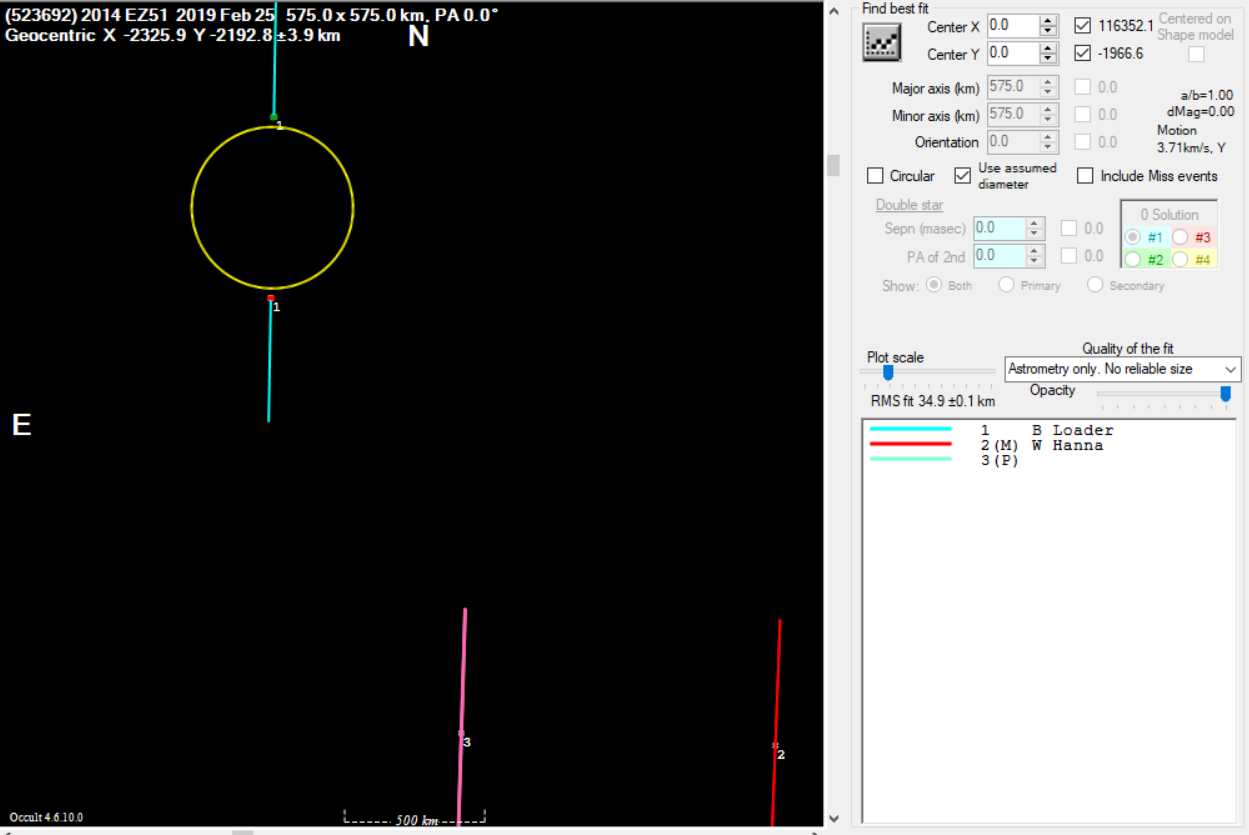
[edit]This website here 2014 EZ51 occultation — 2019-02-25 · SOSB / Lucky Star says that 2014 EZ51's diameter is over 1260 km, so should we change it? Fred1000000000 (talk) 15:19, 14 September 2026 (UTC)
- honestly I don't know, >575 km and >1260 km originated from the same Occultation I don't know which of them should be the main estimate Homlos (Message me bro) 08:23, 15 September 2026 (UTC)
- The >575 km Occultation image says minor axis:575.0 km major axis: 575.0 km, + there's text saying "Astrometry only No reliable size" which makes me wanna lean towards >1260 km one more but... >1260 km is absurd I don't know if that's valid or just a mistake made in that website, while Johnston's archive lists it as >1260 km makes me wanna lean towards the >1260 km web even more and he even listed the albedo as <0.03 Homlos (Message me bro) 08:28, 15 September 2026 (UTC)
- @Renerpho which estimate should we use Homlos (Message me bro) 08:33, 15 September 2026 (UTC)
- The occultation supports >575 km. I have no idea where the figure of 1260 km comes from, but I see no evidence for it. My guess is it's a mix-up of radius and diameter. Johnston's Archive is based on the Brazilian website, but as I said, that seems to be in error. Renerpho (talk) 13:16, 15 September 2026 (UTC)
- I've just emailed Johnston as well as the Rio Group. I'll let you know when they reply. Renerpho (talk) 13:24, 15 September 2026 (UTC)
- I have also emailed the Rio Group a few weeks (or more) ago, and they seem to not have emailed me back yet.... so at least Johnston replys always back fast. because I have sendt multiple emails to him before, and he reply's back pretty fast. Fred1000000000 (talk) 13:56, 15 September 2026 (UTC)
- Johnston has replied. He agrees that the figure of 1260 km is wrong, and says he will get that fixed. In the meantime there is no reason to make any changes to the table. Renerpho (talk) 17:39, 16 September 2026 (UTC)
- Great! Fred1000000000 (talk) 05:50, 17 September 2026 (UTC)
- Thanks Homlos (Message me bro) 08:27, 17 September 2026 (UTC)
- Should we still show the 1260 km figure in the 2014 EZ51 article? All should we wait for Rio Group's response before changing anything Homlos (Message me bro) 07:51, 18 September 2026 (UTC)
- I have tried to contact them before, but they don’t respond, I think we should just wait until Johnston’s archive’s response. Fred1000000000 (talk) 11:52, 18 September 2026 (UTC)
- Update* Fred1000000000 (talk) 11:52, 18 September 2026 (UTC)
- I see no reason to include it. Renerpho (talk) 20:35, 19 September 2026 (UTC)
- I have tried to contact them before, but they don’t respond, I think we should just wait until Johnston’s archive’s response. Fred1000000000 (talk) 11:52, 18 September 2026 (UTC)
- Johnston has replied. He agrees that the figure of 1260 km is wrong, and says he will get that fixed. In the meantime there is no reason to make any changes to the table. Renerpho (talk) 17:39, 16 September 2026 (UTC)
- I have also emailed the Rio Group a few weeks (or more) ago, and they seem to not have emailed me back yet.... so at least Johnston replys always back fast. because I have sendt multiple emails to him before, and he reply's back pretty fast. Fred1000000000 (talk) 13:56, 15 September 2026 (UTC)
- Old requests for peer review
- List-Class List articles
- Unknown-importance List articles
- WikiProject Lists articles
- List-Class Astronomy articles
- Mid-importance Astronomy articles
- List-Class Astronomy articles of Mid-importance
- List-Class Solar System articles
- High-importance Solar System articles
- Solar System task force
- List-Class Systems articles
- Low-importance Systems articles
- Systems articles in systems
- WikiProject Systems articles