


Talk:L-reduction
Add topic | This article is rated Start-class on Wikipedia's content assessment scale. It is of interest to the following WikiProjects: | |||||||||||||||||||||||||||
| ||||||||||||||||||||||||||||


untitled
[edit]I think that the property is false. we must write:
... there exists a polynomial ε-approximation algorithm for B then there also exists a polynomial δ-approximation algorithm for A where ...
You are correct.
[edit]The page has been fixed. Thanks for your comment :-)
Esoth, 26 May 2007, 22:23 CEST
Proof (or reference for the proof) of the property missing
[edit]Where is the proof/reference for that property? Note that the book of Papadimitriou just proves $\delta = \alpha \beta \epsilon / (1-\epsilon)$. —Preceding unsigned comment added by 130.149.15.224 (talk) 09:28, 8 April 2008 (UTC)
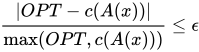
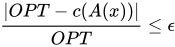
More references added. Do note that in Papadimitriou's book, an ε-approximation guarantees that (where c(A(x)) is the cost of the approximate solution) while the definition for Kann's thesis and the original paper (from the introduction), . —C. lorenz (talk) 00:23, 2 April 2009 (UTC)
Improve definition
[edit]The definition could be improved by adding the correct quantifiers to the last two items: "for any instance $x$ of $A$" and "for any instance $x$ of $A$ and any feasible solution $y$ of $R(x)$".
Should g also depend on x as well? see https://ocw.mit.edu/courses/electrical-engineering-and-computer-science/6-890-algorithmic-lower-bounds-fun-with-hardness-proofs-fall-2014/lecture-videos/lecture-10-inapproximabililty-overview/ — Preceding unsigned comment added by 192.159.178.211 (talk) 17:20, 10 January 2020 (UTC)