


Talk:Hydraulic conductivity
Add topic | This article is rated B-class on Wikipedia's content assessment scale. It is of interest to the following WikiProjects: | ||||||||||||||||||||
| |||||||||||||||||||||


Untitled
[edit]Article doesn't dicuss the hydrolic engineering aspect of the subject
Why does "Transmissivity" re-direct here?
Dimensions?
[edit]No info on dimensions and commonly used units, could be useful, non? — Preceding unsigned comment added by 91.195.112.2 (talk) 14:23, 1 October 2012 (UTC)
I agree. In particular engineers tend to reduce head in feet with volume in cubic feet, even though head is really a measure of pressure. I would suggest going to SI for the units.
This becomes volume (m^3) * length (M) / ( Area (m^2) * pressure (Newtons/m^2) * time (sec) ) = M^4/(N*sec)
Empirical estimation
[edit]The Shepherd (1989) reference should be supplemented with a reference to Hazen equations. —Preceding unsigned comment added by 52.129.8.47 (talk) 21:31, 17 July 2008 (UTC)
Agreed. The Hazen (1892, 1911) equation is . —Preceding unsigned comment added by 66.181.202.26 (talk) 21:43, 28 January 2009 (UTC)
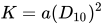
The note at the bottom of this section about and seems self-contradictory to someone learning about hydraulic conductivity. Is there a difference between and ? —Preceding unsigned comment added by Jeff39 (talk • contribs) 17:22, 7 August 2009 (UTC)


- Upper/lower case "d" for diameter does not matter. I'm not sure if one is more common than the other, but I'll change them to the uppercase "D".+mt 16:16, 9 August 2009 (UTC)
Dynamic Viscosity
[edit]There is a typo with regard to the units, it reads "kg m-1 s-1" and it should be "kg m-1s" —Preceding unsigned comment added by 76.5.12.125 (talk)
- No, not a typo. The former is correct. Check your source again. +mt 03:06, 29 December 2008 (UTC)
Experimental approach
[edit]Constant-head method
[edit]It appears you either skipped a step or assumed the reader would know the nomenclature.
Specifically, from the following two lines:

Using Darcy's Law, ,

you jump to this:
yields

While it's implicitly obvious (to a reader who can perform algebra), you don't explicitly state that .

You also didn't define (hydraulic gradient?) or state that it's dimensionless.

Please consider revising for clarity--QLFixBoy (talk) 16:50, 19 May 2009 (UTC)
- Accommodated the comments of QLFixBoy and added sections "Resistance" and "Anisotropy". R.J.Oosterbaan (talk) 23:27, 19 May 2009 (UTC)
- I may be wrong, but doesn't "Q" stand for flow (ex ft3/second) not quantity (ft3)? If so, time should not be included in the formula. Grk1011/Stephen (talk) 13:16, 4 November 2010 (UTC)
- In literature the symbol Q is generally used for quantity of flow per unit of time (discharge) indeed, but here it is clearly defined as a volume. One could consider to change the symbol Q in this article into V. - R.J.Oosterbaan (talk) 08:16, 6 November 2010 (UTC)
- I may be wrong, but doesn't "Q" stand for flow (ex ft3/second) not quantity (ft3)? If so, time should not be included in the formula. Grk1011/Stephen (talk) 13:16, 4 November 2010 (UTC)
Table of saturated hydraulic conductivity values
[edit]There appears to be an error in this table. The conversion factor between cm/sec and ft/day is about 3,000. The values here suggest a factor of 1,000.
I think that the table may have been mis-labeled; and that ft/day should actually be m/day.Davy p (talk) 10:27, 21 May 2011 (UTC)
- The table is intended to show relative orders of magnitude, not absolute magnitudes. The actual conversion from cm/sec → ft/day is 2.8346457×10³, and from cm/sec → m/day is 0.864×10³. These both round up/down to 103, but you are correct that m/day is closer by a small margin. I think the intent is to show both SI and imperial units. +mt 23:26, 22 May 2011 (UTC)
Hydraulic conductivity
[edit]Changed line Q = Av to Q/t = Av. I'm pretty sure flow velocity is flow rate / area as opposed to flow / area. — Preceding unsigned comment added by VikiSturmann (talk • contribs) 11:42, 23 July 2012 (UTC)