


Talk:Hurricane Camille
Add topic| This is the talk page for discussing improvements to the Hurricane Camille article. This is not a forum for general discussion of the subject of the article. |
Article policies
|
| Find sources: Google (books · news · scholar · free images · WP refs) · FENS · JSTOR · TWL |
| Archives: 1 |
 | This article is written in American English, which has its own spelling conventions (center, color, defense, realize, traveled) and some terms may be different or absent from other varieties of English. According to the relevant style guide, this should not be changed without broad consensus. |
 | Hurricane Camille is a featured article; it (or a previous version of it) has been identified as one of the best articles produced by the Wikipedia community. Even so, if you can update or improve it, please do so. | |||||||||||||||||||||||||||
 | This article will appear on Wikipedia's Main Page as Today's featured article on August 17, 2026. | |||||||||||||||||||||||||||
| ||||||||||||||||||||||||||||

| This article is rated FA-class on Wikipedia's content assessment scale. It is of interest to the following WikiProjects: | |||||||||||||||||||||||||||||||||||||||||||||||||||||||
| ||||||||||||||||||||||||||||||||||||||||||||||||||||||||


.svg)


 | On 17 July 2009, Hurricane Camille was linked from xkcd, a high-traffic website. (Traffic) All prior and subsequent edits to the article are noted in its revision history. |

Wind Strength
[edit]There is mention of Camille attaining sustained winds of 190mph, 200mph, 205mph and 210mph all within this article. Can someone please determine which one of these is correct and clean up this contradiction? --Domentolen 10:21, 2 September 2007 (UTC)
No one really knows, but we can put for susytained winds between 190-210 mph. —Preceding unsigned comment added by 72.189.84.203 (talk) 04:22, 20 October 2007 (UTC)
All i can say is that information can come unexpected. After all it took them years before they finally classified Hurricane Andrew as cat. 5. They may raise Camille wind strength or decrease it in the future. —Preceding unsigned comment added by 72.189.84.203 (talk) 04:27, 20 October 2007 (UTC)
Wind strengh is hard to pinpoint, as the storm was so strong, it destroyed the anemometers before reaching peak wind speed on land. That being said, it is definitely the strongest cyclone in terms of wind speed to ever strike land.24.250.74.34 (talk) 12:16, 20 October 2010 (UTC)
Complaints about this article
[edit]I'm disappointed. This page on Camille has gone through so many uninformed and misinformed edits that truth is now irrevocably intertwined with fiction. For example, all references to the 3 Army Corps of Engineers post-Camille studies have vanished from the Wikipedia article. No longer, for instance, is there even a mention of the astounding fact that the Mississippi River flowed backwards for 125 miles, to a point upstream of New Orleans, nor the fact that at least a dozen ocean-going freighters were beached, nor any mention of the impact on the offshore oil platforms. Also vanished is any reference to the series of 1969-1970 U.S. Senate hearings on the federal response to Camille, which could certainly be useful to anyone trying to understand the Katrina debacle.
Instead, you guys fuss around about the hurricane party. You keep changing the official windspeeds and you still keep getting them wrong, and you don't even clarify the difference between sustained winds and gusts. As for your citations, you consider those to be authoritative sources?
I've read the 2000 pages of Senate testimony, the ACOE studies, and I've interviewed dozens of surviving victims.
I was initially inclined to edit the article but, no, I won't waste my time. Some idiot will simply jump in and cancel out what I've written and replace it with uninformed nonsense.
216.227.27.238 (talk) 03:40, 13 December 2007 (UTC)Zeb
- He's right, of course. This article spends too much time on the alleged party and not enough time on more important matters, such as beached freighters or the hearings that occurred after Camille. We need references for the party section, if it's going to survive, in addition to its being scaled back and being worded less wishy-washy. If not, I could see someone dropping the article back down to B class. It certainly won't make FA, as it stands right now, without a lot of work. Thegreatdr (talk) 22:05, 26 January 2008 (UTC)
- For note, the information claiming the Hurricane Party did not happen directly contradicts the testimony of Hubert and Josephine Duckworth, father and mother of
one of the victims, as recorded in the work Category 5: The Story of Camille; Lessons Unlearned from America's Most Violent Hurricane, copyright 2005 (with an afterword that discusses the extensive similarities with Katrina). On another note, it was eight who survived, instead of perished; the number dead was by far the higher. --Chr.K. (talk) 14:03, 22 September 2008 (UTC)- Correction: Ben Duckworth, their son, was one of the survivors, and thus eyewitness to the events. --Chr.K. (talk) 08:53, 23 September 2008 (UTC)
- For note, the information claiming the Hurricane Party did not happen directly contradicts the testimony of Hubert and Josephine Duckworth, father and mother of
Especially since its pretty much confirmed that the party never happened, and that Gerlach was eventually convicted for murdering her husband. She was the one claiming to be the sole survivor and that there was a party. The rest of the survivors apparently were those who were either helping to prepare the town for the hurricane or were unable to evacuate. As far as the work Category 5: The Story of Camille, its false. The Duckworth's son survived the hurricane, and there were 8 deaths. Duckworth himself states that there wasn't a party, and that he was aksed to stay and look after someone who could not be evacuated due to a recent surgery. All references to the party should actually be removed from the article. Mrschwen (talk) 23:27, 30 October 2012 (UTC)
GA Sweeps Review: On Hold
[edit]As part of the WikiProject Good Articles, we're doing sweeps to go over all of the current GAs and see if they still meet the GA criteria. I'm specifically going over all of the "Meteorology and atmospheric sciences" articles. I believe the article currently meets the majority of the criteria and should remain listed as a Good article. However, in reviewing the article, I have found there are some issues that need to be addressed. I have made minor corrections and have included several points below that need to be addressed for the article to remain a GA. Please address them within seven days and the article will maintain its GA status. If progress is being made and issues are addressed, the article will remain listed as a Good article. Otherwise, it may be delisted. If improved after it has been delisted, it may be nominated at WP:GAN.
Sourcing:
- There are several sections and statements that are lacking sources. Since the GA criteria have changed significantly concerning sourcing since the article was passed in 2006, several changes need to be made. The "Storm History" and
"Comparisons to Hurricane Katrina"need further references along with the statements listed below. - "In all, 8,931 people were injured, 5,662 homes were destroyed, and 13,915 homes experienced major damage, with many of the fatalities being coastal residents who had refused to evacuate."
- "Alabama also experienced damage along U.S. Highway 90: 26,000 homes and over 1,000 businesses were wiped out completely across the state of Alabama."
- "Totals say that 3,800 homes and businesses were completely destroyed."
"Camille caused moderate rainfall in Tennessee and Kentucky of between 3 and 5 inches (130 mm),[13] helping to relieve a drought in the area.[citation needed]""In Nelson County alone, 133 bridges were washed out, while some entire communities were under water.[citation needed]""A popular rumor has Brugger telling a radio station during an interview that he wouldn't leave because since Camille's surge had not affected the inn, Katrina's would not either."Got rid of it. Even if it were sourced, I can't see rumors making an encyclopedia. Thegreatdr (talk) 04:15, 22 March 2008 (UTC)- "Prior to the collapse of the Richelieu Apartments, Ben Duckworth shined a flashlight down a stairwell and found the water within one step of the third-story floor; this establishes a surge height of 28 feet (8.5 m) at that spot at that time. About 15 minutes later, the building collapsed and the evidence vanished with it."
Other issues:
"One of its rigs due to both extreme wave action and a mudslide at the Gulf of Mexico's bottom." This sentence needs to be reworded.The "Retirement" section should be merged into the "Aftermath" or "Naming" section since there isn't enough information to warrant a subsection.
Side notes (Not necessary to complete these for the review):
I tagged Image:Camille1969filledrainblk.gif to be copied over to Wikimedia Commons. If anyone is interested in doing so, it shouldn't take too long to do.Done - ✰ALLSTAR✰ echo 23:36, 19 March 2008 (UTC)- It may be beneficial for the article to address the issues raised in the prior section on this talk page ("Complaints about this article"). The article is broad enough to cover the topic but the other information would be beneficial for improving the article and helping it to advancing to higher classes.

This article covers the topic well and if the above issues are addressed, I believe the article can remain a GA. I will leave the article on hold for seven days, but if progress is being made and an extension is needed, one may be given. I will leave messages on the talk pages of the main contributors to the article along with related WikiProjects so that the workload can be shared. If you have any questions, let me know on my talk page and I'll get back to you as soon as I can. Happy editing! --Nehrams2020 (talk) 22:56, 19 March 2008 (UTC)
GA Sweeps Review: Failed
[edit]Sorry for the delay, I guess I've been enjoying spring break too much! Since the issues I raised were not addressed, I have regrettably delisted the article according to the requirements of the GA criteria. If the issues are fixed, consider renominating the article at WP:GAN. If you disagree with this review, you can seek an alternate opinion at Good article reassessment. If you have any questions let me know on my talk page and I'll get back to you as soon as I can. I have updated the article history to reflect this review. Happy editing! --Nehrams2020 (talk) 03:21, 2 April 2008 (UTC)
New source material volume on the most violent landfalling hurricane ever
[edit]Category 5: The Story of Camille, Lessons Unlearned from America's Most Violent Hurricane makes it very plain how this system was, bar none, the most powerful meteorological phenomenon ever to impact the United States; the references in this article to people calling Katrina "much worse" are in fact from residents in the Biloxi region, which was more than 40 miles away from "ground zero" where the Camille eyewall came ashore. The descriptions in that work of the conditions that existed between 10:00 p.m. and 2:00 a.m., August 17-18, 1969 in the Pass Christian and Bay of St. Louis are simply stupify the mind, and as such, I am going to rewrite sections of this article with mind to source it directly to the deeply researched Category 5 work. --Chr.K. (talk) 17:40, 25 September 2008 (UTC)
Separate issue: The second table has the rankings done incorrectly. The two storms before the last one should be tied for 9th rank, and the last one should be rank 11. But I cannot find this table in the code for the page. — Preceding unsigned comment added by 24.177.86.119 (talk) 01:16, 12 September 2017 (UTC)
Virginia portion
[edit]I am working on a project to create an new article which will tentatively be entitled "Hurricane Camille in Virginia", which I hope will be a collaborative effort. For now, I think a subpage "sandbox" is the best starting place. Please see User:Vaoverland/project/Hurricane Camille in Virginia and add any comments, etc. Thanks, Vaoverland (talk) 12:34, 21 January 2009 (UTC)
Residual issues preventing GA
[edit]I see referencing style (and some cases, missing references) as the biggest hindrance to re-submitting this article for GA at some point in the future. You all see anything else which needs to be improved? Thegreatdr (talk) 19:00, 6 November 2009 (UTC)
Camille's later life?
[edit]I notice info that Camille was absorbed (the right word?) by the cold front to the south of Atlantic Canada. Here (p. 7/299) it says "encountered a cold front and was modified rapidly into an extratropical system". The does anyone know what happened to that one extratopical system. It should have hit the European continent at some stage.
The reason I ask is that I heard/read someplace (can't find any ref. right now) that Camille transformed into a mid-latitude cyclone, and that it had something to do with the hurricane that hit western Sweden on 22 of September 1969. That hurricane (ref. ) felled 29 million m³ of standing trees, killing 10. In short the most devastating weather system to hit Sweden during 1969, and the second worst ever (on record) considering the amount of fallen trees.
Many thanks for any info!.--Paracel63 (talk) 12:50, 4 March 2010 (UTC)
- I can't find anything to prove one way or another whether or not the extratropical system that absobed Camille was also the storm which hit Sweden. I would say that it is highly unlikely though, based on the fact that Camille was absorbed off the coast of Newfoundland on August 22 and the storm in Sweden took place on September 22. It more than likely would not have taken a month for the extratropical cyclone to move from that location to Sweden and if it did, it undoubtedly would have interacted with multiple other extratropical cyclones making it virtually impossible to tell if Camille's remnants had in any way contributed to the storm in Sweden. Lou1986 (talk) 16:23, 4 March 2010 (UTC)
- It normally takes 3-7 days for systems to cross the North Atlantic, so a month would be way too long. Next time I go to the NOAA library I'll look up where Camille's extratropical cyclone tracked. Thegreatdr (talk) 16:51, 4 March 2010 (UTC)
- Thanks for the input! Yes, considering the month in between it would seem implausible. Probably the one that connected those two hurricanes was no meteorogically educated person and just acted upon info of those two huge hurricanes only weeks apart. Then, maybe some other tropical cyclone might have been involved here - Debbie? (the others seem to be off track and/or time even more)--Paracel63 (talk) 00:08, 5 March 2010 (UTC)
- It normally takes 3-7 days for systems to cross the North Atlantic, so a month would be way too long. Next time I go to the NOAA library I'll look up where Camille's extratropical cyclone tracked. Thegreatdr (talk) 16:51, 4 March 2010 (UTC)
Luckily, the central library has their new microfilm scanner, so when I visited yesterday I was able to look up what happenned to Camille. Although the NHC track ends at 12z on August 22, the extratropical portion of Camille's track extends to 06z on the 23rd, when it moved about 300 miles south of Cape Farewell, Greenland before becoming absorbed into a larger cyclone to its north. Debbie persisted as an extratropical cyclone and moved ashore Sweden early on August 27 before becoming absorbed by a stronger cyclone moving northeast near southeastern Finland, so it's not Debbie either. As for the system which impacted Sweden on September 22, the system started as a weak frontal wave offshore New England on September 18 and had no connection to a tropical cyclone. The track extensions for Camille and Debbie will show up in the "CLIQR" database sometime in the next week, along with values for their radius of outermost closed isobar. Thegreatdr (talk) 21:39, 12 March 2010 (UTC)
Conflict in 'Meteorological History' section
[edit]The first sentence of this section claims that Camille began as a tropical wave off the African Coast, yet the adjacent tracking map suggests the storm had its genesis in the doldrums. Berberry (talk) 08:42, 29 August 2011 (UTC)
- The cyclone was spawned by a tropical wave which moved offshore Africa. Reference 4 supports this. The tropical cyclone did not form until it reached the western Caribbean. Both statements can be correct. Thegreatdr (talk) 02:06, 18 February 2015 (UTC)
Semi-protected edit request on 12 August 2019
[edit] | This edit request has been answered. Set the |answered= parameter to no to reactivate your request. |
Citation 39 points to a broken link because the DOI is incorrect for the BAMS Camille paper. Please change the DOI from https://doi.org/10.1175%2FBAMS-D-14-00137.2 to https://doi.org/10.1175/BAMS-D-14-00137.1. The Camille paper is an excellent resource and should be available to readers especially given the upcoming 50th anniversary of the hurricane's landfall. Thanks! Taifuu no kaze (talk) 13:23, 12 August 2019 (UTC)
Semi-protected edit request on 28 October 2019
[edit] | This edit request has been answered. Set the |answered= parameter to no to reactivate your request. |
- In the Virginia section, Nelson County is mentioned five times and linked once, but the link happens on the third appearance ("worst was in Nelson County"). Could you move the link from that place to the first appearance (just after the Huffmans)?
- In the Virginia section is a link to Columbia, Virginia. It's the only link to a town that mentions the state. Could you pipe the link so it's just Columbia? The name of the section makes it clear what state Columbia is in. 208.95.51.53 (talk) 20:23, 28 October 2019 (UTC)
 Done: please see Special:Diff/923496582. Thanks, NiciVampireHeart 22:42, 28 October 2019 (UTC)
Semi-protected edit request on 15 September 2020
[edit] | This edit request has been answered. Set the |answered= parameter to no to reactivate your request. |
Please remove the final couple of sentences from the "Records" section:
- They're entirely unsourced
- They aren't records
- They fail to explain how the situation's different from 2020, aside from the use of male names
- They simply don't make much sense without sources or explanation
Thank you. 64.203.187.75 (talk) 18:42, 15 September 2020 (UTC)
- Agreed, Done – Thjarkur (talk) 20:01, 15 September 2020 (UTC)
Semi-protected edit request on 1 November 2021
[edit] | This edit request has been answered. Set the |answered= parameter to no to reactivate your request. |
In the "Hurricane Party" section, please fix the quotation marks from the following paragraph per MOS:QUOTEMARKS:
Another survivor, Ben Duckworth, has expressed irritation at the story. ′′There was no hurricane party,′′ Duckworth reiterated in 2001. ′′We were exhausted from boarding up windows and helping the police move cars. We were too tired to party. I can't tell you why that story persists, or why people didn't put two and two together. I guess the hurricane party makes a good story.′′
Semi-protected edit request on 29 December 2023
[edit] | This edit request has been answered. Set the |answered= parameter to no to reactivate your request. |
Include John Grisham's The Boys From Biloxi under Publications as it was a pertinent plot element therein. 102.248.1.150 (talk) 07:55, 29 December 2023 (UTC)
 Not done: please provide reliable sources that support the change you want to be made. Mattdaviesfsic (talk) 12:32, 29 December 2023 (UTC)
"Records" Section
[edit]Overall this article is solid. But the "Records" section has a couple of issues. I think the text about it having 190 mph winds should just be removed, since-- as the text itself acknowledges-- the storm was reanalyzed and found to have lower winds. The 190 mph is just no longer accepted. Also, I question the prominence of the Hurricane Severity Index. It's put at the very top of the Records section. This scale was developed by a private company and is not widely used-- I'm a hurricane expert and I'd never even heard of it-- and giving it such prominence is misleading to folks who are new to this subject matter. The Saffir-Simpson scale, central pressure, and estimated maximum winds are all more important than this novelty scale that is not widely used. 162.235.28.197 (talk) 17:51, 18 May 2024 (UTC)
Meteorological History - Landfall Location
[edit] | This edit request has been answered. Set the |answered= parameter to no to reactivate your request. |
In the modern reanalysis of this event, the landfall location in Mississippi was deemed to be Waveland, not Bay Saint Louis. Here's the official, peer-reviewed reanalysis with the corrected landfall location: https://www.aoml.noaa.gov/hrd/Landsea/kieper-landsea-beven-bams-2016.pdf 162.235.28.197 (talk) 17:55, 18 May 2024 (UTC)
- Done It shouldn't have taken this long, but I've now updated it. Tavantius (talk) 02:51, 19 October 2024 (UTC)
To do
[edit]- Impact
- Aftermath
- Maybe more Virginia aftermath
- Links to use
- Federal response
- Increased heart attacks after the hurricane
- Survey of damage, currently listed as <ref name="survey"/>
- Federal response to hurricane camille hearings
Those are my thoughts about how to improve Camille's article. It will take a while, but it's doable. ♫ Hurricanehink (talk) 01:23, 11 August 2025 (UTC)
- I have some broad ideas in addition to these, though I think yours are the big ones that will make the article more up to code.
- Impacts and aftermath could use more information. I might add a sentence about Pearl River community college, it tore up the campus. I believe there were several hearings in regard to the federal and state response to the disaster and information on these may be good in the aftermath section. More detail on the aftermath in general would be good, how the region recovered, how the economy was affected long-term etc.
- The records and comparison to Katrina sections could use some work, I'm not sure if the storm still holds any major records at this point since reanalysis downgraded the winds.
- I think the "popular culture" section could be cut down a bit, I don't really know if films by the department of agriculture should count as pop culture for example.
- Side note: thoughts on the main infobox image? Someone changed it a few days ago. MCRPY22 (talk) 04:21, 12 August 2025 (UTC)
- The satellite image is an interesting discussion. I looked at what it was previously, and it looks like there was a satellite image from some tweet, but it doesn't work anymore. We should use the best possible image to represent the storm, but for that time period, there might be a few decent options. As for pop culture, yea that can be cut down to more significant works. ♫ Hurricanehink (talk) 23:32, 19 August 2025 (UTC)
- @MCRPY22:, I found a great source for the US death toll. I wasn't getting good numbers for certain states that matched up, especially with the higher Virginia total, which I'm thinking might've been wrong. I found a good source from the USGS that has a US death toll of 262, plus the 5 in Cuba. This is higher than the 256 that the NHC lists as the US death toll, but I emailed them that their death toll might be wrong. ♫ Hurricanehink (talk) 03:38, 27 August 2025 (UTC)
- That is a good source, especially since it is from May 1970 so there was probably time for more of the missing to be accounted for. Maybe the NHC can shed some light on the discrepancies, it’s possible the 153 some places list for Virginia was both dead and missing and not just dead. That report is for the Mobile district so I wonder if the New Orleans district has a report on the storm that’s available, I’ll keep an eye out. MCRPY22 (talk) 14:13, 27 August 2025 (UTC)
- Some updates on this and other things: LSU has a copy of the New Orleans District report but it's not digitized, looks like it's a little longer than the Mobile district report. Looking for something about whether they really adopted more stringent building codes after the hurricane and where. There were recommendations made but I don't know what was actually adopted. And there's something in the article right now about fires breaking out after the storm so should probably see what that was about. Unrelated but reading through the Herbert Saffir report it looks like wind measurements not at standard height were adjusted to 30 feet instead of to 10 meters (or 33 feet) back then. I don't think that's relevant to anything here but I guess it's something to keep in mind if whether something was adjusted to standard height becomes relevant for something. I've been sifting through a lot of stuff in the storm wallet, apparently the Mississippi Test Site had an anemometer 200 ft above ground level and they measured sustained winds above 100 knots, which may be the source of the estimated 140 knot gusts in Picayune, details like that sometimes get lost in the full NWS report but I'm still checking. MCRPY22 (talk) 20:17, 5 September 2025 (UTC)
- I added the bit about the fires starting from downed power lines. Good find with the Mississippi Test Site measurement. Also as a general note, I'm trying to replace any of the information from a reference that is a book, or is otherwise unavailable. Namely that covers the reference called "Sullivan". ♫ Hurricanehink (talk) 00:31, 27 September 2025 (UTC)
- Glad those fires got sorted out. Phasing out the Sullivan reference will be tricky, it's the only reference for a large section in aftermath, though the info there can likely be found elsewhere, maybe in the report on federal action and possibly the army corps of engineers report. Any other references you're specifically thinking of?
- Also to bring up the death toll again the Rappaport paper about indirect fatalities gives a death toll of 343, with 288 direct and 55 indirect fatalities. It's not entirely clear if that's the toll for the whole storm or just Mississippi and Virginia. I found the vital statistics for Mississippi in 1969 but there's not much there that's useful for the article, all the Camille deaths are marked as death by cataclysm, doesn't look like they're broken down by county. MCRPY22 (talk) 05:35, 27 September 2025 (UTC)
- Yea the Sullivan reference and the Army Corps Louisiana paper ideally would have online links. And as for deaths, that would make sense if a few were indirect, given the discrepancy I’ve found. I’m going to try replacing the Sullivan info where I can. For example, starting with the National guard being activated, even if I have to use newspapers. Also at this point, I think the biggest sections that need work are the met history, Virginia impacts (I’ve only scratched the surface), and aftermath in general still. Hurricanehink mobile (talk) 14:11, 27 September 2025 (UTC)
- I've got another source that might really help the aftermath section. Federal response to hurricane camille hearings. The hearings themselves (witness testimony) might not be useful, but the volumes have some appendices containing reports by federal agencies and others on the impact and response to Camille and are searchable by text. Lots of numbers, descriptions, a few recommendations that it might be worth following up on to see if they were implemented. I can check out the reanalysis for met history. MCRPY22 (talk) 01:22, 28 September 2025 (UTC)
- Really good stuff. I've spent some time today on the aftermath. I cleared out some old links, and some of the info cited to Sullivan, while also fleshing out on details. There is a much better structure to the aftermath, which is showing now that the Virginia aftermath might be lacking now. Also, I feel like the pop culture stuff could be trimmed down to a sentence or two in the aftermath. "Appearing in such media as..." ♫ Hurricanehink (talk) 01:17, 29 September 2025 (UTC)
- I've got another source that might really help the aftermath section. Federal response to hurricane camille hearings. The hearings themselves (witness testimony) might not be useful, but the volumes have some appendices containing reports by federal agencies and others on the impact and response to Camille and are searchable by text. Lots of numbers, descriptions, a few recommendations that it might be worth following up on to see if they were implemented. I can check out the reanalysis for met history. MCRPY22 (talk) 01:22, 28 September 2025 (UTC)
- Yea the Sullivan reference and the Army Corps Louisiana paper ideally would have online links. And as for deaths, that would make sense if a few were indirect, given the discrepancy I’ve found. I’m going to try replacing the Sullivan info where I can. For example, starting with the National guard being activated, even if I have to use newspapers. Also at this point, I think the biggest sections that need work are the met history, Virginia impacts (I’ve only scratched the surface), and aftermath in general still. Hurricanehink mobile (talk) 14:11, 27 September 2025 (UTC)
- I added the bit about the fires starting from downed power lines. Good find with the Mississippi Test Site measurement. Also as a general note, I'm trying to replace any of the information from a reference that is a book, or is otherwise unavailable. Namely that covers the reference called "Sullivan". ♫ Hurricanehink (talk) 00:31, 27 September 2025 (UTC)
- Some updates on this and other things: LSU has a copy of the New Orleans District report but it's not digitized, looks like it's a little longer than the Mobile district report. Looking for something about whether they really adopted more stringent building codes after the hurricane and where. There were recommendations made but I don't know what was actually adopted. And there's something in the article right now about fires breaking out after the storm so should probably see what that was about. Unrelated but reading through the Herbert Saffir report it looks like wind measurements not at standard height were adjusted to 30 feet instead of to 10 meters (or 33 feet) back then. I don't think that's relevant to anything here but I guess it's something to keep in mind if whether something was adjusted to standard height becomes relevant for something. I've been sifting through a lot of stuff in the storm wallet, apparently the Mississippi Test Site had an anemometer 200 ft above ground level and they measured sustained winds above 100 knots, which may be the source of the estimated 140 knot gusts in Picayune, details like that sometimes get lost in the full NWS report but I'm still checking. MCRPY22 (talk) 20:17, 5 September 2025 (UTC)
- That is a good source, especially since it is from May 1970 so there was probably time for more of the missing to be accounted for. Maybe the NHC can shed some light on the discrepancies, it’s possible the 153 some places list for Virginia was both dead and missing and not just dead. That report is for the Mobile district so I wonder if the New Orleans district has a report on the storm that’s available, I’ll keep an eye out. MCRPY22 (talk) 14:13, 27 August 2025 (UTC)
- @MCRPY22:, I found a great source for the US death toll. I wasn't getting good numbers for certain states that matched up, especially with the higher Virginia total, which I'm thinking might've been wrong. I found a good source from the USGS that has a US death toll of 262, plus the 5 in Cuba. This is higher than the 256 that the NHC lists as the US death toll, but I emailed them that their death toll might be wrong. ♫ Hurricanehink (talk) 03:38, 27 August 2025 (UTC)
- The satellite image is an interesting discussion. I looked at what it was previously, and it looks like there was a satellite image from some tweet, but it doesn't work anymore. We should use the best possible image to represent the storm, but for that time period, there might be a few decent options. As for pop culture, yea that can be cut down to more significant works. ♫ Hurricanehink (talk) 23:32, 19 August 2025 (UTC)
Alright, as of now, the Sullivan reference has been replaced. There was one bit that I couldn't replace, about the prisoners in Gulfport being offered release, so it might be worth looking into for the preparations. ♫ Hurricanehink (talk) 03:59, 29 September 2025 (UTC)
- I found a little story in a paper about that, only one though. What do you think? This page sure has a lot of newspaper clippings.
- Also I put together a sentence in aftermath about popular culture. Meteorological history is tricky, harder to find information that's readily available for today's storms. I gotta add info about the rest of the recon flights. MCRPY22 (talk) 16:39, 1 October 2025 (UTC)
- Good find for the jail! And as for there being a lot of newspaper clippings, that tends to happen when there's so much info about one aspect of a topic (like the floods in Mississippi and Virginia) that it can be difficult finding the other relevant information at times. If we wanna go for featured article status (and this hopefully will be by 2029), then these details are useful. ♫ Hurricanehink (talk) 19:15, 1 October 2025 (UTC)
I finished rewriting the met history, striking that from the to do list. There isn't too much met details from the sources we have available, so there's always a chance there's some more info out there. But for now I think the met history is good enough, as it uses the reanalysis page plus MWR and the prelim report. I also updated the to do list. The main part that probably needs work is Virginia. There are conflicting sources on the death toll, so it's worth looking to more, plus more Virginia impact and aftermath. Also, there's a part in Virginia (about birds drowning) that either needs to be confirmed with a better source, or be removed. ♫ Hurricanehink (talk) 21:48, 4 October 2025 (UTC)
- Once again I've found info in a newspaper clip that mentions birds drowning in trees (end of the second column). Whether that actually happened or if that was just the impression people got from all the dead birds I don't know. Here's the NWS assessment of virginia flooding, mostly about the meteorological forecasts and the warnings I think, not sure if there's anything new in it. Slideshow thing about the virginia floods NWS Baltimore put together, there's a bit about landslides I haven't seen elsewhere. As for the death toll, it looks to me like the number of people confirmed dead in Virginia continued to rise beyond when most reports were compiled in 1969 and early 1970. It would explain why later reports list the death toll above 150, and why the Rappaport paper lists 288 killed directly. MCRPY22 (talk) 03:22, 5 October 2025 (UTC)
- Excellent on both accounts! I incorporated the bird part into the rest of the Virginia section, so at this point, I don't think there are any dead or unreliable URL's in the article. That means it's almost ready for GA nomination though, not much left. ♫ Hurricanehink (talk) 21:09, 6 October 2025 (UTC)
I checked, there was one last dead URL, and then there were a few times that Storm Data was cited. I opted to replace the Storm Data links with other citations, but unfortunately I couldn't find anywhere else to verify the damaged high school in Princess Anne, Maryland. It's a pretty minor thing, so if it doesn't get added back in, it's not the biggest deal. My focus is now on finishing up the aftermath, and getting any more information from the various reports we've cited. Also, I read about the hurricane party in contemporaries newspaper accounts, so I don't think it originated from the "Nova" episode, and it doesn't need so many quotes. ♫ Hurricanehink (talk) 19:09, 9 October 2025 (UTC)
- I can look for a proper link to the Storm Data if that would work, it's freely available for download from NOAA but I'm not sure if it's hosted on an individual webpage anyplace. If there's something specific you can think of to be on the lookout for in aftermath I can check the newspaper archive I use, it seems to be different from yours.
- I think the hurricane party story came up as soon as the storm was over, from what I gather it originated from a survivor who had a habit of telling tall tales. I don't know if we should even keep the section outside a sentence mentioning that the building was destroyed but the story of the hurricane party wasn't true. It seems that it was a fixture of the whole story of Camille for a long time so it should probably be mentioned, but I'm not sure how that kind of thing fits into a wikipedia article. MCRPY22 (talk) 21:59, 9 October 2025 (UTC)
- I got lucky with the Tennessee Storm Data appearing in the NCDC, but no such luck for Maryland. If you get an actual link, that would be ideal. And yea, I agree the Hurricane Party section can be trimmed down and just incorporated into the Mississippi section.
- As for aftermath, I expect something like “food and money donations came from throughout the United States.” The way there was the Bob Hope relief concert, I suspect there were other things like that. Also, it would be amazing if there was some connection to the moon landing, which was a few weeks prior. If Neil Armstrong or Buzz Aldrin appeared in some charity event, it would be a great way of connecting the hurricane to the year’s arguably biggest event. Hurricanehink mobile (talk) 01:57, 10 October 2025 (UTC)
- OK, I moved the hurricane party between Mississippi and the aftermath part where it appears in pop culture. ♫ Hurricanehink (talk) 02:08, 11 October 2025 (UTC)
I don't think there were any other major relief events other than the telethon, and looks like nothing happened with the moonwalkers. Also, I found a good NWS source confirming Virginia's death toll, so that last bit is finally done. I think the article is ready for GAN. I'm sure there is more to be done, but at this point, I've closed all of the Camille tabs in my browser, and most info I'm finding is a continuation of what's here, rather than unearthing much that's missing. ♫ Hurricanehink (talk) 21:06, 12 October 2025 (UTC)
- Oh, also thanks a lot to MCRPY22 (talk · contribs), as well to Columbia719 (talk · contribs) - I hope I can count on you both for taking this all the way to FAC in the future! ♫ Hurricanehink (talk) 21:08, 12 October 2025 (UTC)
- Real shame about the Moon, but NASA did provide help to their employees after the storm, including from Werhner von Braun. Hope we get that GA status, and FA before 2100. MCRPY22 (talk) 00:06, 15 October 2025 (UTC)
A Commons file used on this page or its Wikidata item has been nominated for deletion
[edit]The following Wikimedia Commons file used on this page or its Wikidata item has been nominated for deletion:

Participate in the deletion discussion at the nomination page. —Community Tech bot (talk) 19:36, 22 August 2025 (UTC)

GA review
[edit]| GA toolbox |
|---|
| Reviewing |
- This review is transcluded from Talk:Hurricane Camille/GA1. The edit link for this section can be used to add comments to the review.
Nominator: Hurricanehink (talk · contribs) 21:08, 12 October 2025 (UTC)
Reviewer: Jason Rees (talk · contribs) 22:02, 20 November 2025 (UTC)
- @Hurricanehink: has asked me to review this article for possible elevation to GAN and I am happy to do so when time allows.
Lead
- Hurricane Camille was an extremely powerful and devastating tropical cyclone that was one of four Category 5 Atlantic hurricanes to make landfall in the contiguous United States, moving ashore in southern Mississippi in August 1969. -> You are trying to combine several ideas here, which means that the sentence doesn't flow very well, as a result I would recommend that you split it up.
- I split it up into two sentences. ♫ Hurricanehink (talk) 18:13, 21 November 2025 (UTC)
- reaching maximum sustained winds of 175 miles per hour (282 km/h) -> needs rounding off.
- Done. ♫ Hurricanehink (talk) 18:14, 21 November 2025 (UTC)
- Camille's landfall intensity, as measured by pressure, was the second-lowest recorded for the continental United States, only behind the 1935 Labor Day hurricane. - seems trivial to mention in the lead & I'd personally remove this in favour of the one of four Category 5 Atlantic hurricanes to make landfall in the contiguous United States record.
- I dropped this part. ♫ Hurricanehink (talk) 18:14, 21 November 2025 (UTC)
- Throughout the United States, Camille killed at least 301 people, and contributed to 55 indirect fatalities, most of them from cardiovascular failure. -> So 200 odd people died from cardiovascular failure?
- Changed to: "Throughout the United States, Camille killed at least 301 people, including 55 indirect fatalities, most of them from cardiovascular failure." ♫ Hurricanehink (talk) 18:13, 21 November 2025 (UTC)
- The way I'm reading it the sentence that 200 odd people died from cardiovascular failure, which isn't true per the source later in the article.Jason Rees (talk) 23:50, 23 November 2025 (UTC)
- Changed to: " Throughout the United States, Camille killed at least 301 people. This included 55 indirect fatalities, mostly from cardiovascular failure." ♫ Hurricanehink (talk) 01:00, 24 November 2025 (UTC)
- The way I'm reading it the sentence that 200 odd people died from cardiovascular failure, which isn't true per the source later in the article.Jason Rees (talk) 23:50, 23 November 2025 (UTC)
- Changed to: "Throughout the United States, Camille killed at least 301 people, including 55 indirect fatalities, most of them from cardiovascular failure." ♫ Hurricanehink (talk) 18:13, 21 November 2025 (UTC)
- The hurricane also caused at least $1.42 billion in damages.[nb 2] This made it the most expensive hurricane in the country, just ahead of Hurricane Betsy in 1965. - Combine this but it seems that they were tied in damages.
- Camille was just ahead of Betsy actually. Camille had $1.42075 billion, which was $750,000 more than the official estimate for Betsy. It's rounded here, so should I write it out to make it clearer? Here's the combined sentence: ♫ Hurricanehink (talk) 18:13, 21 November 2025 (UTC)
- "The hurricane also caused at least $1.42 billion in damages in the United States, making it the country's most expensive hurricane, surpassing Hurricane Betsy in 1965."
- Camille was just ahead of Betsy actually. Camille had $1.42075 billion, which was $750,000 more than the official estimate for Betsy. It's rounded here, so should I write it out to make it clearer? Here's the combined sentence: ♫ Hurricanehink (talk) 18:13, 21 November 2025 (UTC)
- After the hurricane intensified over the Gulf of Mexico, the United States Weather Bureau issued widespread hurricane warnings and watches from Louisiana to Florida - so there were no warnings before or as Camille intensified?
- Changed the beginning to "After the hurricane entered the Gulf of Mexico, " ♫ Hurricanehink (talk) 18:13, 21 November 2025 (UTC)
- I just thought of something so I double checked it and the estimated damage for Betsy in the US specifically was actually $1.4198 billion, so Camille was closer to about a million dollars ahead of Betsy in the US. Adding the damage Betsy caused in the Bahamas brings Betsy's total overall to about $1.434 billion, which would mean Camille never surpassed or tied Betsy for costliest in the basin unless the $100 million in damages to oil rigs in the Gulf is considered separate from the damage in the US and I'm not sure if it is. MCRPY22 (talk) 22:02, 31 December 2025 (UTC)
- Thanks for looking into that MCRPY22 (talk · contribs). The main claim was that it was the country's costliest hurricane, barely, but technically surpassing Betsy. That's easier to cite than it being the costliest in the basin or not. ♫ Hurricanehink (talk) 22:06, 31 December 2025 (UTC)
MH
- The MH contradicts the lead: The lead says: The third named storm of the 1969 Atlantic hurricane season, Camille originated as a tropical depression on August 14 south of Cuba from a long-tracked tropical wave. The MH says: Hurricane Camille originated from a tropical wave that emerged off the coast of West Africa near Dakar, Senegal, on August 5, 1969. As a result, we have to ask which is correct?
- I changed the MH to say "Camille's precursor was from a tropical wave". Does that work? ♫ Hurricanehink (talk) 18:13, 21 November 2025 (UTC)
- The wave quickly moved westward along the 15th parallel north, tracked by satellite imagery - This seemed strange so I went and looked at the sources and I can not find where it says that it tracked along 15N.
- Yea, I changed that to "The wave moved westward across the Atlantic Ocean,..." ♫ Hurricanehink (talk) 18:13, 21 November 2025 (UTC)
- Peak Winds 282 km/h ????
- Fixed. ♫ Hurricanehink (talk) 00:38, 1 January 2026 (UTC)
- Based on this data, a reanalysis in 2014 by the Hurricane Research Division - The Reanalysis project is being led by NHC not HRD
- Reworded. ♫ Hurricanehink (talk) 00:38, 1 January 2026 (UTC)
- It would be nice to include some of what was said operationally about Camille, rather than solely relying on post-event reports, as it would flow better.
- Added. ♫ Hurricanehink (talk) 00:38, 1 January 2026 (UTC)
@Jason Rees:, do you have anything else? ♫ Hurricanehink (talk) 07:54, 13 December 2025 (UTC)
- Sorry am unexpectedly busy in real life and I have a few bits to come when I get a proper chance to sit down and work on the review, but for now go through and make sure all wind speeds are appropriately rounded off. I would also suggest that Southeastern United States would work better as the areas affected in the infobox, rather than having Southern United States, Midwestern United States, East Coast of the United States.Jason Rees (talk) 12:57, 14 December 2025 (UTC)
- Citations
- I have noticed that your citations need to be a bit more consistent and either be at the end of the sentence, which I personally prefer or at the end of a paragraph, which I personally hate as it makes verification harder.
- If I'm using multiple citations multiple times, then I find it better to put them at the end of whatever they're citing. For example, the quote by NHC, I wanted the citation right next to the quote. Same thing with the fourth MH paragraph. A few sources are used for certain parts, a few for other parts. ♫ Hurricanehink (talk) 23:34, 27 December 2025 (UTC)
- You also need to be consistent in your authors, either first names first or last name then first name.
- Roth, David M or Roth, David, David M Roth or David Roth.
- I believe I standardized all citations. ♫ Hurricanehink (talk) 23:34, 27 December 2025 (UTC)
- Caribbean and Offshore Gulf of Mexico
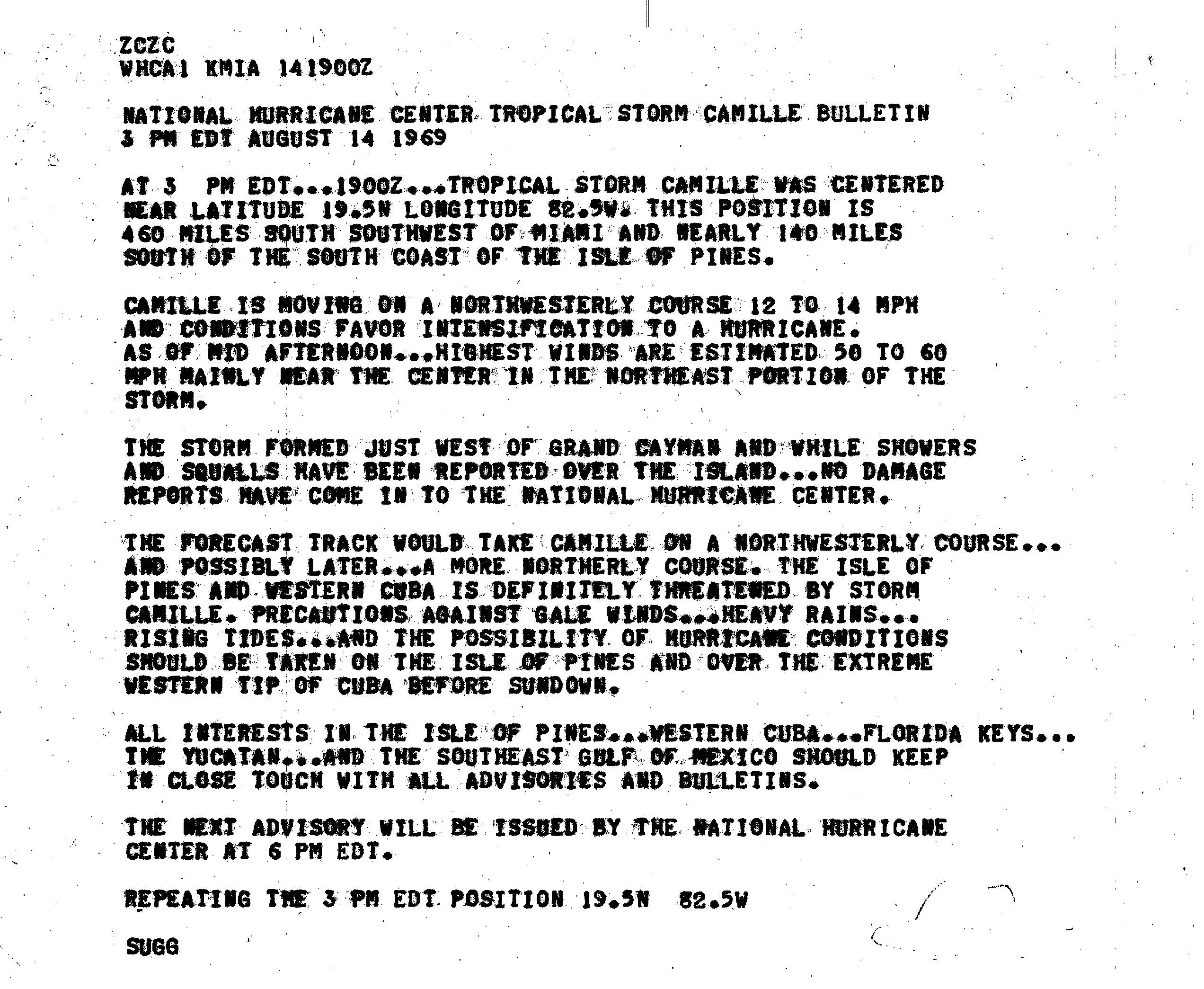
- What was the weather like in Jamaica, Mexico and the Cayman Islands as Camille or its precursor system passed nearby?
- I had to cite a thesis paper from Mexico from 1990, but I found that there was beneficial rainfall in the country. ♫ Hurricanehink (talk) 23:34, 27 December 2025 (UTC)
- In its second advisory, NHC mentions that showers and squalls were reported but no damage was reported in Grand Cayman.Jason Rees (talk) 15:27, 31 December 2025 (UTC)
- Thanks, added. ♫ Hurricanehink (talk) 17:29, 31 December 2025 (UTC)
- No Spanish sources or non-American sources such as a report from the Cuban Weather Service?
- I added a bit more about the Cuban crop damage, and a local state of emergency. ♫ Hurricanehink (talk) 23:34, 27 December 2025 (UTC)
- When did it make landfall on Cuba?.Jason Rees (talk) 15:59, 31 December 2025 (UTC)
- The MH has "At 22:00 UTC that day, Camille struck western Cuba between Cape San Antonio and Guane." And the previous sentence mentioned "August 15". ♫ Hurricanehink (talk) 17:29, 31 December 2025 (UTC)
- Louisana
- When did it pass over Louisana? Being near peak intensity doesn't really work IMO.Jason Rees (talk) 15:59, 31 December 2025 (UTC)
- The MH has "From 02:30–03:30 UTC on August 18, the hurricane moved across marshlands in St. Bernard Parish, Louisiana". Given the difference between local time and UTC (as tropical cyclone articles usually use), I didn't want to reintroduce the date again, when it was already established earlier, and the important thing was the impacts. ♫ Hurricanehink (talk) 17:29, 31 December 2025 (UTC)
- I had a read through of the article earlier and could not find anything major that is worth writing home about, so am gonna pass the article.Jason Rees (talk) 23:46, 1 February 2026 (UTC)
In Pop Culture
[edit]I recently removed a small paragraph about Camille appearing in pop culture. The problem is that most of them don't have a very good source confirming that Camille as the hurricane, not to mention none of the pieces of pop culture seemed especially interesting. I removed it, but wanted to include it here in case anyone in the future can expand on the pop culture impacts of the hurricane. ♫ Hurricanehink (talk) 22:58, 22 February 2026 (UTC)
Camille and its effects were depicted in several pieces of media, including Hurricane, a 1974 ABC made-for-TV disaster movie starring Frank Sutton and Larry Hagman, The Bluest Water: A Hurricane Camille Story, an original play about the storm in Nelson County, a 1989 episode of Nova, and a 1991 episode of the NBC series Quantum Leap, titled "Hurricane."[1][2][3][4]
- ↑ Jeff Masters (March 4, 2015). "That infamous Hurricane Camille party on Aug. 17, 1969? It never happened". Weather Underground. Retrieved October 10, 2025.
- ↑ "Nelson County Historical Society". nchsva. 2009.
- ↑ Hurricane. Quantum Leap. NBC.
- ↑ Hurricane at the TCM Movie Database (archived)
- Wikipedia articles that use American English
- Wikipedia featured articles
- Featured articles that have not appeared on the main page
- Old requests for peer review
- FA-Class Weather articles
- High-importance Weather articles
- FA-Class Tropical cyclone articles
- High-importance Tropical cyclone articles
- WikiProject Tropical cyclones articles
- FA-Class Atlantic hurricane articles
- High-importance Atlantic hurricane articles
- WikiProject Weather articles
- FA-Class United States articles
- High-importance United States articles
- FA-Class United States articles of High-importance
- FA-Class Louisiana articles
- Top-importance Louisiana articles
- WikiProject Louisiana articles
- FA-Class Mississippi articles
- Top-importance Mississippi articles
- WikiProject Mississippi articles
- FA-Class West Virginia articles
- High-importance West Virginia articles
- WikiProject West Virginia articles
- WikiProject United States articles
- FA-Class Alabama articles
- WikiProject Alabama articles
- FA-Class Virginia articles
- High-importance Virginia articles
- WikiProject Virginia articles
- Articles linked from high traffic sites