


Talk:General frame
Add topic | This article is rated Start-class on Wikipedia's content assessment scale. It is of interest to the following WikiProjects: | ||||||||||
| |||||||||||

Sigma algebra? Cardinality?
[edit]In the definition (quoting the article), I see this:
- A modal general frame is a triple , where is a Kripke frame (i.e., is a binary relation on the set ), and is a set of subsets of that is closed under the following:
- the Boolean operations of (binary) intersection, union, and complement,
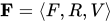


Based on my reading, this means that is a sigma algebra (the elements of are Borel sets). Is there some reason technical reason not to state this? OK, well, I see one: sigma algebras are closed under countable intersections and unions, whereas this article makes no statements about cardinality, one way or the other.
Am I supposed to assume that the statements in this article are valid for sets of arbitrary cardinality? e.g. for ? Or is this intended to work for only or ? Defining the set correctly seems to require a walk up the Borel hierarchy and you'll immediately bump into analytic sets.


The reason I ask is because in Bayesian inference, each Bayesian "prior" is an element of , each possible inference is in , and then is just the normal probability space. So its all hunky-dorey for small-enough sets. Whether any of this works out for higher order logic is not clear. 67.198.37.16 (talk) 21:31, 31 May 2024 (UTC)