


Talk:Exponential type
Add topicLatest comment: 11 years ago by Tsirel in topic Why lim sup?
 | This article is rated Start-class on Wikipedia's content assessment scale. It is of interest to the following WikiProjects: | ||||||||||
| |||||||||||

Why lim sup?
[edit]Here's a question – maybe User:Mkelly86 or User:Michael Hardy can answer: Why do we use "lim sup" instead of just "lim"? Can we give an example of a function that is of exponential type but for which the limit of the log over r does not exist? Eric Kvaalen (talk) 09:22, 17 August 2015 (UTC)
- How about ? Do you have an example of a function such that the limit exists? (I don't think that is possible). —Kusma (t·c) 10:07, 31 August 2015 (UTC)

- Note that it is not it is just
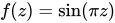
- An example is already given: ; how big it is, depends not only on |z| but also on the argument of z; if z remains real, the function does not grow at all! Boris Tsirelson (talk) 10:09, 31 August 2015 (UTC)
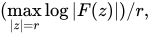
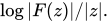
- But moreover, a counterexample exists also for (but is harder to find). This maxlog can behave (roughly, for large r) as a convex piecewise-linear function (of r) that oscillates between two parabolas. Why? Well, the convex piecewise-linear function is the maximum of linear functions, each corresponding to exponential F. Sure, we cannot take maximum of holomorphic functions (as long as we need another holomorphic function); but we can take their sum. And in this case, when all parameters are very large, the sum and the maximum are relatively close! Boris Tsirelson (talk) 10:57, 31 August 2015 (UTC)
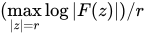
- Thanks. It's true that I had misunderstood it as the lim sup of as r goes to infinity. So my question is really whether there exist examples of functions of exponential type such that does not have a limit as r goes to infinity. I'd be interested in seeing an explicit example of what you mean, Boris, in your last paragraph. Eric Kvaalen (talk) 13:58, 31 August 2015 (UTC)
- It is surely written somewhere, but I am not an expert in complex variables, and I do not know where to look. It would be too much work, to wrire down all details. But let me try to say more.
- Consider such a function: (for x>0); it is piecewise linear; it is x for 0<x<1 but 2x-1 for x>1.
- Now consider and its logarithm. The sum is more than the maximum, thus, for x>0. On the other hand, the sum is less than twice the maximum, thus, for x>0. You see, (and the error may be smaller if you replace "10" with "1000" etc.)
- Adding more terms like this: you get more pieces of linearity, and still, Now add infinitely many pieces; you get a series for F, and it converges! (Check it.) Its sum is a counterexample: the limit of over r=1,2,3,.. is less than the limit over r=1.5,2.5,3.5,...
- Or not? Well, not. In the limit the non-small difference divides by r2 and vanishes. It means we should take larger pieces of linearity. Not [0,1], [1,2], [2,3], ... but [1,2], [2,4], [4,8], ... Or even, [1,10], [10,100], [100,1000], ... It must work, ultimately. The graph of g should oscillate between two parabolas, one y=a r2, the other y=b r2, for some a<b. Boris Tsirelson (talk) 14:26, 31 August 2015 (UTC)







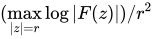
- Oops! Now I misunderstood what are we talking about. Sorry. I should not divide the log by r2 ! Let me think a bit more. Boris Tsirelson (talk) 14:32, 31 August 2015 (UTC)
- No, you'd better ask an expert... I do not know, really. Boris Tsirelson (talk) 15:17, 31 August 2015 (UTC)
- Thanks, Boris. I get the idea. I think this is an explicit example:
- I think will oscillate between about 1 and about 121/40 (=3.025). The idea is that each term is an entire function whose L function is approximately Each term dominates in a certain range of r from about 102n to 102n+2. The L function for a term is about 1 at both ends of this interval, and reaches a maximum of about 3.025 when Eric Kvaalen (talk) 16:56, 31 August 2015 (UTC)
- Thanks, Boris. I get the idea. I think this is an explicit example:




- (Edit conflict) Here is a freely available source: Warner: Zeros, of 556 pages (wow!); Sect. 17: Exponential type; Sect. 18: The Borel transform. Boris Tsirelson (talk) 16:58, 31 August 2015 (UTC)
- Very interesting! I just intended to write that, it appears, is an entire function of order 1/2 (according to Warner sect 17.6) but you already know much more... Boris Tsirelson (talk)
- And, ridiculously, at the same time I intended to write that, according to Warner sect 18.19, every exp type function is basically a linear combination of exponential functions (well, integral combination, not a finite one), and probably (??) it follows that the limit exists... Boris Tsirelson (talk) 17:06, 31 August 2015 (UTC)
- Now you really has a question to experts in complex analysis: was it known? If not, bother to publish it! Boris Tsirelson (talk) 17:08, 31 August 2015 (UTC)

- Well, that sounds like a lot of work! Just one sort of correction, Boris – I didn't need to divide by n2. I guess I was thinking I needed that so it would converge at 0, but the exp takes care of that. So we have:
- Eric Kvaalen (talk) 18:47, 31 August 2015 (UTC)
- Well, that sounds like a lot of work! Just one sort of correction, Boris – I didn't need to divide by n2. I guess I was thinking I needed that so it would converge at 0, but the exp takes care of that. So we have:

- Nice. But, I am afraid, it is forbidden, a link from article to its talk page (and any link from the article space to any other namespace of wikipedia). Boris Tsirelson (talk) 19:23, 31 August 2015 (UTC)
- Well, I say one should only enforce a rule if one personally thinks it should really be applied.
- Anyway, I hereby dub this function סולם יעקב, Jacob's ladder. If you make a graph of log(log(F(x))) versus log(x), it looks like an infinite stairway going to heaven. Eric Kvaalen (talk) 10:56, 2 September 2015 (UTC)
- Thus, it becomes "dual" to Devil's staircase. :-)
- Really, it should be well-known among experts in complex analysis. My problem was that I naively thought that an entire function cannot be of order 1/2. Experts surely do not think so. Boris Tsirelson (talk) 13:46, 2 September 2015 (UTC)
- Yes, well I happened to know that because I wrote a lot of the article "Entire function". Eric Kvaalen (talk) 15:45, 3 September 2015 (UTC)
- Ah, yes, I see... even order 1/4 and 1/3, nice... Boris Tsirelson (talk) 21:13, 3 September 2015 (UTC)