


Talk:Euler function
Add topic | This article is rated Start-class on Wikipedia's content assessment scale. It is of interest to the following WikiProjects: | ||||||||||
| |||||||||||

dots in the equation
[edit]Do the dots at the end of some equations have some mathematical meaning/purpose? I'm about to delete them. — Preceding unsigned comment added by 181.20.134.170 (talk) 22:13, 7 May 2015 (UTC)
Also Interesting
[edit]The cube of the Euler function, and its natural logarithm are also interesting - insofar as they both have interesting (i.e. simple) Taylor expansions anout q=0.
Perhaps these should be added to the article? Hair Commodore (talk) 14:39, 14 January 2009 (UTC)
- And I forgot to add its Functional Equation! Hair Commodore (talk) 15:14, 14 January 2009 (UTC)
- There is a particularly elegant derivation of the functional equation for this function - to be found in the book: Asymptotics and Mellin-Barnes Integrals, by R.B. Paris and D. Kaminski (Cambridge University Press, 2001). Hair Commodore (talk) 15:14, 12 February 2009 (UTC)
Notation: possible confusion
[edit]The use of lowercase-phi for this function is potentially confusing, especially as it is also used as standard for Euler's totient function, albeit sometimes in a different script!
One obvious alternative is to use an uppercase-E in script or italic form. Hair Commodore (talk) 12:01, 15 January 2009 (UTC)
Name? References?
[edit]Is this function actually called the "Euler function?" I checked out the only reference on this page (Apostol, 1976), and it does not call it the Euler function, use the notation , nor does it give it any other name as far as I can tell. Furthermore, the book does not appear to mention q-series or q-Pochhammer symbols (at least according to the index). At the very least, this article needs more citations because Apostol 1976 is not sufficient for some of the things listed here. Lasindi (talk) 21:25, 28 October 2013 (UTC)

Response to Lasindi: (Sorry I'm a newb on wiki editing, so am just typing this here. Experts please fix as you see fit.) I also had trouble tracking down this terminology, but see page 8 of the paper https://arxiv.org/abs/1602.01085 where "Euler function" is used. I also looked at the Watson 1936 paper they cite, and in that paper Watson quotes the famous Ramanujan, who in turn called certain functions "Eulerian", which I guess led to calling (q,q)_infty an Euler function. — Preceding unsigned comment added by 165.124.240.246 (talk) 19:04, 25 April 2017 (UTC)
- That arxiv link has the problem that it is much newer than this wiki page, which means that it cannot be used to rule out citogenesis.
- For a source that actually uses the term "Euler function" for this function and pre-dates the oldest mention of the "Euler function" in wikipedia itself (which appears to be https://en.wikipedia.org/w/index.php?title=Q-series&oldid=9036273 from 2005), have a look at https://web.archive.org/web/20041210092438/http://mathcircle.berkeley.edu/BMC3/SymPol.pdf which lists it on page 6 - this document is undated, but given that it was captured by the wayback machine on 10 dec 2004, it's at least old enough to rule out citogenesis (running exiftool on it indicates that it was originally created on 2 oct 2000.) ~2026-33609-93 (talk) 22:37, 9 June 2026 (UTC)
What about this related function too?
[edit] :,
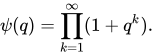
whose relationship to the Modular Group is also obvious! 81.102.15.200 (talk) 12:18, 30 June 2009 (UTC)
- This function is obviously directly related -as:
- .

86.22.72.56 (talk) 20:39, 18 November 2009 (UTC).