


Talk:Divisor function
Add topic | This article is rated C-class on Wikipedia's content assessment scale. It is of interest to the following WikiProjects: | ||||||||||
| |||||||||||


What is ''the'' divisor function?
[edit]The header defines "the divisor function" as σ0(), and then mentions the "related" divisor summatory function, but does not mention σ1(). The articles on perfect number, deficient number, abundant number, etc use "the divisor function" as σ1(). Sumbuddy who's a better mathemetician than me should make this consistent. — Randall Bart 08:26, 11 February 2007 (UTC)
- The article does mention : it is in the first few sentences under "definition". I changed some mentions of "the divisor function" to "the sum-of-divisors function" in a few articles for clarity, though is a divisor function, so it is proper to say "the divisor function ". Hopefully this change will make things more clear. Doctormatt 21:14, 26 April 2007 (UTC)


No, you can't say "the divisor function " if you want to write clearly. The devisor function is d(n). is shorthand for with is the sum-of-divisors function. The family of sigma-sub-k functions is a family of sum-of-divisor functions. The divisor function can be expressed as a sum-of-divisor function. — Preceding unsigned comment added by 107.142.105.226 (talk) 15:17, 24 July 2015 (UTC)
- All of the are called the divisor function. Like all terminology, you can find variations. If there is something that is true, is that regarding terminology the statement "No, you can't say" is definitely false almost always. ~2026-39108-82 (talk) 15:47, 9 July 2026 (UTC)

Graphic
[edit]
The image File:Divisor cube.svg does not display for me in two browsers, though I can view the image on its file page. Hyacinth (talk) 01:19, 11 June 2016 (UTC)
- File:Divisor cube.svg says: "Invalid SVG file: Expected <svg> tag, got svg in NS". I see File:Fileicon-svg.png which is a file-error icon and not the intended image. According to https://web.archive.org/web/*/https://en.wikipedia.org/wiki/Divisor_function it worked 13 May where it displayed as https://web.archive.org/web/20160107121844im_/https://upload.wikimedia.org/wikipedia/en/thumb/d/de/Divisor_cube.svg/220px-Divisor_cube.svg.png. Do you see the error icon or the real image? PrimeHunter (talk) 02:01, 11 June 2016 (UTC)
- Fixed. Offnfopt(talk) 09:12, 22 July 2016 (UTC)
- Thanks. I have restored it in the article. PrimeHunter (talk) 10:40, 22 July 2016 (UTC)
- Fixed. Offnfopt(talk) 09:12, 22 July 2016 (UTC)
External links modified
[edit]Hello fellow Wikipedians,
I have just modified one external link on Divisor function. Please take a moment to review my edit. If you have any questions, or need the bot to ignore the links, or the page altogether, please visit this simple FaQ for additional information. I made the following changes:
- Added archive https://web.archive.org/web/20140411041855/http://webdocs.cs.ualberta.ca/~zacharyf/papers/superabundant.pdf to http://webdocs.cs.ualberta.ca/~zacharyf/Papers/superabundant.pdf
When you have finished reviewing my changes, you may follow the instructions on the template below to fix any issues with the URLs.
This message was posted before February 2018. After February 2018, "External links modified" talk page sections are no longer generated or monitored by InternetArchiveBot. No special action is required regarding these talk page notices, other than regular verification using the archive tool instructions below. Editors have permission to delete these "External links modified" talk page sections if they want to de-clutter talk pages, but see the RfC before doing mass systematic removals. This message is updated dynamically through the template {{source check}} (last update: 5 June 2024).
- If you have discovered URLs which were erroneously considered dead by the bot, you can report them with this tool.
- If you found an error with any archives or the URLs themselves, you can fix them with this tool.
Cheers.—InternetArchiveBot (Report bug) 16:00, 11 September 2017 (UTC)
Suggestion
[edit]Omit unclear sentences like
"This summation also appears as the Fourier series of the Eisenstein series and the invariants of the Weierstrass elliptic functions."
unless they can be changed to clear ones. The Fourier series of which Eisenstein series?
No doubt this makes perfect mathematical sense. That is not the question. The question is whether it is explained so that most people who read it for the first time are able to understand what they are reading.
It is not. 2600:1700:E1C0:F340:C8EF:22B1:3B92:C52C (talk) 05:01, 24 May 2019 (UTC)
- I made the links in that sentence more specific. If you look in the targeted sections, you can see an expression of the same form as the left hand side of the equation immediately preceding this sentence. — Anita5192 (talk) 05:41, 24 May 2019 (UTC)
Table of values
[edit]Why is the Table of values aligned right? This looks ridiculous on my laptop. Why not align left and put the comment either before or after the table?—Anita5192 (talk) 06:55, 1 August 2019 (UTC)
- The table was in another section and was messing up the text in that section. I put it in it's own section, no changes to alignment. See if it is better now. Bubba73 You talkin' to me? 07:03, 1 August 2019 (UTC)
- Much better now! Thank you!
 —Anita5192 (talk) 08:08, 1 August 2019 (UTC)
- Much better now! Thank you!
Multiplicativity
[edit]There is currently a note asking for a proof sketch as to why the divisor function is multiplicative, saying it does not appear obvious.
It is obvious, given the simple result that if is a multiplicative function, then

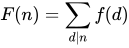
is also multiplicative. This is a special case of the Dirichlet convolution of multiplicative functions being multiplicative (convolve with the constant 1 function).
Since is (completely) multiplicative for all , so is .


I'm not sure how best to integrate this information into the brief sentence about multiplicativity. Extracurriculars (talk) 21:27, 3 August 2021 (UTC)
Utterly confusing article
[edit]The article's first section is as follows:
"In mathematics, and specifically in number theory, a divisor function is an arithmetic function related to the divisors of an integer. When referred to as the divisor function, it counts the number of divisors of an integer (including 1 and the number itself). It appears in a number of remarkable identities, including relationships on the Riemann zeta function and the Eisenstein series of modular forms. Divisor functions were studied by Ramanujan, who gave a number of important congruences and identities; these are treated separately in the article Ramanujan's sum.
"A related function is the divisor summatory function, which, as the name implies, is a sum over the divisor function." "The notations d(n), ν(n) and τ(n) (for the German Teiler = divisors) are also used to denote σ0(n), or the number-of-divisors function. When z is 1, the function is called the sigma function or sum-of-divisors function, and the subscript is often omitted, so σ(n) is the same as σ1(n)."
But then the definition is as follows:
"The sum of positive divisors function σz(n), for a real or complex number z, is defined as the sum of the zth powers of the positive divisors of n. It can be expressed in sigma notation as
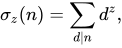
where is shorthand for "d divides n"."

Is it really necessary to present the definition in such utmost generality, and leave readers wondering how this connects to "counting the divisors" ... until they may notice that this is the case of z = 0 if they are lucky.
The next sentence breezily fixes this problem ... but only if a reader gets that far without giving up because the article appears to be about a different subject.
Suggestion: The article should just define the @#$%^&* divisor function as described in the introduction. Then in the next section define the generalization (or give the generalization its own article). 2601:200:C000:1A0:98F:4BB9:DFD5:F0CE (talk) 19:48, 7 June 2022 (UTC)
2601:200:C000:1A0:98F:4BB9:DFD5:F0CE (talk) 19:48, 7 June 2022 (UTC)
halp !!
[edit]is the tau of any prime numbre 1????? — Preceding unsigned comment added by 2604:3D09:1580:9600:1C8A:57FA:9F13:B64F (talk) 21:47, 30 June 2022 (UTC)
- No, tau of every prime number is 2. Bubba73 You talkin' to me? 00:38, 1 July 2022 (UTC)
Clarification needed
[edit]The first sentence of the section Definition reads as follows:
"The sum of positive divisors function σz(n), for a real or complex number z, is defined as the sum of the zth powers of the positive divisors of n."
But because in general complex exponentiation is multivalued, it ought to be mentioned that if z here is not a real number, the expression dz for a divisor d should be understood to mean exp(ln(d) z), which is well-defined since d > 0.
I hope that someone knowledgeable about this subject can add this information.
Section Formulas at prime powers is a mess
[edit]- It doesn't stay on topic, since it ends with formulas for all cases.
- It states without proof that the function is multiplicative and presents the formula as a consequence of this. However, the formula is easier to prove combinatorially (the very section mentions it) and multiplicative follows from it immediately. Therefore, the explanation should be reversed, and probably put in its own subsection.
- The attempt at a combinatorial proof mentions variables that do not seem to have been introduced or actually used for anything. From knowing the argument, it is clear that the intention was that the are the exponents of the primes in the prime factorization of the divisors. This is not said explicitly, which should be confusing for someone who doesn't already know the proof.
- The case of the primorial and the segway to which natural numbers are the smallest giving a power of two value is awkward. It looks like someone read about it, wanted to say it somewhere, and jammed it in the first place they thought it more or less fits. It is one question that can be asked, but so are many others. A better place (if any) would be at, or near the section on growth rate. There it serves the purpose of supporting one of the asymptotics mentioned.


