


Talk:Determinism/Archive 3
 | This is an archive of past discussions about Determinism. Do not edit the contents of this page. If you wish to start a new discussion or revive an old one, please do so on the current talk page. |
| Archive 1 | Archive 2 | Archive 3 | Archive 4 |
Multi-deterministic position?
This section seems to me to be the weakest in this article. I've cleared up the anthropocentrism of its language and attempted to lay it out more neatly, but this seems to smack of a personal commentary, rather than a summary of a position advanced by one or more philosophers or scientists concerning determinism. For one thing, 'multideterminism' isn't a recognised term in this field (it isn't in the dictionary either); I've seen it used as a psychiatric term but I get the feeling that here its an ad hoc construction used to title someone's personal theory. Certainly, given the apparent lack of proper referential support, it seems strange to dedicate an entire subsection of the article to it.
Basically, this section needs references and external support if it is not to drag down the general tone of the article. The references to dualism are also slightly problematic, given the general disfavour which this theory of mind has amongst philosophers today. Any suggestions? Could it be subsumed into another section/strand of discussion? In all honesty I don't think it should even be in the article until it's got proper references and sources to back it up.Visual Error 16:08, 20 January 2006 (UTC)
- I favor deleting it, though this is partly my personal bias. For me, science does not need references if it is not disputed, but discussion of "souls of conscious beings" and "the creator of the universe" doesn't make sense unless I know who thinks that way. David R. Ingham 20:36, 20 January 2006 (UTC)
- Interesting. I never heard of deterministic souls before (although I suppose religious predestination would require it)--what do they do? I could be misunderstanding the section. It sounds like original research, but perhaps I should ask over in theology. WhiteC 23:13, 20 January 2006 (UTC)
- If it is entirely original research, surely it doesn't belong in Wikipedia. I have no problem with someone citing original research by a recognised authority, but I don't think it has any place being presented in Wikipedia (or, indeed, any encyclopedia article). If no one presents any objections, I'm going to remove the offending section. Visual Error 19:21, 21 January 2006 (UTC)
- I filled out that section, which is a report on the mainstream position of Christian philosophers in the Middle Ages, and also has resonances in one early Chinese school. It is not original research to report on information that is common knowledge among students of the history of philosophy, especially when references are provided. "René Descartes continues a train of thought that starts at least as early as Duns Scotus and runs through Suarez to affirm that 'the will is by its nature so free that it can never be constrained. (Passions of the Soul, I, art. 41). []" The Chinese matter is explicated at some length in D.C. Lau's "Introduction" to his translation of that book, p. 28ff., and references can be provided to the Mencius too. P0M 21:32, 10 February 2006 (UTC)
- See W.D. Ross's Aristotle, p. 82f, where he describes The Philosopher's teaching that acts of free will are uncaused causes in the Universe. P0M 17:09, 11 February 2006 (UTC)
I don't understand where you got the need for a god to start the universe, in the first place. Isn't the universe easier to start than a god?
- Is this a reference back to deism? WhiteC 19:39, 10 February 2006 (UTC)
- I removed reference to God, and replaced it with first cause. Is this theory supported by anyone worth mentioning in an encyclopedia, or should it stand on its own merits? WhiteC 15:25, 11 February 2006 (UTC)
- Somebody with a set of Copleston's history of philosophy series could easily come up with a number of citations. Of course Thomas Aquinas http://www.newadvent.org/summa/104401.htm is out of date, Aristotle is even more out of date, and Plato is hardly worth mentioning. ;-) P0M 16:54, 11 February 2006 (UTC)
Determinism, quantum mechanics and classical physics
I edited this section, which is a sub heading of "Arguments against determinism" to reflect more of a mainstream approach. I took out a paragraph on moral choice, which has noting to do with physics. I also took out the bit about what Professor B. once taught his class. --agr 21:25, 15 February 2006 (UTC)
That quantum mechanics is irrelevant to "moral choice" has been mentioned prominently in the literature, but I don't recall where I last saw it, at this moment. The argument goes something like, since the future is only theoretically predictable, given infinite computing power and information, physical determinism has no bearing on moral determinism. The "Physics and the Real World" article (though it was wrong on physical determinism) pointed out that homeostasis is one of the principles that separate microscopic physics from daily experience. That is, the presence of negative feedback on many levels, simplifies everyday life in a way that is too complicated to explain directly with physics, without the help of biology. David R. Ingham 05:42, 11 March 2006 (UTC)
If the edit you refer to is , then it does include some worthwhile deletions. David R. Ingham 06:08, 11 March 2006 (UTC)
Of course, the "Dr. Herbert P. Broida" quote is not the best reference, but would establish the fact that the probabilities are due to the classical approximation and not to qm in isolation, if other sources were not available. It was my best source at that time and where I first learned it. David R. Ingham 06:08, 11 March 2006 (UTC)
- Since you are the only witness who has come forth with this point of evidence, in the spirit of having an "interpersonal object" as the basis of inquiry, please supply a reference to a published source. ~~
This may not have been a legitimate edit, but the deleted part does not make much sense to me. David R. Ingham 05:25, 11 March 2006 (UTC)
- It seems to be perfectly clear both in terms of individual words chosen, and in terms of the way those words are arranged into sentences. It also seems to me to have something interesting and relevant to say. Rather than deleting such a passage, it would be better to bring it up for discussion, quote it here, and explain in concrete terms what you think the problem is. P0M 14:48, 11 March 2006 (UTC)
What I meant to say is that the who and why this edit was not clear to me, but I did not actually disagree with the deletion, so I didn't revert it. David R. Ingham 18:11, 12 March 2006 (UTC)
Questionable paragraph
For notions that the wave function is computable to rescue determinism, one must envision a single wave function for the entire universe, starting at the big bang. Putting aside the fact that computing the wave function for something as simple as a single uranium atom is far beyond any known technology and that the initial conditions at the big bang can never be known, such a "wave function of everything" would carry the probabilities of not just the world we know, but every other possible world that might have existed. For example, large voids in the distributions of galaxys are believed by many cosmologists to have originated in quantum fluctuations during the big bang. The "wave function of everything" would carry the possibility that the region where our Milky Way galaxy is located could have been a void and the Earth never existed at all. Even if one accepted such a "wave function of everything" as meaningful, it is difficult to understand how it could be reconciled with the concept of determinism.
" It stars alright, but then assumes the Many World idea. There must be resemblance between what did happen and what could have, and, since the quantum state includes everything that still exists, it must be there. Admittedly, qm provides a version of determinism that would only be of use to God, but does not allow Him to interfere with us. What all of this shows is that theoretical determinism in physics is not relevant to questions like moral responsibility. David R. Ingham 07:33, 11 March 2006 (UTC)
- I have put the quoted texts into "blockquotes" since as it was before the original passage ran almost seamlessly into the critique.
- The passage does not assume the "Many World idea."
- You say: "There must be resemblance between what did happen and what could have, and, since the quantum state includes everything that still exists, it must be there." I do not understand whether this sentence is intended as a statement of fact, a sarcastic paraphrase of the presumed belief or interpretation of the original passage, or what. You then continue with what I regard as a non sequiter. "Admittedly, qm provides a version of determinism that would only be of use to God, but does not allow Him to interfere with us." I doubt that you have inquired of God how his attempts to perform miracles have fared, so what can be the grounds for your assertion? You finish with another non sequiter that at least insinuates that whether I was pre-programmed from time 0 to kill and eat Bambi, I am in either case "morally responsible."
- The problem with the passage, as I read it, rests with its lack of citations. As is, it stands as an interesting piece of "personal research" at best. It could only be correctly written as a reflection of "Bohr, Born, and Bobrick," since it is not, afaik, even as widespread an opinion as the Copenhagen Interpretation. P0M 15:05, 11 March 2006 (UTC)
- I added the paragraph in question to balance statements in the article such as "So quantum mechanics is deterministic, provided that one accepts the wave function itself as reality..." I'd be happy to add citations, but I am not clear as to which parts of that paragraph are being questioned. Is it the statement that "For notions that the wave function is computable to rescue determinism, one must envision a single wave function for the entire universe, starting at the big bang?" If we are not talking about the wave function for the entire universe, than it seems to me to be up to the proponents of determinism to make clear which wave function they have in mind. The fact that a wave function carries the probabilities of all possible outcomes is pretty standard physics. I don't think it depends on any particular interpretation. Many cosmologist attribute large scale structure of the universe to quantum fluctuations shortly after the big bang. I'm not saying it's a settled matter, but I'll look for a suitable cite.--agr 00:00, 12 March 2006 (UTC)
The paragraph is not so bad, but something needs fixing. I admit that my "God" part is unusual. I am discussing the difference between what could in principle be predicted and what is reasonable to talk about predicting. Some explanations of the Judeo-Christian-Muslim god attribute unlimited knowledge, and unlimited ability to interpret it, to him. That sheds a very different light on qm, because "He" would be able to predict the future, including all the phases (except for one non-physical overall phase for the universe), most of which can never be known to humans. The time independent Schrödinger equation is explicitly deterministic. The equations of more complicated systems are much harder to integrate but, in principle, equally deterministic. The reason the future is not predictable is that our instruments and computers are finite. In fact they are constrained to be smaller than the universe they strive to predict. In that I am in agreement with the paragraph. What I call to question is "every other possible world". The universe's wave function describes only itself, and not, directly, any other possible worlds. David R. Ingham 05:03, 12 March 2006 (UTC)
- Thanks, it will be a few days before i can respond. --agr 05:30, 12 March 2006 (UTC)
POM comments
Point by point: (1) For notions that the wave function is computable to rescue determinism, one must envision a single wave function for the entire universe, starting at the big bang.
- (To agr:)That is a highly dogmatic statement. If Feynman said it, putting it in the article is legitimate provided it is cited. If P0M said it, it's personal research at best.
(2) Putting aside the fact that computing the wave function for something as simple as a single uranium atom is far beyond any known technology and that the initial conditions at the big bang can never be known, such a "wave function of everything" would carry the probabilities of not just the world we know, but every other possible world that might have existed.
- (To agr:)Even the "facts" that you are putting aside are not things that can stand on your authority. Personally, I would let them stand, but I am lax about these things. Your assertion that "a 'wave function of everything' would carry the probabilities of not just the world we know, but every other possible world that might have existed," sounds plausible to me, but only plausible. Where does this assertion appear in the work of any recognized physicist?
(3)"For example, large voids in the distributions of galaxys are believed by many cosmologists to have originated in quantum fluctuations during the big bang."
- (To agr:)Since "many cosmologists" believe it, it should be easy to document.
(4) "The 'wave function of everything' would carry the possibility that the region where our Milky Way galaxy is located could have been a void and the Earth never existed at all."
- (To agr:)Documenting (3) would probably uncover documentation for (4).
(5) "Even if one accepted such a 'wave function of everything' as meaningful, it is difficult to understand how it could be reconciled with the concept of determinism."
- (To agr:)It looks to me like you set up a straw man in the beginning, and here your burn it.
(To agr:)Your language needs to be tightened up to make it amenable to logical analysis. You seem to be asserting that: If there is a Single properly formulated wave function for the entire universe starting at the big bang, then computing that wave function will "rescue" determinism. And you also maintain that If there is a Single properly formulated wave Cfunction for the entire universe starting with the big bang, then it is not the case that Computing the wave function will "rescue" determinism. To reduce two statements to symbolic form you have:
- S-->C
- S-->~C
That's like the father who promises his child, "If I give you a Silver dollar, then I'll give you a copper coin," and "If I give you a Silver dollar then I will not give you a copper coin." As long as the father only hands out copper coins, nobody can call him a liar. On the other hand, if he gives his son a Silver dollar and does not give him a copper coin, then he lied when he said the first sentence, but if he does give him a copper coin, then he lied when he said the second sentence. The ordinary purpose of if-then sentences is to communicate some reasonable expectations, e.g., "If you feed my dogs, then I will pay you a dollar a day per dog." If a parent says that to a child, and tells the truth, then the child has a good basis for deciding whether it is worthwhile for him to feed the dogs. But if the parent adds, "And if you feed my dogs, the I will not pay you a dollar a day per dog," the parent has made a self-contradictory assertion and the child doesn't know what to expect. The child thinks, "Even if I go through with it and actually feed the blasted dogs, there is no telling whether I'll get paid or not. The child doesn't know whether doing it or not doing it is a good idea because by making a contradiction the parent has "unlinked" the consequences, i.e., said, in effect, "My words do not make any difference. Just wait and see what happens." Your statement reminds me of the kind of fairy story where the king says, "If you were to prove capable of weaving a single flawless thread in one night from a thousand pounds of silkworm cocoons, then I will release you from the staircaseless tower -- or maybe I won't."
(To agr:)Here is something else: Can the statement that "There is a single properly formulated wave function for the entire universe starting at the big bang," possibly be proven wrong? If there is no way that it might be proven false, if it's like the statement, "The streets of Heaven are paved with gold," then we are not dealing with a scientific matter.
(To agr:)Maybe you are trying to say something more interesting and I simply haven't guessed the correct formulation. P0M 06:49, 12 March 2006 (UTC)
Ingram comments
Point 1
No, I think that the fact that the universe is completely described by a celestial wave function is perfectly orthodox physics and that every high-school student should be able to say it if asked in a test. David R. Ingham 07:58, 12 March 2006 (UTC)
- I am asking that the original author, or anybody else for that matter, provide substantiation, citable evidence. My opinion is not evidence. If you have peer-reviewed publications to your credit that establish any of these points you may cite those publications. Just giving your opinion here stands at best as "personal research." P0M 18:57, 12 March 2006 (UTC)
Perhaps, that may not be the ultimate form that physics will take, or there may be inconsistencies between genera relativity and quantum mechanics, but that is the description that well established physics gives.
- Prove it, don't just assert it. P0M 18:57, 12 March 2006 (UTC)
Point 2
No I didn't mean to say I greed with that part. Knowledge of a wave function may give clues to those of other things, but it does not actually contain information about anyting else that exists or could exist. David R. Ingham 18:06, 12 March 2006 (UTC)
- I was not addressing my point 2 to you, personally. What the original writer, or someone else, needs to do is to prove that Dirac or Feynman or Einstein or somebody with generally recogized authority has demonstrated the truth of this statement, or at least asserted it is true so that we can say, "According to Dirac..." P0M 19:02, 12 March 2006 (UTC)
Point 3
That sound like he could justify it, though I would like to see it too.
- Personally, in editing articles I tend to concentrate on things that I can refute with evidence, put things that questionable up for other people to weigh in on, and leave things that seem to me to be "general knowledge" alone. (Ideally, a statement like, "Wolf 359 is the star closest to our own," should be cited. But I'm pretty sure that it is correct unless an even closer star has been found, so I'd just pass on by.) That being said, any statement should have evidence behind it. In this case, we are not dealing with statements like, "The sky appears blue," so we need proof. The citation is for the article, for the general well-informed reader, not for me. P0M 19:26, 12 March 2006 (UTC)
Point 4
That is point 2 again. That is what seems like a many worlds interpretation to me, though perhaps that is not the best name for it.
Point 5
I think that may be about something I said or agree with again.
The time dependent Schrödinger equation is explicitly deterministic. That is why I put in a picture of it. The equations for many body wave functions are derived from it and so are also deterministic, in the sense that the wave function progresses according to its Hamiltonian in a way that is determined by the mathematics. The physics determinism question seem to revolve around the issue of whether one accepts the wave function as reality. To one who retains the notion that reality can only be something that is describable in classical physics or ordinary language, there can not be determinism because of the uncertainty principle. This seems to be mostly a question of definition rather than of physics.
(One of the first things that prevents one from actually being able to integrate many body equations is that they tend to be chaotic. Chaos is a property of classical mechanics, not shared by quantum physics, but according to the correspondence principle, qm must be quasi-chaotic. So when things (like nuclei) get big enough to start acting classically the qm often becomes very difficult. The relevance of this is that it helps to explain why things fall apart so quickly when one tried to merge classical and quantum descriptions, as in experiments.)
- Are you using "chaos" in its ancient Greek form? Or are you using the ineptly chosen term that arose from some of the attempts to model physical systems with equations whose solutions are not easily anticipated without doing the math? In the "chaos" of "chaos theory" there is nothing indeterminate going on.P0M 10:38, 26 March 2006 (UTC)
I still think the paragraph should not be in the article, as it was, as it contains at least some errors.
- Do you still view it as wrong in all the respects you originally criticized? P0M 10:38, 26 March 2006 (UTC)
Sorry I am not organizing these comments better. Maybe they should be pasted in where the fit with the above points. David R. Ingham 19:14, 12 March 2006 (UTC)
agr reply
First of all, I've added some headings to try to make this discussion more readable. Hope that is ok with everyone.
Next some general remarks. I added the paragraph in question, along with some other edits, to try to provide balance in this article. I believe the article had a very pro determinism POV. That is not all together bad, I think it is one of Wikipedia's strengths that articles are often first written by proponents, so one gets an undiluted version of their arguments. Nonetheless it is important that opposing viewpoints should be presented as well. And while I agree with the need for citation, that standard should be applied uniformly. There are only three references given in the entire article as it stands today, one to a 1966 physics textbook (with no page cites), one to an unverifiable recollection of a lecture given no later than 1978, and one to a recent article. The last reference, however, includes the highly POV statement "This article seems to make the common error of thinking quantum probability goes on in nature...".
In particular I tried to address two clearly stated themes in the original article: that quantum effects only affect the world at the microscopic level and that "...quantum mechanics is deterministic, provided that one accepts the wave function itself as reality..." The later is reinforced by a depiction of the time dependent Schrödinger equation in all its glory, which lends an aura of credibility that I think demands a more careful explanation of what the wave function means. Let me be clear that I am not accusing anyone of bad faith; this is just the nature of the editorial process at Wikipedia unfolding.
Point 1
"For notions that the wave function is computable to rescue determinism, one must envision a single wave function for the entire universe, starting at the big bang." Here I am simply making explicit what the article implies when it states "...quantum mechanics is deterministic, provided that one accepts the wave function itself as reality..." The whole notion that physics supports determinism is based on the assumption that the laws of physics apply to the universe as a whole, in a form unbroken since the beginning of time. I believe Mr. Ingram acknowledges that.
- As I think you point out, the article is no model for well-grounded assertions. So if you are making something explicit that the article implied you may be making explicit an ungrounded implicit argument. Anyway, what would happen if you examined the converse, the idea that there was, ab initio, two or more wave functions? If you could show why such an initial condition would inevitably lead to a non-deterministic universe, then you'd have forced the issue to a kind of clarity that I doubt it has now. P0M 06:15, 22 March 2006 (UTC)
Point 2
"Putting aside the fact that computing the wave function for something as simple as a single uranium atom is far beyond any known technology and that the initial conditions at the big bang can never be known, such a "wave function of everything" would carry the probabilities of not just the world we know, but every other possible world that might have existed. " There are a couple of statements here: the present unfeasibility of computing the wave function for a uranium atom, is uncontroversial. The last I heard, the current state of the art is 3-particle systems. See, for example .
As for 'such a "wave function of everything" would carry the probabilities of not just the world we know, but every other possible world that might have existed.', this is the nature of the wave function. For system of N-particles (ignoring spin and other complexities), the wave function is a function on the a vector space of 3N dimensions. It value at any point is generally interpreted as the probability amplitude of each of of the N particles being near the N different points in 3-space. See for example, wave function#Two distinguishable particles in three spatial dimensions or The Feynman Lectures on Physics, Volume III pp. 1-10, 16-5, 21-6.
- I personally have no problem with your point 2. I think the citations you suggest here should be added as footnotes to the article. Have the hidden variables disciples faced up to this problem? Do they claim that "if we only knew what God must know" we would not be dealing with probabilities but with certainties, with deterministic results? P0M 06:22, 22 March 2006 (UTC)
Points 3 and 4
"For example, large voids in the distributions of galaxys are believed by many cosmologists to have originated in quantum fluctuations during the big bang." Again this is standard stuff. See the articles Cosmic inflation and Primordial fluctuations, both of which have extensive references. And just last week, NASA announced new results from their WMAP project which they claim allows measurements of conditions during the first picosecond after the big bang. From NASA's press release; "The new WMAP data, combined with other cosmology data, also support established theories on what has happened to matter and energy over the past 13.7 billion years since its inflation, according to the WMAP researchers. The result is a tightly constrained and consistent picture of how our universe grew from microscopic quantum fluctuations to enable the formation of stars, planets and life." http://map.gsfc.nasa.gov/m_or/PressRelease_03_06.html
- Again, I have no problem with the assertion. But for the average well-informed reader this is quite likely not "standard stuff." It just needs to be pegged down to somebody reliable. The NASA quotation should be good enough for anybody. But, again, it might be worthwhile to consider the converse. If there had been no quantum fluctuations, if the early universe had been a Newtonian universe or if in some other way non-quantum considerations were involved, could the "clumping" have another kind of explanation? If I remember correctly, astrophysicists were unable to account for the emergence of features from a uniform primal plasma until they gave thought to QM. P0M 06:30, 22 March 2006 (UTC)
Point 5
"Even if one accepted such a "wave function of everything" as meaningful, it is difficult to understand how it could be reconciled with the concept of determinism." I think I am drawing a valid conclusion here, but I am happy to drop the sentence. To answer some of POM's other concerns, I am not saying a "single properly formulated wave function for the entire universe starting at the big bang will "rescue" determinism" but that such a wave function is implied by the notion "...quantum mechanics is deterministic, provided that one accepts the wave function itself as reality...". It is certainly possible to entertain such a wave function as a mathematical idea. However I am trying to point out that not only is computing such a wave function is completely hopeless; even if one could it would tell almost nothing about the world as it is today because it carries the probabilities of all outcomes of the big bang, not just the one we know.
- I'm editing this section by section, so I can't scoll up to point 1, but I think I was quoting the orignal paragraph. Anyway, if you put it in the form you use to explain yourself above, it might be stronger. Anyway, the issue would not be whether the wave function could be computed, because just as in the case of Uranium decay you brought up above, the uranium works itself out and doesn't care whether we can calculate what it is going to do. People could use the expedient of appealing to an omnipotent, omniscient God would could calculate faster than the physical universe could evolve, and say, "The rule was set from the beginning of time, and it worked its way out just as God could have calculated it would. The fact that humans are too limited to calculate such a big problem is irrelevant. It's the certainty of what is going to happen that matters." I gladly accept your assertion that "it carries the probabilities of all outcomes of the big bang, not just the one we know," but I think the hidden variables group would say that there is only one outcome -- if only we could know. I've never been able to see anything that would motivate acceptance of the idea that there are these hidden variables except that people are unwilling to accept a dicing God. P0M 07:03, 22 March 2006 (UTC)
So here is a revised version of the paragraph, which I propose to restore to the article, along with the references I cited here:
Asserting that quantum mechanics is deterministic by treating the wave function itself as reality implies a single wave function for the entire universe, starting at the big bang. Putting aside the fact that computing the wave function for something as simple as a single uranium atom is far beyond any known technology and that the initial conditions at the big bang can never be known, such a "wave function of everything" would carry the probabilities of not just the world we know, but every other possible world that could have evolved from the big bang. For example, large voids in the distributions of galaxys are believed by many cosmologists to have originated in quantum fluctuations during the big bang. (See cosmic inflation and primordial fluctuations.) The "wave function of everything" would carry the possibility that the region where our Milky Way galaxy is located could have been a void and the Earth never existed at all. (See large-scale structure of the cosmos.)
--agr 21:52, 19 March 2006 (UTC)
- I think your paragraph might be stronger if you were to delete: "Putting aside the fact that computing the wave function for something as simple as a single uranium atom is far beyond any known technology and that the initial conditions at the big bang can never be known,"
- I have trouble editing this article since I am one of those who thinks of the human mind as being something like HAL in 2001 -- something constructed by largely knowable physical processes, maybe even made by assembling off the shelf parts, and yet something that can work out its own detachment from the forces that created and seek to control it. But even so I should try to do more to make sure it gets better citations -- even where I don't like the conclusions.P0M 07:03, 22 March 2006 (UTC)b
I've restored the paragraph in questions after making the deletion you proposed. Thanks for the help --agr 17:50, 24 March 2006 (UTC)
I am still not happy with it. David R. Ingham 05:44, 26 March 2006 (UTC)
- Isn't that because you believe there are hidden variables that would make things turn out with certainty?P0M 10:25, 26 March 2006 (UTC)
Small yet important mistake
The article currently says: "the equations of Newtonian mechanics can exhibit sensitive dependence on initial conditions, meaning small errors in knowledge of initial conditions can result arbitrarily large deviations from predicted behavior."
… and there's a link on the terms "sensitive dependence on initial conditions" which leads to the butterfly effect. The butterfly effect (Lorenz) has nothing to do with sensitivity dependence on initial conditions (Hadamard). Lorenz wrote in The Essence of Chaos that the butterfly could also stop astorm from happening: there's nothing here related to sensitivity, on the contrary, Lorenz's argument says that the butterfly and the storm cannot be linked in any way (hence chaos), whereas sensitivity is about small causes and considerable results, yet the causality link is preserved. User:phnk
- It's my understanding the the so-called Butterfly effect is simply a dramatic way of explaining "sensitive dependence on initial conditions." If one runs two numerical simulations of the atmosphere with initial conditions identical, except for a disturbance in one on the order of a butterfly flapping its wings, they will soon diverge to such an extent that one may predict a storm where the other does not. No one suggests storms are caused by butterflies. If you disagree, I suggest you discuss it at the butterfly effect page, which takes the same position and is presumably watched by more people expert in the field. --agr 13:33, 27 March 2006 (UTC)
- I would like to insist: as indicated earlier, Lorenz wrote the same butterfly could prevent a storm from occurring. What you are expressing is the argument by Hadamard that a small deviation in the initial conditions may lead to an indefinite variation in the results: this deviation is not chaotic. User:phnk
- Google Lorenz and "butterfly effect". Or just see one site that popped up for me: http://www.pha.jhu.edu/~ldb/seminar/butterfly.html which says: "His simple model exhibits the phenomenon known as 'sensitive dependence on initial conditions.' This is sometimes referred to as the butterfly effect." P0M 10:31, 28 March 2006 (UTC)
- Right. I've compiled software to work a few of the equations that demonstrate this situation. The computations could be done with pencil and paper, but nobody suspected anything because you need to do (and, to be helpful, plot) quite a few computations before you notice that things are going strange. When computers came into use to do weather predictions
somebodyLorenz was experimenting with one formula and did two runs with initial numbers that differed only because the experimenter truncated his Xs and Ys, i.e., he may have done run 1 with x = 1.04958694 and the second time he used x = 1.04959. He was surprised to find differences of major proportions down the line. In that model of the atmosphere, there were three causal factors, and varying just one of them a tiny bit would result in vastly different results down the line. "Chaos" is an unfortunate name for this phenomenon. It may have been chosen because one of the situations in which these considerations become important is the change from laminar flow to turbulent flow. When you turn on the water faucet in your bathtub you can keep the rate of flow slow and get a smooth column of water coming out from which it would be easy to fill a bottle. As you gradually open the faucet things stay laminar for a while and then suddenly you get turbulent flow and you need a bucket instead of a bottle to catch the water because it is going this way and that way "chaotically." Actually, it's the same physical process and the same equation, but you reach a cross-over value after which the outcomes can be computed but the rate of change in predicted values gets much higher. So you get "chaotic" flow. P0M 15:39, 27 March 2006 (UTC)
- Right. I've compiled software to work a few of the equations that demonstrate this situation. The computations could be done with pencil and paper, but nobody suspected anything because you need to do (and, to be helpful, plot) quite a few computations before you notice that things are going strange. When computers came into use to do weather predictions
- Perhaps the use of the correct mathematical term 'ill-conditioned' would be better than 'chaos' then.--WBluejohn 20:31, 2 April 2007 (UTC)
Eliminative Determinism?
Newly added section on "Eliminative Determinism" appears to be original research. At the least it needs a citation other that a self-published web page. Even if it has been independently published elsewhere, it's not clear it deserves so much space in this article.--agr 22:36, 30 May 2006 (UTC)
New material on Quantum reality
I was trying to find a place where this fits in, but there is so much QM on the page that I decided to add it at the bottom.
Here is some more new source material, from The Road to Reality by Roger Penrose, 2004, section 21.6, (p. 508 in my copy):
- If we are to believe that anyone thing in the quantum formalism is 'actually' real, for a quantum system, then I think that it has to be the wavefunction (or state vector) that describes quantum reality. (I shall be addressing some other possibilities later, in Chapter 29; see also the end of 22.4.) My own viewpoint is that the question of 'reality' must be addressed in quantum mechanics—especially if one takes the view (as many physicists appear to) that the quantum formalism applies universally to the whole of physics—for then, if there is no quantum reality, there can be no reality at any level (all levels being quantum levels, on this view). To me, it makes no sense to deny reality altogether in this way. We need a notion of physical reality, even if only a provisional or approximate one, for without it our objective universe, and thence the whole of science, simply evaporates before our contemplative gaze!
The review of this book in Physics Today was quite favorable and indicated that the author is of considerable status in the physics community. This paragraph was clearly carefully considered.
Does this settle all our disputes about quantum reality, or should I continue to look for additional material here or elsewhere? David R. Ingham 19:27, 15 August 2006 (UTC)
- Our article on Roger Penrose points out that he is "highly regarded for his work in mathematical physics" but has many controversial views, particularly on the relationship between QM and human consciousness. The quote you provide merely expresses a desire for a theory of quantum reality. I don't read in it any suggestion that he is proposing one or that he thinks it would be deterministic. There is no shortage of quotes from physicists who have philosophical concerns about QM. But it remains the most successful physical theory ever and I think it is fair to say that that few physicists believe QM will some day be supplanted by a deterministic theory.--agr 11:44, 16 August 2006 (UTC)
That brings us to my other point, which is that QM is deterministic. See the quote from from Steven Weinberg that I put under quantum reality above.
Am aware that many, even including physicists, require that "reality" be classical. You do have the right to your own definitions. I see that my last sentence was optimistic. David R. Ingham 21:44, 21 August 2006 (UTC)
- You too are entitled to your views and I don't doubt you can find physicists to support you, but your claim that "QM is deterministic" is not the majority view. See Interpretation of quantum mechanics. --agr 17:45, 25 August 2006 (UTC)
Yes I have been reading the page on Interpretation of quantum mechanics and objecting to it for some time. I think most physicists will agree that QM is internally, that is mathematically, deterministic, until one starts to "interpret" it. The disagreement is that I prefer the word "approximate". David R. Ingham 22:46, 26 August 2006 (UTC)
- You prefer the word "approximate" to... what? Penrose's "provisional"? P0M 16:45, 11 November 2006 (UTC)
Even Penrose speaks of the "R process" as though it were physical and speculates that it goes on in nature, so you may be right about the majority. David R. Ingham 22:58, 26 August 2006 (UTC)
- This is how I see it. QM on its own is certainly deterministic - in the same sense as any other consistent and mature mathematical theory. What is not deterministic is our application of QM to measurements. The transition between quantum and classical (in that order) is what makes results not fully determined. Karol 08:54, 27 August 2006 (UTC)
Deleted Verse
This didn't seem to relate to anything in a strict philosophical sense, so I deleted it from the "philsophy of determinism" section:
- With Earth's first Clay They did the Last Man's knead,
- And then of the Last Harvest sow'd the Seed:
- Yea, the first Morning of Creation wrote
- What the Last Dawn of Reckoning shall read.
- (Rubaiyat of Omar Khayyam, LIII, rendered into English verse by Edward FitzGerald)
Removed supercausality section
<div="small>
Supercausality In special relativity the energy-momentum relation, which relates the energy of an object (E) with its momentum (p), and mass (m), where c is the speed of light: , has a dual energy solution:
±
one positive , which moves forward in time (causality), and one negative , which moves backward in time (retrocausality).
This equation describes events as the result of causes which propagate from the past to the future (causality) and causes which propagate backwards in time from the future to the past (retrocausality)/attractors. Einstein used the term Übercausalität (supercausality) to refer to this new model of dual causation.
According to Chris King all living systems would constantly be faced with bifurcations among causes (+E) and attractors (-E) forcing the system into a constant state of choice, a state of free will, which would be common to all the levels and structures of life, from molecules to macrostructures, and organisms.
However, causes from the future propagating backward in time would as well be precise results of their determinants. A causal system (+E) and an attractor system (-E) each imposing influence on the disposition of the same event is notably analogous to two causal systems (+E) combining to affect a single outcome. Just as events stemming from antecedents are considered products of multiple contributors, events determined by past and future causal systems together would be products of a combined influence from both directions. The effect ratios of past influential factors to future influential factors would be firmly established by the deterministic pattern. As with determinism from one direction, the effect would be a precise inflexible result. In accord, the process of choosing would be bound by strict cause and effect governance. A decision is nothing more than a result of its contributors, irrespective of whether those contributors impose their effects from the past, or from the past and future together.

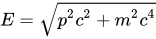


I removed the above section. Similar material has been inserted into several pages. It has been unreferences whereever it appears. As best as I can determine, it is based on somewhat dubious fringe theory with little or no mainstream coverage. In WP, it has spawned AFDs at retrocausality and supercausality, and a partial rewrite at conciousness. I've inserted the text here in case there is some application or validation for the material to this topic that I have overlooked. Serpent's Choice 10:52, 31 December 2006 (UTC)
- I have again removed this section. There are several concerns I have over its verifiability and accuracy. It is correct that this important physics equation has negative-energy solutions. These equate to the existence of antimatter. It is true that Feynman modeled the behavior of antimatter as normal matter moving backward in time, but this modeling system does not imply anything resembling the "attractor system" framework discussed above. Nor is Einstein's use of "Übercausalität" thought to imply such a structure. I am unable to find any reference to the author mentioned, Chris King, in physics or philosophy literature. The end result is that this passage is unsourced original research. Please discuss sources for this material before including it in articles in its current condition. Serpent's Choice 00:08, 9 January 2007 (UTC)
"Scientific Determinism" and First Cause
The "Scientific Determinism" section gives an unclear treatment of the First cause issue, which is dealt with much better in the First Cause section. The claim at the end is at least bordering on WK:OR. The scientific determinism page linked in currently contains suspected OR material.1Z 01:40, 13 January 2007 (UTC)
Merge with First Cause?1Z 21:56, 16 January 2007 (UTC)
"A Multi -deteministic model"
"Multi-determinism" is not an accepted term. The section should be called somehting like "psycho-physical causation"
Some determinists argue that materialism does not present a complete understanding of the universe, because while it can describe determinate interactions among material things, it ignores the souls of conscious beings. By 'soul' in this context is meant an autonomous immaterial agent that has the power to control the body but not to be controlled by the body of which there is no evidence (this theory of determinism thus conceives of conscious agents in dualistic terms).
The bolded passage appears to be an attempt at WK:NPOV. The section certainly needs some balance, but the status of the "soul" in the face of brain science should be given a fuller mention.
However, determinism is not necessarily limited to matter; it can encompass energy as well.
Not relevant to anything -- delete.
The question of how these immaterial entities can act upon material entities is deeply involved in what is generally known as the mind-body problem.
amend to
The question of how these immaterial entities can act upon material entities is deeply involved in what is generally known as the "interactionist dualism" solution to the mind-body problem.
It is a significant problem which has yet received no answer within the universe of discourse related to the physical universe.
Of course, physicalists simply reject the soul. Delete.
Albatross
Determinism has some inherent self-contradictions. It is based upon a logical conception of the universe following rational chains of cause and effect. Although some may like to think of logic as objective, the answers it comes to are derived by applying it to purely subjective data: that of our senses. As our thought patterns themselves are largely based upon our perceptions of the outside world, it is perfectly possibly that logic itself is subjective. Now, without any application of logic, people will tend to naturally believe themselves in control of their own actions to some extent, independant of what has already been. What is to say that this natural perception is any less to be trusted than those arrived at by means of logic? So determinism could be seen as defying one perception with another, which it holds as somehow closer to objective truth, when in reality, this percepetion is also subjective to at least some extent. -Albatross thief1Z
- None of that has anything to do with the writing of this encyclopaedia article. Please read our Wikipedia:Talk page guidelines. Uncle G 14:50, 15 March 2007 (UTC)
I don't understand two of the "Arguments against determinism"
The first argues about how morality would be moot if there's no free will... How is that an argument against [the validity] of determinism?
The second talks about physical phenemona to which a set of deterministic rules was not entirely found.
But determinism is "defined as the thesis that there is at any instant exactly one physically possible future" and not something like "everything can possibly be foreseen given all variables and rules and all variables and rules of the Universe can be discovered and acquired some day".
Thus the question of what humans can or cannot predict seems moot and I fail to see how is it as an argument against the validity of determinism...
"(Perfect) predictability implies strict determinism, but lack of predictability does not necessarily imply lack of determinism."
Those two sub-sections however are quite intersting and relevant but shouldn't they be relabeled/relocated?
Thanks
Miguelrj 22:59, 9 April 2007 (UTC)
- "How is that an argument against [the validity] of determinism?".
- It is an argument if you think morality is not moot. Otherwise it fails.
- I see it as more of an argument against the assumption of certain moral conclusions from Determinism (which don't necessarily follow, I think) than one against its validity proper. As a logical counter-argument, it's simply fallacious.AoS1014 16:20, 19 May 2007 (UTC)
- "defined as the thesis that there is at any instant exactly one physically possible future" and not something like "everything can possibly be foreseen given all variables and rules and all variables and rules of the Universe can be discovered and acquired some day".
- If determinism cannot be asserted as true on the basis of successful prediction, on what other basis can it be asserted? This argument does not show determinism to be false so much as problematic, or "moot". Note that it is far from commonly agreed that determinism is true-unless-proven-false.1Z 01:02, 10 April 2007 (UTC)
- It's worse than that. The thesis that "there is at any instant exactly one physically possible future" has testable consequences that have not been observed in the Bell test experiments.--agr 11:43, 20 May 2007 (UTC)
First Cause
The article currently does not provide a counter-argument for First Cause, which is given in the First Cause article. Namely, that there's no logical reason to why the First Cause would itself not be caused; or, in other words, that there's no logical reason to simply "admit an exception" to causality, assuming it to be true in all other cases (and abandoning the assumption of causality would, of course, destroy the whole argument for assuming a First Cause). I'd add it myself but I don't have appropriate sources at hand. AoS1014 16:00, 19 May 2007 (UTC)
Agreed. The entire First Cause section looks like original research to me; the whole thing is just an uncited argument for the existence of an uncaused First Cause. I have particular problems with the passage "(2) There is no event A0 prior to which there was no other event, which means that we are presented with an infinite series of causally related events, which is itself an event, and yet there is no cause for this infinite series of events", which seems to dismiss without adequate justification the possibility of an infinite series of events by writing off (without explanation) such a series of events as an "event" itself in need of explanation. But wiki is not the place for our own arguments and counter-arguments. I think the "first cause" section would be better rewritten as equally presenting the three possible answers to the cosmogenic question (a first cause, an infinite series of events, or a causal loop) in equal light, citing various philosophers who have presented arguments for these three positions. -Forrest 17:07, 12 December 2007 —Preceding unsigned comment added by 70.177.4.159 (talk)
Radical Behaviorism?
Radical Behaviorism is a philoophical system that supports a non-mechnistic form of determinism. It is not "scientific determinism" as I read the page. Unless I am mistaken this page summarized only the mechanistic position, and then developed only that position.
--florkle 02:47, 21 May 2007 (UTC)
- Really, I believe Skinner relies on a radical interpretation of a Hobbesian argument related to the subject just above this one. I can look into it if you like. --Kenneth M Burke 23:57, 26 May 2007 (UTC)
Weasel Words
I added a "Weasel Word" warning to the "Argument from Morality" section of the page. The section continuously uses hypothetical people and sources rather than real ones. Additionally, it also says that 'determinists' view morality as having a logical basis, as if this were a worldwide view of determinists. If there were other weasel-wordy sections that I did not mark, it it not necessarily bias; that section was the only one I read that was very bad, although I did not read every small section of the page. Justin Satyr 19:47, 28 May 2007 (UTC)
- "The section continuously uses hypothetical people and sources rather than real ones".
- Then it needs "who" tags or "fact" tags. I am removing the weasel banner.
Inaccurate report on scientific consensus on Bell issue. Not objective
If nobody is going to do this, at one point I will be going to change the following passage (so please, do contribute with what you think, and with sources): "There have been a number of experiments to verify those predictions, and so far they do not appear to be violated (sic!) although many physicists believe better experiments are needed to conclusively settle the question. (See Bell test experiments.)"
There are two views on this, and both lead me to the conclusion that the wording should be changed. View one: True. All experiments in Physics need better experiments. This is true and it is a fundamental tenet of Science, as in regard to it any experiment, if more accurate, would unveil new phenomena, incosistent with the present theories (it is Popper's principle). In this sense, this note of caution should be used along every single experiment that is mentioned all throughout Wikipedia, or elided here. Otherwise, it would seem that this particular experiment is less reliable or has been perfmormed less accurately than all other experiments mentioned in Wikipedia, or that the results are more controversial than others. And this is untrue, simply put.
View two: The main article refers to the fact that some voices have been raised that question the conclusions of the experiments. This is indeed true, but the right word to be used here is a handful of physicists and not many physicists. We are talking about four of five physicists (of minor impact) againts the view of a community of hundreds, who are both (i.e. on either side) familiar with the experiments and their set-ups. The wording that I propose would be more objective, I think. This does not entail in any way that those few physicists are wrong, indeed they may be right. But the new wording would just refelct the objective reality as to how things are in the Physics community. As it is written now, it is as if in fact the majority of physicists are concerned. What a paradox! (maybe it was a lapsus, the intention being "many philosphers", not many physicists)
I would also say that so far they do not appear to be violated should be changed into they have been verified (predictions are verified, and not not violated). Again, I get the impression from the article that for some reason this should be considered a unique experiment in all the realm of Physics and indeed Science (especially of notice is also the wording "so far", again, applicable in principle to every experiment known to mankind but used only here), wherby we expect it to be violated any moment much more than all others. I might add: Ironically, Bell tests are about some inequalities that cannot be violated, were Einstein's view tenable. Indeed, experiments show they are violated, as Bell predicted. That to refer to this fact one should use the wording "prediction not violated" seems very ironic indeed (but also very confusing). To put it explicitly, the article is basically saying that the prediction that certain inequalities are going to be violated (because of quantum reality) has not been violated in experiments. Terrible! --209.150.240.231 04:56, 18 June 2007 (UTC)
| This is an archive of past discussions about Determinism. Do not edit the contents of this page. If you wish to start a new discussion or revive an old one, please do so on the current talk page. |
| Archive 1 | Archive 2 | Archive 3 | Archive 4 |
Determinism vs Fatalism
It is acknowledged, in the second paragraph no less, that people generally mistake determinism for fatalism - and vice versa. I think given this popular misconception, a fuller explanation of the differences between causal determinism and fatalism is warranted.
For example, the following from the Fatalism page sums it up succinctly: "Therefore, in determinism, if the past were different, the present and future would differ also. For fatalists, such a question is negligible, since no other present/future/past could exist except [that which] exists now. —Preceding unsigned comment added by 203.116.167.165 (talk) 09:16, 29 November 2007 (UTC)
- I agree that the point needs cleaning up. Also, determinism just involves predictability (say, in a mathematical or theoretical sense). There is no necessity for causality, ie, there is no need for a cause of everything. The fact that a pendulum is here now is not caused by it being there then, it is just following a completely determined path. When two balls collide, one is not the cause of the collision.
- The problem is that you get these religious arguments that something had to cause the universe to exist. It is just deterministic, it doesn't need a cause. The past does not cause the future, but a theoretical complete knowledge of the past in determinism would allow you to predict the future. (Except that the means of predicting it would have to be part of that past!) Mike0001 (talk) 11:07, 22 February 2008 (UTC)
- Obviously the past does cause the future. If at a given moment you are falling through the air next to a tall building, the future (in which you are on the ground, dead) was caused by the past (in which you jumped off the building); if you hadn't jumped, you would have lived therefore your actions (past) caused your death (future). Determinism does not allow you to predict the future completely because the causes of any event are unimaginably complex but clearly the future is somewhat predictable because once you have jumped off the building you can predict with certainty that you are going to hit the ground and die.
Cleanup and rewrite
Huge mess that needs immediate attention. Viriditas (talk) 09:06, 16 October 2008 (UTC)
Archived
Wow, this page was way too long so I've created some archives. If you want restart an archived discussion, please do not edit the archive but start a new section on the current talk page. Astronaut (talk) 20:48, 23 November 2008 (UTC)
Free will in theology
There should perhaps be a short mention on the debate of Free will in theology, which is largely related to the question of determinism. ADM (talk) 12:59, 4 February 2009 (UTC)
NPOV on Cognitive Sciences
Not every emergentist cognitive scientist defends determinism. —Preceding unsigned comment added by 189.146.4.89 (talk) 09:08, 9 October 2008 (UTC)
The above statement is pov. There is no references given to back the above stated assertion. However the passages regarding emergentist perspctive in the article have been stated with references. thanks Robin klein (talk) 18:24, 22 March 2009 (UTC)
Deleted section
I today deleted this section cause it was not cited an in my opinion is misleading:
- By now we not only see that we are unable to describe a very large piece of reality exactly but we also moved from direct to statistical formulations of physical laws. Many of today's scientists still understand physical laws as rules that drive the world and believe there must be some most basic rules all the others are derived from, but this view is much weaker now than in Newton's era. [quote needs citation]
- You have to present the science that states that there are weaker believe in determinism now, rather than in Newtons era.
- You have to discuss the part of reality that we cannot describe exactly. What effect does this have on the life as such. The most of this is annulled on molecular level.
- Stephen Hawking thinks that there also may be room for determinism within Quantum_mechanics:
- “These quantum theories are deterministic in the sense that they give laws for the evolution of the wave with time. Thus if one knows the wave at one time, one can calculate it at any other time. The unpredictable, random element comes in only when we try to interpret the wave in terms of the positions and velocities of particles. But maybe this is our mistake: maybe there are no positions and velocities, but only waves. It is just that we try to fit the waves to our preconceived ideas of positions and velocities. The resulting mismatch is the cause of the apparent unpredictability.”
- (A Brief History Of Time by Hawking)
- “These quantum theories are deterministic in the sense that they give laws for the evolution of the wave with time. Thus if one knows the wave at one time, one can calculate it at any other time. The unpredictable, random element comes in only when we try to interpret the wave in terms of the positions and velocities of particles. But maybe this is our mistake: maybe there are no positions and velocities, but only waves. It is just that we try to fit the waves to our preconceived ideas of positions and velocities. The resulting mismatch is the cause of the apparent unpredictability.”
-- Hogne (talk) 11:35, 27 March 2009 (UTC)
The reason modern physics is not as deterministic as in Newton's time is because of two of the three fundamental theories of physics; Quantum Mechanics and Thermodynamics. However, these theories introduce the concept of probability for completely different reasons and in completely different ways. And both can be disposed of if you want!
If you want to get rid of probabilities in QM you only need to realize that all probabilities here are introduced not by the theory itself but by it's philosophical interpretation. If you simply chose to adhere to any of the minority interpretations of QM that are deterministic you don't have to view QM as probabilistic at all. You will for sure have to accept some other very weird things in the process, but all probabilities can disappear from QM if you really want.
If you want to get rid of probabilities in Thermodynamics you only need to realize that all probabilities here are introduced as a means to reduce very complicated calculations into a form that are manageable and indeed solvable. The only prize we have to pay for this is that the results are not certain anymore, only probable in nature. Until quite recently probabilistic reasoning in thermodynamics was also only seen as an heuristic and not a fundamental and indispensable ingredient in the theory. Now Chaos Theory has taught us that the problems involving many interacting particles (three is enough) are really theoretically unsolvable without probabilistic reasoning. We can therefore now talk about Deterministic Chaos, meaning theoretical (mathematical) systems that are indeed deterministic but where we nevertheless need to invoke the probability concept to calculate the evolution of any quantity larger than a mathematical point. In this way 'determinism' and 'indeterminism' aren't seen as contradictory concepts today, as they originally were.
So for these reasons physicist of today are more sympathetic towards indeterminism than physicists two centuries ago. But it's still true that physical theories are stated in a "deterministic" way. The physicist then, when applying the theory, introduces probabilities as an aid. Either as an aid in interpreting the deterministic theory (QM), or as an aid in solving the complicated equations the theory produces (thermodynamics).
Worth noting...
Using determinism as a basis for predicting the future, would not knowledge of the predicted future then allow one to change the predicted future (simply by consciously avoiding predictions), therefore invalidating the original predicted future and revealing determinism to be an inaccurate basis for prediction? Physical impossibilites aside, of course.
- You could only change something if it weren't predetermined anyway. The ability of individuals to change the future arbitrarily assumes free will, which gets into the whole free will -v- determinism thing. WhiteC 18:23, 14 Jan 2005 (UTC)
- Another mention of the 'free will' vs determimism thing. Don;t forget QM doesn't allow free will either.
- I'm not sure if this is the right proceedure for reviving older discussions - I've moved this section from the archive. Anyway, carrying on from the two previous entries:
- The idea of determinism assumes that the future is determined, therefore if such a computer could be contrived that had the memory and ability to capture and store all the present information/rules (current state, basically) of the universe, it could predict the future with certainty for all eternity based on those conditions or causes (given some unimaginable processing power). Obviously such a computer or form of intelligence is not conceivable, but it still poses a theoretical problem.
- What theoretical problem is posed by this? It's basically time travel; If you could accurately predict the future like that, you knowing the future, would be a part of the calculation and your decisions could not change the future from the prediction. If you traveled back in time, you might try to change what is going the happen, but you can't because from your original point of view, whatever you did/do in the past already happened Obviously these things are impossible, but they do not pose any theoretical problem.
- The problem with this is that given an intelligent life form knows the future, it will then be possible for it to change things, rendering that future no longer true. I don't believe that free will could stop this - even if we have no free will our genetic make-up could still cause us to behave in this way. The key problem here for me is that such a machine would then have to try to take its own existence into account, which if it lead to a change in the future from its own determination of the future (a person acting on that knowledge, for example), the results could not be computed as a series of infinite loops would be created. Therefore such a calculation could never be made even in theory, if it allowed for anything acting upon that prediction in some way as to change it.
- Answer: It may seem a bit paradoxical at first glance, but in theory this is how it would work. If an intelligent life form had precise awareness of the future and took action upon the present to alter that specific course of progression which his foreknowledge had revealed, the following would hold true. As you've indicated above, the course of progression in question could in fact become altered (from what this acquired information seemed to decree) by actions taken because of the awareness itself. However, the crux here is that if it were altered, the altered course of progression would not truly be an alteration of the steadfast determinative pattern. Instead, it would be the opposite: a forever-standing preset part of the progressive determinate universe. As would the intelligent life form's foreknowledge of what would have occurred absent 1) his foreknowledge, 2) his altering action, and 3) the subsequent effect upon the target outcome. The key is that any precise knowledge of the future and all that would stem from it would as well be predetermined. As such, any changes stemming from such conditional foreknowledge would in fact not be changes from what has always been the inflexible determinate course of progression. Ergo, in order to have a precisely accurate determinative awareness of what is to occur, any machine or person's calculations would be required to factor in *themselves*, their own foreknowledge, and, most importantly, whatever actions they would in fact take upon events leading to the end point in question.
- Question, what is the smallest item that could be used to store information about the smallest possible particle? The answer is surely 'the smallest possible particle'. So the best computer we could hope to create that could store the information about the mass, momentum, location, etc of every particle in the universe would itself have the mass of the universe. In which case we now have a universe with twice as much mass, so where do we strore the info for the extra bits (another universe mass computer), and so on. The only option is to assume that the computer IS the universe. It is the only thing that can predict the future, and it is doing exactly that - in real time. --WBluejohn 20:40, 2 April 2007 (UTC)
- This is just the same logic as travelling back in time, in fact it is basically the same thing, as you are bringing the future 'back in time' to the present. I am unsure whether it is possible, only in theory, to calculate the future without acting upon that knowledge to change it. Richard001 09:27, 25 July 2006 (UTC)
Laplace's demon only works if the information of the future does not have an effect on the present state of the universe, laplace's demon must be omniscient but powerless to all within the universe otherwise laplace's demon would become a paradox, it can only exist either 1) outside the universe or 2) within the universe as a spirit who is powerless to physical events. Omniscience IS possible, Omnipotence is NOT possible because all in the universe is governed by strict unchanging physical laws, one may argue that an entity tweeked the laws of physics so everything would happen according to a plan, but the fact that the laws of physics are so simple e.g. E=mc2 and shows that they have not been tweaked as finely as one might imagine. The future is predetermined but without intent. User; Joshua Reid —Preceding unsigned comment added by Joshuareid (talk • contribs) 10:53, 9 June 2009 (UTC)
Bad Philosophy
This article seriously needs rewriting. First of all, determinism and causality are two wholly separate issues and should not be treated as being the same thing. Second, we need proper definitions of what we mean by determinism before we launch into all the "Free Will" stuff. I suggest someone with the time and the motivation read John Earman's Primer on Determinism and then rewrite the begining of this article so that it isn't quite so philosophically naive and misleading.Incompetnce (talk) 17:13, 28 July 2009 (UTC)
Views of Koch, Polkinghorne et al.
Hi Snalwimba. Christof Koch is not "speculation presented as fact". Nor for that matter is Polkinghorne. There seems to have been a real change in attitudes in the last few years, and I think you would struggle to find a first-rate neuroscientist who now claimed that the brain was deterministic. If so, please add the refs. NBeale (talk) 19:49, 3 September 2009 (UTC)
- Somewhat like what critics of Questions of Truth contend, this section is a moulinex of two fields, Quantum indeterminacy and Biological determinism creating a funny grey goo. It may sell but it ain't WP and there is no need for that section to be there at all. If by Determinism in biology we mean Biological determinism then we link to that but this article is about the philosophy not the mechanics. It is plainly stated elsewhere in say Genetic determinism that few go with strong Biological determinism - it is refer to as a strawman (we cite "The Myth of Genetic Determinism" in A Devil's Chaplain by you-know-whom). This section on Determinism and biology is superfluous and insufficiently nuanced to correctly reflect the material. Ttiotsw (talk) 07:38, 7 September 2009 (UTC)
- The trouble is that the article on biological determinism is in terrible shape and needs a lot of work to make it worthwhile, which I for one certainly don't have time to do. The view that the brain is non-deterministic which is now mainstream was not at all so a few years ago, indeed much of the discussion of freewill is about "compatbilism" which is now a dead letter. This is of course different from "it's all in the genes" or "it's all in the environment" which I agree are now straw men. The idea of the deterministic brain is still quite widespread amongst non-specialists. NBeale (talk) 19:16, 7 September 2009 (UTC)
- Let's not forget that a minority of physicists subscribe to hidden variables that (conceivably) may yet throw determinism back into the mix. I'm also a little uneasy that QoT is being cited here as an authority on this topic by (surprise, surprise) an authority on QoT. Last I read, this source's treatment of the subject was being roundly spanked. Surely we can find references to support this (ostensibly) widely-held view in the primary scientific literature rather than the deep gray? --PLUMBAGO 16:55, 9 September 2009 (UTC)
- Well Grayling knows nothing about physics. Polkinghorne may be said to be parti pris although QoT is a WP:RS. But Koch is completely mainstream. Also is hidden variables bring back determinism this would apply to everything, not just the brain. The majority view as late as the 1990s was that indeterminism applied at the quantum scale but not at the neuron scale. I have another ref as well which I'll add, and I'm sure there are more. NBeale (talk) 18:40, 9 September 2009 (UTC)
- Let's not forget that a minority of physicists subscribe to hidden variables that (conceivably) may yet throw determinism back into the mix. I'm also a little uneasy that QoT is being cited here as an authority on this topic by (surprise, surprise) an authority on QoT. Last I read, this source's treatment of the subject was being roundly spanked. Surely we can find references to support this (ostensibly) widely-held view in the primary scientific literature rather than the deep gray? --PLUMBAGO 16:55, 9 September 2009 (UTC)
- The biological question cannot be settled when the physical question is not, and it is not. I am toning down the hype in the addition. 1Z (talk) 21:08, 9 September 2009 (UTC)
- Polkinghorne is not a biologist and QoT is a semi-theological work, not primary mainstream science. I'm pulling the ref. 1Z (talk) 21:08, 9 September 2009 (UTC)
- The new reference (Lewis & MacGregor, 2006) is a much better source. Good find. It's not only primary literature, but it's also more conservative and even-handed in its references to chaos and quantum indeterminism. It might be better to source a statement from this than use the rather over-reaching one of Koch's that is currently in the article. Although a deterministic, neorealist interpretation of QM is not much favoured, Koch's statement precludes it out of hand. I would imagine that he's a lot more cautious in a formal scientific publication rather than a book. Cheers, --PLUMBAGO 12:37, 10 September 2009 (UTC)
Things have actually moved on quite a bit between 06 and 09. Koch and Polkinghorne are both highly notable, and since this is in the field of how quantum mechanics may scale up through chaotic systems this is well within Polkinghorne's area of expertise. Plus QoT has heavyweight scientific endorsement and this is AFAIK the first time a plausible explanation for how the quantum uncertainties can be amplified to neural scales had been published - so (although I must declare an interest as co-author) I really think it is only fair to leave it in. NBeale (talk) 12:58, 10 September 2009 (UTC)
- Hmmm. While Koch is a neurobiologist, I'd much prefer some writing from him that was from a peer-reviewed publication instead of a book, largely for the reason I mention above (he may, of course, say the same thing there, but I expect more cautious utterances). And as much as Polkinghorne is an expert on QM, it's not obvious that this translates into expertise in the biological determinism discussed here. The Lewis & MacGregor source seems better given (a) it's a paper and not a book, and (b) the background of its authors is much closer to the topic at hand. If Polkinghorne has published on this topic in the scientific literature, then that would be a more appropriate source than QoT. --PLUMBAGO 14:13, 10 September 2009 (UTC)
- Not suggesting Polk instead of L&M 2006 but I think it should stand alongside. Again, although not formally "peer reviewed" QoT carries endorsements from Nobel Laureates Hewish and Phillips and NIH Director Francis Collins (all of whom read it beforehand!) and it is highly unlikely that L&M got a similar level of scrutiny. NBeale (talk) 16:05, 10 September 2009 (UTC)
- Oops. I forgot about all this. Sorry. Anyway, it really doesn't matter who "reviewed" QoT before its publication — the point remains that QoT is primarily a book with a strong theological core, one that ranges widely over science topics instead of being a specific treatment of biological determinism, and one whose authors are experts in subjects other than biology. If QoT is summarising a scientific viewpoint that is expressed more fully elsewhere, ideally within the scientific literature (since this is a science article), then these other sources should be used instead. QoT, at least judging from its website and blurb, is not at all an obvious source for this topic. Were the article section a meditation on determinism and theology (as a lower section is) then, yes, it would be a good source. But this section focuses on science, so a book whose main motivation lies in theology (and, more specifically, one flavour of this), is not going to be a good source. 1Z, and [[User:Snal
wibma|Snalwibma]] before him, were right to favour more relevant sources. And I'd still prefer something from Koch that's from a more staid publication too (but can't find anything). Cheers, --PLUMBAGO 11:58, 16 September 2009 (UTC)
- What possible relevance lies in the fact that several distinguished people agreed to "endorse" QoT? Such argument from authority has no bearing on the (ir)relevance of a book about religion and science in a section of the article that is concerned with biological determinism. As Plumbago says, it is very far from an obvious source on the topic, and its insertion here looks like some pretty desperate self-citation! Especially now that there is a source from something much more suitable (even though not perfect), the QoT reference should be deleted. SNALWIBMA ( talk - contribs ) 12:18, 16 September 2009 (UTC)
- Peer review consists essentially of getting people to look at a paper and "endorse" it or otherwise. And this is an article about philosophy - not a scientific paper about biology. As for "desperate self-citation" Koch has joined a collaboration based on the work in Appendix B of QoT which is how I have a copy of his Chapter. NBeale (talk) 14:35, 16 September 2009 (UTC)
- The section of the article in question is about science. 1Z (talk) 14:37, 16 September 2009 (UTC)
- Well somebody has an interestign interpetation of "absence of objections". 1Z (talk) 17:00, 16 September 2009 (UTC)
- All these objections arrived after I had noted the "absence of objections". Ah well :-) NBeale (talk) 18:06, 16 September 2009 (UTC)
- Well somebody has an interestign interpetation of "absence of objections". 1Z (talk) 17:00, 16 September 2009 (UTC)
- It is clearly the case that several of the objections made above were made before your re-insertion. 1Z (talk) 20:37, 16 September 2009 (UTC)
Determinism and ethics
To argue that determinism negates morality is akin to arguing that determinism negates sex. Determinism can present no argument as to why we should or shouldn't feel emotionally compelled to behave in a certain way, it only points out that our feeling compelled to behave in any way is the result of heredity and environment and not "free will". This renders moral responsibility meaningless but not morality itself. The idea of morality being meaningful or meaningless is a value judgement and a question for philosophers, not scientists or 'logic'. —Preceding unsigned comment added by 76.71.57.17 (talk) 01:06, 4 January 2009 (UTC)
Well, i agree that morality doesn't become meaningless with determinism. In fact, determinism doesn't change anything! All we need to do is redefine "free will" as just "will". It doesn't make a difference at all because no one can even explain "free will"!Mehfoos (talk) 19:05, 6 March 2010 (UTC)
Looking into the future
If determism is right, you should in theory be able to produce a machine which can calculate the future. But then you could be able to see what you were doing in the future. Then what about if you decide not to do it. What happens then? Does it say anything about that in this article? --212.247.27.110 17:40, 30 August 2007 (UTC)
- No. Who made up such a rule? It's high time that you guys understand- the idea that the future is predictable is different form the idea that the future is fixed.Mehfoos (talk) 19:10, 6 March 2010 (UTC)
- oh! here he is the one that I've been looking for. :)
- http://en.wikipedia.org/wiki/Talk:Laplace%27s_demon#Another_argument_against_Laplace.27s_demon
- I'm glad to have found you! ...may I reply to MikeUpNorth: "but, would you be capable of imagining yourself not be able to not do what the machine saw you'd be doing? it's a strange paradox: the machine tells you you'll be at this place in two hours, but in reality it is mistaken because you'll not be there (because you want to change the future). Whatever people think, I myself would not be able to imagine that going somewhere else than where the machine pointed to would be impossible. I mean, your legs would be out of your control and bring you where you're supposed to be? give me a break." opinions welcomed! Twipley (talk) 07:08, 9 December 2008 (UTC)
- Discussion moved to: Twipley (talk) 17:24, 9 December 2008 (UTC)
You are basing this on the premiss that hard determinism and free will can co-exist; it is a necessary truth that they cannot. If we accept hard determinism to be true then all human actions and behaviours are governed by an unbroken chain of prior events just like everything else. This means the ability to 'decide', as you put it, does not exist in any real sense. MikeUpNorth 09:46, 19 October 2007 (UTC)
Still an interesting theory but one point: this machine would have to have every single piece of information that exists (not an easy feat by any means (and probably impossible, when you consider energy cannot be created/des... i.e. you would have 2 universes going at once) including the fact that someone built the machine and looked at his/her future so the outcomes would be the same. —Preceding unsigned comment added by 86.3.147.244 (talk) 16:44, 9 March 2008 (UTC)
arguably the machine would to take into account all factors, including your reaction to the machine's prediction
This is not a issue of determinism. The problem is that such a machine could not exist.
http://en.wikipedia.org/wiki/Halting_problem
http://en.wikipedia.org/wiki/Undecidable_problem —Preceding unsigned comment added by 128.193.160.34 (talk) 09:01, 9 February 2010 (UTC)
Separating Necessitarianism from Causal, Physical, and Mechanical Determinism
The lengthy opening paragraph under Varieties combined and confused different determinisms in other Wikipedia entries. They now have separate paragraphs.
Here is the original version in case we want to recover some material to other sections.
Causal (or nomological) determinism is the thesis that future events are necessitated by past and present events combined with the laws of nature. Such determinism is sometimes illustrated by the thought experiment of Laplace's demon. Imagine an entity that knows all facts about the past and the present, and knows all natural laws that govern the universe. Such an entity might be able to use this knowledge to foresee the future, down to the smallest detail.[1] Simon-Pierre Laplace's theory is generally referred to as "scientific determinism" and predicated on the supposition that all events have a cause and effect and the precise combination of events at a particular time engender a particular outcome.[2] This causal determinism has a direct relationship with predictability. Perfect predictability implies strict determinism, but lack of predictability does not necessarily imply lack of determinism. Limitations on predictability could alternatively be caused by factors such as a lack of information or excessive complexity. An example of this could be found by looking at a bomb dropping from the air. Through mathematics, we can predict the time the bomb will take to reach the ground, and we also know what will happen once the bomb explodes. Any small errors in prediction might arise from our not measuring some factors, such as puffs of wind or variations in air temperature along the bomb's path. Cmsreview (talk) 15:10, 6 April 2010 (UTC)
References
- ↑ Suppes, P., 1993, “The Transcendental Character of Determinism,” Midwest Studies in Philosophy, 18: 242–257.
- ↑ Hawking, Stephen. "Does God Play Dice?". Retrieved 2008-11-16.
Paradox on Laplace's demon
"Would not knowledge of the predicted future allow one to change the predicted future (simply by consciously avoiding predictions), therefore invalidating the original predicted future and revealing determinism to be an inaccurate basis for prediction?"
- Not really. If the original prediction was correct, it would have taken this into account. So if there is any deviation between the prediction and the actual outcome, then that means that the prediction was wrong. 12.10.248.51 (talk) 17:21, 2 April 2008 (UTC)
- beats the heck out of me. imagine an all-knowledgeable machine telling the future, e.g. that you will be at your friend's house in two hours. is the machine broke? it is supposed to tell the truth. so pretending it tells the truth, what holds you back "breaking the fate" and going somewhere else instead? I've talked about the paradox at the following places:
- http://en.wikipedia.org/wiki/Talk:Determinism#Looking_into_the_future
- http://en.wikipedia.org/wiki/Talk:Laplace%27s_demon#Another_argument_against_Laplace.27s_demon
- as I understand it, a concrete example is needed. "what could possibly be foretold, that could not consciously be avoided?" Twipley (talk) 07:25, 9 December 2008 (UTC)
- The true basis for the theory is that what will happen is what is going to happen and you cant do a damn thing about it. Take into account this hypothetical situation. A prediction is made saying the world will end. Does you knowing the world will end change the fate of the world? The world is tied together and everyones actions are connected. Cloudblazer (talk) 15:59, 4 February 2009 (UTC)
- But what if I have the machine in my possession. And I ask it where I will be in two hours. Will I be able to change fate? But I shouldn't be able to, because the machine I have in my possession is not supposed to be flawed. See the paradox? Twipley (talk) 07:47, 9 February 2009 (UTC)
- I think the paradox results from you giving the machine a causal role in your choice. It's like this. Suppose I build a machine to predict the future and I tell it "I am going to buy either a black bucket or a white bucket. I want you to predict which one it is, and I will then choose the opposite."
- The machine can't possibly give you a correct answer because your choice is dependent on the machine's answer.
- The machine still knows the correct answer, but it can't tell you while you haven't made the choice as that represents new information that changes the outcome. So suppose the machine says "black", it knows you will buy a white bucket because of that, but it's not a paradox of determinism, it's a paradox that stems from the way you're framing the problem. Think about it this way: if the machine tells you you will buy a black bucket, and you then buy a white bucket or don't buy a bucket to prove it wrong, you're still in a deterministic path where the choices you make are the product of earlier events.
- Your actual choice - to visit your friend or not, to buy a black or white bucket - is going to be the result of your psychological makeup - your desire to see your friend versus your desire to prove you have free will - and the machine would be able to predict the outcome. It just can't tell you because as soon as it tells you, the new information determines a new outcome, so the act of telling makes the prediction out of date.
- But for all that, I still think the idea of free will is relevant because we will probably never have enough information to make predictions to any level of relevant accuracy. If you could measure every variable when you rolled a dice you would not have any reason to bet on any number but the winning one, but as long as the situation is too complex for us to fully understand, we can make meaningful choices. 152.91.9.219 (talk) 03:29, 24 February 2009 (UTC)
- hmmmm, that's nice talk. reminds me of that "problems cannot be solved by the same level of thinking that created them." if i ever get more insight on the problem, i'll be sure to post here and let you know. by the way, for the ones interested, some more chat on the matter can be found on my talk page. Twipley (talk) 01:58, 12 April 2009 (UTC)
This is simply the liar paradox in disguise and is troubling in virtue of that, not in virtue of being a problem for determinismIncompetnce (talk) 17:10, 28 July 2009 (UTC)
I honestly don't understand why people don't get the point. The point is: "You cannot make such a machine". Simple as that! What was Heisenberg's principle all about? There is no way we can predict even the exact location and momentum of an electron. And electron is not even one of the fundamental particles that we know of. There can never be any technology ever (future-proof) developed to do that. Hence the talk of this hypothetical machine is pointless! It is plain irrational! But determinism doesn't break down because it doesn't claim that the future can be predicted. All it claims is that the future is(from the bigger picture) very much fixed. One must understand that each one of us, individually need not be concerned about that, because all of our knowledge is due to perception/is a resultant of empiricism. Hence, the "bigger picture" doesn't affect us.Mehfoos (talk) 18:05, 6 March 2010 (UTC)
- Says the person who thinks it's viable in his mind experiment to clone a person exactly and raise them at exact same conditions, all the while rolling his eyes at this thought experiment because it doesn't sound possible.--66.211.73.233 (talk) 13:37, 13 April 2010 (UTC)
- True, thought experiments can make some assumptions. In this case HP, and in my case-i dunno what. Let me clarify: The main reason I don't "roll my eyes" when I read that is because it doesn't contradict itself, but this does: If you were to know the future, you changing it would make the "knowing the future"-part false. It's logically incompatible with itself as a whole. Hence it's irrational and not just "unscientific as of now". Mehfoos (talk) 18:24, 26 April 2010 (UTC)
- Perhaps you would all enjoy David Lewis' "Paradoxes of Time Travel". As Doctor Manhattan puts it in the Watchmen movie: "Anything that CAN happen DOES happen". If we had all the information, we would know the one and only outcome of the universe. The word "possible" as we use it really just means "imaginable"- determinism would argue there is only one REAL possible future.
- True, thought experiments can make some assumptions. In this case HP, and in my case-i dunno what. Let me clarify: The main reason I don't "roll my eyes" when I read that is because it doesn't contradict itself, but this does: If you were to know the future, you changing it would make the "knowing the future"-part false. It's logically incompatible with itself as a whole. Hence it's irrational and not just "unscientific as of now". Mehfoos (talk) 18:24, 26 April 2010 (UTC)
- How does Lewis' article relate to Laplace's Demon? Our thought experiment first stated that you "see THE future". As mentioned above, we cannot allow for the idea that "you change your future" because then the first premise of our thought experiment is violated: obviously you did not see THE future! If we keep that first premise, it seems to follow that you must, by definition, witness a future that will be unavoidable.
- Question: "A machine/fortune teller showed me my future of buying a white bucket. But now it's possible that I will go buy a black bucket. Paradox ensues!"
- The Oracle from the Matrix Answers: "A machine/fortune teller showed you your future of buying a white bucket. Do not confuse what you can imagine doing with what is actually possible- you posses factual knowledge that you will buy the white bucket. All you can do now is understand WHY you certainly will buy the white bucket."
- Tricky eh? But it seems to follow from premises "One time line" + "You saw the later end of that time line". But who knows if we will ever get to test any of this empirically: some philosophers have suggested that a machine holding all the details of this universe would have to be just as large as this universe (how else would you simulate a universe with perfect accuracy?)
- Just some thoughts
- Tesseract2 (talk) 03:10, 14 April 2010 (UTC)
Determinist
We can only think of God from a human point of view. If God knows the end from the beginning he knows a person`s life. But that person still has free will and a choice whether to choose him or not. It`s an example of if you were given a chance to do something you really wanted and you took it and you went through the steps. and then you think later well, what would have happened to me if I didn`t take this chance? What would`ve been different? Would I have ended up somewhere completely different? But, at the same time you never have regrets in life, because you choose what you want and live with those choices. I believe after you have done something bad and you serve your time it should be dropped because, it was the past and you were already punished for what you did or didn`t do. Are there still consequences? Should there be consequences? —Preceding unsigned comment added by 99.11.234.155 (talk) 03:05, 21 May 2010 (UTC)
fatalism for lols
i made a small edit to fatalism, adding "and temporally unstable airplane engines" after miracles. if anyone can say how being hit by an airplane engine falling from the sky (or being hit by an airplane engine falling from a position that that airplane is not yet in - hence the temporal instability...watch the movie) is not fatalistic, or more or less relevant than miracles, then i'd be happy to hear it. for the bewildered, it's a donnie darko reference.
p.s. on a like note, i stopped myself from adding "or a deranged plot" at the end of the proceeding predictability section
Many changes
I read through the entire determinism page recently and (being a determinist) found the treatment fragmented. The goal of my re-writing has been to make the page more enjoyable and clear. I realize I have made many edits, but I am ready to discuss (and in some cases) every decision I have made.
I should also point out that I plan to tackle the "implications" section next chance I get (it needs way more links to moral viewpoints). -Tesseract2 (talk) 11:08, 25 August 2010 (UTC)
{dn}
User:R'n'B added a {dn} tag to the lede, and I'm wondering what he thinks needs disambiguating. -Stevertigo (t | log | c) 05:45, 6 October 2010 (UTC)
- Good question. Actually, this article has received a lot of editing since that January tag (not the least of which include my substantial re-writes in recent months). I will remove that tag for now, but certainly any more recent tags/criticisms may be made. -Tesseract2 (talk) 07:03, 6 October 2010 (UTC)
- What needs disambiguating is the link to state, which I realize may have been hard to figure out since I put the tag immediately following that link. :-) What meaning of state is intended? If there is no intention to direct the reader to one of the relevant articles listed on the disambiguation page state, then both the link and the template should be removed. --R'n'B (call me Russ) 10:14, 6 October 2010 (UTC)
I've removed that link for now, but Stevertigo can easily put it back with a more specific page in mind.-Tesseract2 (talk) 14:55, 7 October 2010 (UTC)