Talk:Degree of unsaturation
Add topicLatest comment: 1 year ago by Mykhal in topic Comment by AStudent
 | This  level-5 vital article is rated Start-class on Wikipedia's content assessment scale. level-5 vital article is rated Start-class on Wikipedia's content assessment scale.It is of interest to the following WikiProjects: | ||||||||||
| |||||||||||

LaTeXation complete
[edit]I think we should include some examples, since the formula is being written for everyone.
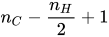
I typeset the formula. However, wouldn't it make more sense to represent it in this simplified version?
Twinxor t 21:28, 8 April 2006 (UTC)
I agreed so I changed it. Isopropyl 21:40, 8 April 2006 (UTC)
Comment by AStudent
[edit]I had 4 good ones on there, where did they go? AStudent — Preceding undated comment added 21:58, 8 April 2006 (UTC)
Oxygens, Nitrogens, Halides
[edit]Don't these affect the degree of unsaturation?142.58.43.188 (talk) 17:09, 22 October 2008 (UTC)
halides do, oxygen and nitrogen don't. i've changed it.--75.62.179.247 (talk) 02:28, 30 November 2008 (UTC)
- Yes! Where is the nitrogens? The description in the article confuses reader how to count the nitrogens. --石 (talk) 14:44, 8 December 2008 (UTC)
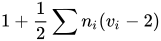
- Now the article ignores nitrogens and other trivalent atoms. I suggest the following formula: where is the number of atoms with valence . For example, in the formula CnHx, we have the DU as 1 + (n(4-2) + x(1-2))/2 = 1 + (2n-x)/2, which gives the same result as the current formula. Bbi5291 (talk) 00:50, 14 January 2009 (UTC)
- No objections for a month! It's edited. Bbi5291 (talk) 15:15, 21 February 2009 (UTC)