


Talk:Confluent hypergeometric function
Add topic | This article is rated Start-class on Wikipedia's content assessment scale. It is of interest to the following WikiProjects: | ||||||||||
| |||||||||||

Whittaker function
[edit]Is U(a,b,z) the Whittaker function? (anon, Oct 2006)
- I don't know, that's not what A&S calls them.linas 00:43, 11 December 2006 (UTC)
I am certainly not an expert, but I now know a bit about Kummer/Whittaker functions. Enough to find severe discrepancies between A&S and maple. Anybody have an opinion about whether I should tack some things up on the main page?
Kummer's function
[edit]I am interested in the real part of Kummmer's function in the case a=2n+1, b=a+1 (real part of incomplete gamma). From a numerical point of view, which is cheaper to approximate, what is the convergence like for each and what methods are used? (anon, Nov 2006)
a sub n is defined in this article, but what is b sub n? — Preceding unsigned comment added by 213.122.105.23 (talk) 12:11, 29 April 2015 (UTC)
continuous fraction for ez
[edit]The original text used to say
by setting b = 0 and c = 1
It is hard to tell what it meant because there was no c around.
M(1, 2, z)⁄M(0, 1, z)
= 1/
1 − 1⁄2 z/
1 + 1⁄6 z/
1 − 2⁄12 z/
1 + 2⁄20 z/
…
1 − k⁄(2 k − 1) (2 k) z/
1 + k⁄(2 k) (2 k + 1) z/
…
= 1 + 1/ 1 − 1⁄2 z/
1 + 1⁄6 z/
1 − 1⁄6 z/
1 + 1⁄10 z/
…
1 − 1⁄2 (2 k − 1) z/
1 + 1⁄2 (2 k + 1) z/
…
Transforming this fraction with the sequence (1, 2, 3, 2, …, 2 k + 1, 2, …) gives
1/
1 − z/
2 + z/
3 − z/
2 + z/
…
(2 k − 1) − z/
2 + z/
…
=
(ez − 1)⁄z
which is not quite what was postulated.
Formal power series?
[edit]The following is simply too cryptic for inclusion as it stands
- Moreover,
- where the hypergeometric series degenerates to a formal power series in z (which converges nowhere).


Please explain precisely what it is that this is supposed to convey, including a reference. Sławomir Biały (talk) 18:37, 3 July 2009 (UTC)
- Addendum: Presumably this is supposed to hold as an asymptotic series as z→0 in the right half-plane. But a reference (or at least a clarification) is needed to establish this. Sławomir Biały (talk) 19:05, 3 July 2009 (UTC)
Referring to @book{andrews2000special,
 title={Special functions},
 author={Andrews, G.E. and Askey, R. and Roy, R.},
 year={2000},
 publisher={Cambridge Univ Pr}
} Page 189 They agree, the formal form above diverges and they provide a convergent alternative solution by taking limits on 2F1.

Rrogers314 (talk) 20:53, 16 July 2009 (UTC)
- No one is disagreeing that the "formal form" diverges. The question is, what exactly is intended by the string of symbols
- Because a power series it most certainly is not. Sławomir Biały (talk) 03:03, 21 July 2009 (UTC)

It's the result of various transformations and limits giving a asymptotic series for x "large". The above reference covers this and computes R_n(x) as O(1/x^n) . If you would like I could try to capture the reasoning or result. To give credit; how much can I quote before violating copyright? The book is succinct and I have a tendency to wander off; this means that quoting is probably preferred in some instatnces. My guess about your request is:
1) How does this form, both as symbols and series, come about
2) The effectiveness as a asymptotic series.
3) Skipping the actual intermediate details
Clarification request
[edit]
This section seems confusing
... .Similarly
- When a is a non-positive integer, this equals where θ is a Bessel polynomial.
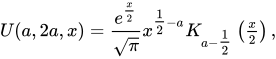

It isn't clear what the function is supposed to be. The preceding text would incline me guess at Kelvin function, but it really shouldn't have to be a guess. Could somebody please add an appropriate definition? Thank you.

I am pretty sure its the modified Bessel function

https://en.wikipedia.org/wiki/Bessel_function#Modified_Bessel_functions:_I%CE%B1_,_K%CE%B1
Multiplication theorem
[edit]It's obvious the written equation is wrong. The left-hand side doesn't contain t and the right-hand side doesn't seem to match DLMF. I will wait for other comments/references or edits before changing it though. Perhaps the author had some other formula completely in mind? [] — Preceding unsigned comment added by Rrogers314 (talk • contribs) 14:40, 9 December 2017 (UTC)