


Talk:Complete measure
Add topic | This article is rated Start-class on Wikipedia's content assessment scale. It is of interest to the following WikiProjects: | ||||||||||
| |||||||||||

In measure theory, a complete measure is a measure in which every subset of every null set is measurable (having measure 0).
Why do they say "every" null set ... i thought there could be only one, unique null set --> no elements, empty set !! ... and then "every subset of every null set" !! ... a null set will have ony one subset always (itself, and nothing else).
What a piece of cake. "m(A) = 0" is for every set!!! Not only for the empty one! —Preceding unsigned comment added by 149.156.124.9 (talk) 19:32, 2 February 2010 (UTC)
So, what is the meaning of "every subset of every null set"
- A null set is not to be confused with the empty set... a null set is a measurable set (a set element of a sigma algebra which itself has a measure attached to it) that has measure zero. A countable set of points in the reals has Lebesgue measure zero for example. In fact, there's more subtleties about a null set than it being of measure zero, see the article about it.
I have no idea how to fix this, but this article doesn't come up under a search for "complete measure space" and it ought to. 134.50.3.40 (talk) 10:59, 10 March 2008 (UTC)
Can someone improve the examples section by giving an example of a Borel set and a non-measurable subset of it, explaining why the Borel measure is not complete. —Preceding unsigned comment added by 82.31.209.115 (talk) 20:20, 7 July 2008 (UTC)
I don't know of a constructive proof, but I know of an existence proof, based on the Cantor function (the only use for that function that I know of...)
First, you have to start knowing that every positive measure set contains a nonmeasurable subset. Let K be the Cantor set, and let f be the Cantor function. Obviously, f(Kc) is the Cantor set, which has measure zero, so f(K) has measure one. We need a strictly monotonic function, so consider , which is obviously strictly monotonic, hence one-to-one, hence a homeomorphism. Now, has measure one. Let be non-measurable, and let . Because is injective, we have that , and so is a null set. However, if it were measurable, then would be measurable (here I use the fact that the preimage of a Borel set by a continuous function is measurable, since continuous functions are measurable; is the preimage of through the continuous function .)



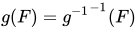

Therefore, is a null, but non-Borel measurable set. Loisel (talk) 04:16, 8 July 2008 (UTC)
Actually, I just regurgitated that mostly from memory, but in my half-drunken state, right now I can't determine if that's correct. I've edited the article, but if I got it wrong, just delete the whole thing. Loisel (talk) 04:27, 8 July 2008 (UTC)
Different definition of the completion of a measure space
[edit]Studying Measure Theory in University, I came across the following definition for the completion of a measure space: let be a measure space; then the set


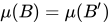
is a -algebra and, extending to defined on by letting for any set such that is contained in a null set, the measure space is complete. is defined as . I've tried to prove this. So far, I've proved , or in fact that , since for any we have and obviously , and that, supposing is well-defined, it extends , as one possible set for which is itself, as used in the short proof above. My doubts are:


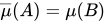





1) Give , are and elements of ? In other words, is a -algebra?


2) Is it true that for any two such sets as enter the definition of , we have that ? In other words, is well-defined?

3) Is this the same as what there is in this article under the name of «completion of a measure space»?
MGorrone (talk) 11:18, 15 March 2014 (UTC)
OK http://math.stackexchange.com/questions/713084/completion-of-a-measure-space/713140#713140 now has an answer to this. I suggest this be placed in the article. MGorrone (talk) 14:24, 15 March 2014 (UTC)