


Talk:Chain complex
Add topic | This article is rated C-class on Wikipedia's content assessment scale. It is of interest to the following WikiProjects: | ||||||||||
| |||||||||||

Chain maps
[edit]There's two sections on chain maps Chris2crawford (talk) 21:43, 5 October 2017 (UTC)
Connecting homomorphism
[edit]I'd like to suggest changing all in this article to , so that can be recycled as the connecting homomorphism. Is this a bad idea? Any alternative suggestions? I've got one text that uses for both, and another text that tries to distinguish between the two in this way. linas 12:50, 17 April 2007 (UTC)


- I think it is preferable to use in a chain complex and d in a cochain complex. Geometry guy 13:41, 14 May 2007 (UTC)
Definition
[edit]The first section defines chain complexes and cochain complexes, but they appear to be the same thing, but for the fact the indices run in the other direction. Is there something hidden or missing? Jfr26 (talk) 20:38, 15 March 2009 (UTC)
- yes, they're more or less the same thing. in practice a the dual of a chain complex gives a cochain complex, e.g. de Rham cohomology is dual to (smooth) singular homology. Mct mht (talk) 04:57, 17 March 2009 (UTC)
double complexes
[edit]I think it would be good to have some mention of double complexes, either on this page or on a separate page. I'd vote that they qualify as chain complexes, there are just a few subtleties involved. Amazelgee (talk) 18:00, 26 May 2009 (UTC)
the meaning of F
[edit]Consider the de Rham complex F of M as a singular complex (M is triangulable), we obtain the following natural isomorphism .

- where is the triangular decomposition of .



Then I'll modify--Enyokoyama (talk) 01:52, 11 March 2015 (UTC)
C class not B class -- TODO list
[edit]This article was marked as "B class" quality, and it seems obviously not so, however, it could be if, for example, some fraction of the contents of chapter 3 section 2 of Novikov "Topology I General Survey" was reproduced here. The article currently lacks the following "notable" topics:
- Definition of the cochain complex C(K;G) as Hom(C(K),G) for chain complex C(K) and abelian group G.
- Explanation for why non-abelian G fails/can't work.
- Definition of pullback (cohomology) -- see Talk:pullback for details
- Definition of scalar product between chains and cohains.
- characteristic zero G for cochains, i.e. when G is Q
- rough allusion to various dualities.
In my eyes, that would probably transform this article from C class to B and then to get to B+ or GA article, a more category-theoretic approach e.g. cribbed from JP May. "concise course in algebraic topology" book. 67.198.37.16 (talk) 18:40, 7 May 2016 (UTC)
- This is a bad article for some of the above reasons and in addition that it tells us nothing about why there is cohomology (this is a precise kind of duality) and how a cochain complex with the coboundary operator is related to the chain complex. Coboundary redirects here but there is no explanation of coboundary. Zaslav (talk) 23:54, 3 November 2021 (UTC)
Quotient module
[edit]To my knowledge the quotient module is written


and not as
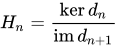
Madyno (talk) 13:36, 10 October 2020 (UTC)
- Both are used, like and . pma 20:03, 12 October 2020 (UTC)
- The more common notation uses the /. That should be used here. Zaslav (talk) 23:48, 3 November 2021 (UTC)

