


Syndetic set
In mathematics, a syndetic set is a subset of the natural numbers having the property of "bounded gaps": that the sizes of the gaps in the sequence of natural numbers is bounded.
Definition
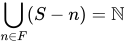
[edit]A set is called syndetic if for some finite subset of where . Thus syndetic sets have "bounded gaps"; for a syndetic set , there is an integer such that for any .





![{\displaystyle [a,a+1,a+2,...,a+p]\bigcap S\neq \emptyset }](https://wikimedia.org/api/rest_v1/media/math/render/svg/f40fe6ece101c6531276a83b3086a9b6bc4b6583)

See also
[edit]References
[edit]- McLeod, Jillian (2000). "Some Notions of Size in Partial Semigroups" (PDF). Topology Proceedings. 25 (Summer 2000): 317–332.
- Bergelson, Vitaly (2003). "Minimal Idempotents and Ergodic Ramsey Theory" (PDF). Topics in Dynamics and Ergodic Theory. London Mathematical Society Lecture Note Series. Vol. 310. Cambridge University Press, Cambridge. pp. 8–39. doi:10.1017/CBO9780511546716.004. ISBN 978-0-521-53365-2.
- Bergelson, Vitaly; Hindman, Neil (2001). "Partition regular structures contained in large sets are abundant". Journal of Combinatorial Theory. Series A. 93 (1): 18–36. doi:10.1006/jcta.2000.3061.