


Steenrod problem
In mathematics, and particularly homology theory, Steenrod's Problem (named after mathematician Norman Steenrod) is a problem concerning the realisation of homology classes by singular manifolds.[1]
Formulation
[edit]Let be a closed, oriented manifold of dimension , and let be its orientation class. Here denotes the integral, -dimensional homology group of . Any continuous map defines an induced homomorphism .[2] A homology class of is called realisable if it is of the form for some manifold and map . The Steenrod problem is concerned with describing the realisable homology classes of .[3]


![{\displaystyle [M]\in H_{n}(M)}](https://wikimedia.org/api/rest_v1/media/math/render/svg/10d0cbc38a1e6d9498d406b3c289ce1ea424f289)




![{\displaystyle f_{*}[M]}](https://wikimedia.org/api/rest_v1/media/math/render/svg/335da7d72343e438e31c78796c5908f40c41c1a1)

Results
[edit]All elements of are realisable by smooth manifolds provided . Moreover, any cycle can be realized by the mapping of a pseudo-manifold.[3]


The assumption that M be orientable can be relaxed. In the case of non-orientable manifolds, every homology class of , where denotes the integers modulo 2, can be realized by a non-oriented manifold, .[3]


Conclusions
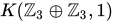
[edit]For smooth manifolds M the problem reduces to finding the form of the homomorphism , where is the oriented bordism group of X.[4] The connection between the bordism groups and the Thom spaces MSO(k) clarified the Steenrod problem by reducing it to the study of the homomorphisms .[3][5] In his landmark paper from 1954,[5] René Thom produced an example of a non-realisable class, , where M is the Eilenberg–MacLane space .




![{\displaystyle [M]\in H_{7}(X)}](https://wikimedia.org/api/rest_v1/media/math/render/svg/8c3cb832f51f8eafd3d4ea2716da441b05ca95a6)
See also
[edit]References
[edit]- ↑ Eilenberg, Samuel (1949). "On the problems of topology". Annals of Mathematics. 50 (2): 247–260. doi:10.2307/1969448. JSTOR 1969448.
- ↑ Hatcher, Allen (2001), Algebraic Topology, Cambridge University Press, ISBN 0-521-79540-0
- 1 2 3 4 Encyclopedia of Mathematics. "Steenrod Problem". Retrieved October 29, 2020.
- ↑ Rudyak, Yuli B. (1987). "Realization of homology classes of PL-manifolds with singularities". Mathematical Notes. 41 (5): 417–421. doi:10.1007/bf01159869. S2CID 122228542.
- 1 2 Thom, René (1954). "Quelques propriétés globales des variétés differentiable". Commentarii Mathematici Helvetici (in French). 28: 17–86. doi:10.1007/bf02566923. S2CID 120243638.