


Starred transform
In applied mathematics, the starred transform, or star transform, is a discrete-time variation of the Laplace transform, so-named because of the asterisk or "star" in the customary notation of the sampled signals. The transform is an operator of a continuous-time function , which is transformed to a function in the following manner:[1]


![{\displaystyle {\begin{aligned}X^{*}(s)={\mathcal {L}}[x(t)\cdot \delta _{T}(t)]={\mathcal {L}}[x^{*}(t)],\end{aligned}}}](https://wikimedia.org/api/rest_v1/media/math/render/svg/0ac41a1e11d8301c6668e16912ba74c15dbf99d5)
where is a Dirac comb function, with period of time T.

The starred transform is a convenient mathematical abstraction that represents the Laplace transform of an impulse sampled function , which is the output of an ideal sampler, whose input is a continuous function, .

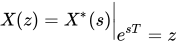
The starred transform is similar to the Z transform, with a simple change of variables, where the starred transform is explicitly declared in terms of the sampling period (T), while the Z transform is performed on a discrete signal and is independent of the sampling period. This makes the starred transform a de-normalized version of the one-sided Z-transform, as it restores the dependence on sampling parameter T.
Relation to Laplace transform
[edit]Since , where:
![{\displaystyle X^{*}(s)={\mathcal {L}}[x^{*}(t)]}](https://wikimedia.org/api/rest_v1/media/math/render/svg/55ca599338444fcc637c1eeff41126a3313cc868)

Then per the convolution theorem, the starred transform is equivalent to the complex convolution of and , hence:[1]
![{\displaystyle {\mathcal {L}}[x(t)]=X(s)}](https://wikimedia.org/api/rest_v1/media/math/render/svg/0e8b4f3f18a8bb973214717ecc7308b7431b8e39)
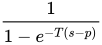
![{\displaystyle {\mathcal {L}}[\delta _{T}(t)]={\frac {1}{1-e^{-Ts}}}}](https://wikimedia.org/api/rest_v1/media/math/render/svg/a62126eda645d6213b3b9f7b0a5b42741dd46889)

This line integration is equivalent to integration in the positive sense along a closed contour formed by such a line and an infinite semicircle that encloses the poles of X(s) in the left half-plane of p. The result of such an integration (per the residue theorem) would be:
![{\displaystyle X^{*}(s)=\sum _{\lambda ={\text{poles of }}X(s)}\operatorname {Res} \limits _{p=\lambda }{\bigg [}X(p){\frac {1}{1-e^{-T(s-p)}}}{\bigg ]}.}](https://wikimedia.org/api/rest_v1/media/math/render/svg/61eb7b147e2927a7d3030e3b59f44e1f699c0115)
Alternatively, the aforementioned line integration is equivalent to integration in the negative sense along a closed contour formed by such a line and an infinite semicircle that encloses the infinite poles of in the right half-plane of p. The result of such an integration would be:

Relation to Z transform
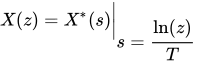
[edit]Given a Z-transform, X(z), the corresponding starred transform is a simple substitution:

This substitution restores the dependence on T.
It's interchangeable,[citation needed]
Properties of the starred transform
[edit]Property 1: is periodic in with period



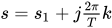
Property 2: If has a pole at , then must have poles at , where



Citations
[edit]References
[edit]- Bech, Michael M. "Digital Control Theory" (PDF). AALBORG University. Retrieved 5 February 2014.
- Gopal, M. (March 1989). Digital Control Engineering. John Wiley & Sons. ISBN 0852263082.
- Phillips and Nagle, "Digital Control System Analysis and Design", 3rd Edition, Prentice Hall, 1995. ISBN 0-13-309832-X