


Spt function
The spt function (smallest parts function) is a function in number theory that counts the sum of the number of smallest parts in each integer partition of a positive integer. It is related to the partition function.[1]
The first few values of spt(n) are:
Example
[edit]For example, there are five partitions of 4 (with smallest parts underlined):
- 4
- 3 + 1
- 2 + 2
- 2 + 1 + 1
- 1 + 1 + 1 + 1
These partitions have 1, 1, 2, 2, and 4 smallest parts, respectively. So spt(4) = 1 + 1 + 2 + 2 + 4 = 10.
Properties
[edit]Like the partition function, spt(n) has a generating function. It is given by

where .
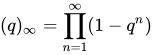
The function is related to a mock modular form. Let denote the weight 2 quasi-modular Eisenstein series and let denote the Dedekind eta function. Then for , the function


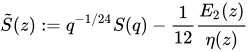
is a mock modular form of weight 3/2 on the full modular group with multiplier system , where is the multiplier system for .


While a closed formula is not known for spt(n), there are Ramanujan-like congruences including



References
[edit]- ↑ Andrews, George E. (2008-11-01). "The number of smallest parts in the partitions of n". Journal für die Reine und Angewandte Mathematik. 2008 (624): 133–142. doi:10.1515/CRELLE.2008.083. ISSN 1435-5345. S2CID 123142859.
 | This number theory–related article is a stub. You can help Wikipedia by adding missing information. |
.svg) | This combinatorics-related article is a stub. You can help Wikipedia by adding missing information. |