


Slowly varying function
In real analysis, a branch of mathematics, a slowly varying function is a function of a real variable whose behaviour at infinity is in some sense similar to the behaviour of a function converging at infinity. Similarly, a regularly varying function is a function of a real variable whose behaviour at infinity is similar to the behaviour of a power law function (like a polynomial) near infinity. These classes of functions were both introduced by Jovan Karamata,[1][2] and have found several important applications, for example in probability theory and extreme value theory.
Basic definitions
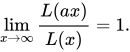
[edit]Definition 1. A measurable function L : (0, +∞) → (0, +∞) is called slowly varying (at infinity) if for all a > 0,
Definition 2. Let L : (0, +∞) → (0, +∞). Then L is a regularly varying function if and only if . In particular, the limit must be finite.

These definitions are due to Jovan Karamata.[1][2]
Basic properties
[edit]Regularly varying functions have some important properties:[1] a partial list of them is reported below. More extensive analyses of the properties characterizing regular variation are presented in the monograph by Bingham, Goldie & Teugels (1987).
Uniformity of the limiting behaviour
[edit]Theorem 1. The limit in definitions 1 and 2 is uniform if a is restricted to a compact interval.
Karamata's characterization theorem
[edit]Theorem 2. Every regularly varying function f : (0, +∞) → (0, +∞) is of the form
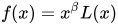
where
- β is a real number,
- L is a slowly varying function.
Note. This implies that the function g(a) in definition 2 has necessarily to be of the following form

where the real number ρ is called the index of regular variation.
Karamata representation theorem
[edit]Theorem 3. A function L is slowly varying if and only if there exists B > 0 such that for all x ≥ B the function can be written in the form

where
- η(x) is a bounded measurable function of a real variable converging to a finite number as x goes to infinity
- ε(x) is a bounded measurable function of a real variable converging to zero as x goes to infinity.
Examples
[edit]- If L is a measurable function and has a limit
- then L is a slowly varying function.

- For any β ∈ R, the function L(x) = log β x is slowly varying.
- The function L(x) = x is not slowly varying, nor is L(x) = x β for any real β ≠ 0. However, these functions are regularly varying.
See also
[edit]- Analytic number theory
- Hardy–Littlewood tauberian theorem and its treatment by Karamata
Notes
[edit]- 1 2 3 See (Galambos & Seneta 1973)
- 1 2 See (Bingham, Goldie & Teugels 1987).
References
[edit]- Bingham, N.H. (2001) [1994], "Karamata theory", Encyclopedia of Mathematics, EMS Press
- Bingham, N. H.; Goldie, C. M.; Teugels, J. L. (1987), Regular Variation, Encyclopedia of Mathematics and its Applications, vol. 27, Cambridge: Cambridge University Press, ISBN 0-521-30787-2, MR 0898871, Zbl 0617.26001
- Galambos, J.; Seneta, E. (1973), "Regularly Varying Sequences", Proceedings of the American Mathematical Society, 41 (1): 110–116, doi:10.2307/2038824, ISSN 0002-9939, JSTOR 2038824.