


Six factor formula
The six-factor formula is used in nuclear engineering to determine the multiplication of a nuclear chain reaction in a non-infinite medium.
| Symbol | Name | Meaning | Formula | Typical thermal reactor value |
|---|---|---|---|---|
| Thermal fission factor (eta) | neutrons produced from fission/absorption in fuel isotope | 1.65 | ||
| Thermal utilization factor | neutrons absorbed by the fuel isotope/neutrons absorbed anywhere | 0.71 | ||
| Resonance escape probability | fission neutrons slowed to thermal energies without absorption/total fission neutrons | 0.87 | ||
| Fast fission factor (epsilon) | total number of fission neutrons/number of fission neutrons from just thermal fissions | 1.02 | ||
| Fast non-leakage probability | number of fast neutrons that do not leak from reactor/number of fast neutrons produced by all fissions | 0.97 | ||
| Thermal non-leakage probability | number of thermal neutrons that do not leak from reactor/number of thermal neutrons produced by all fissions | 0.99 | ||



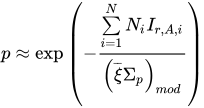

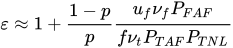



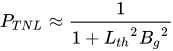
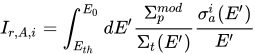
The symbols are defined as:[2]
- , and are the average number of neutrons produced per fission in the medium (2.43 for uranium-235).
- and are the microscopic fission and absorption cross sections for fuel, respectively.
- and are the macroscopic absorption cross sections in fuel and in total, respectively.
- is the macroscopic fission cross-section.
- is the number density of atoms of a specific nuclide.
- is the resonance integral for absorption of a specific nuclide.
- is the average lethargy gain per scattering event.
- Lethargy is defined as decrease in neutron energy.
- (fast utilization) is the probability that a fast neutron is absorbed in fuel.
- is the probability that a fast neutron absorption in fuel causes fission.
- is the probability that a thermal neutron absorption in fuel causes fission.
- is the geometric buckling.
- is the diffusion length of thermal neutrons.
- where is the diffusion coefficient.
- is the age to thermal.
- is the evaluation of where is the energy of the neutron at birth.




![{\displaystyle \tau =\int _{E_{th}}^{E'}dE''{\frac {1}{E''}}{\frac {D(E'')}{{\overline {\xi }}\left[D(E''){B_{g}}^{2}+\Sigma _{t}(E')\right]}}}](https://wikimedia.org/api/rest_v1/media/math/render/svg/46740576c97170f8a677df00cb76237bceeed065)


Multiplication
[edit]The multiplication factor, k, is defined as (see nuclear chain reaction):
- k = number of neutrons in one generation/number of neutrons in preceding generation
- If k is greater than 1, the chain reaction is supercritical, and the neutron population will grow exponentially.
- If k is less than 1, the chain reaction is subcritical, and the neutron population will exponentially decay.
- If k = 1, the chain reaction is critical and the neutron population will remain constant.
See also
[edit]References
[edit]- ↑ Duderstadt, James; Hamilton, Louis (1976). Nuclear Reactor Analysis. John Wiley & Sons, Inc. ISBN 0-471-22363-8.
- ↑ Adams, Marvin L. (2009). Introduction to Nuclear Reactor Theory. Texas A&M University.